

The Mediterranean Basin: Simplicity as Philosophy
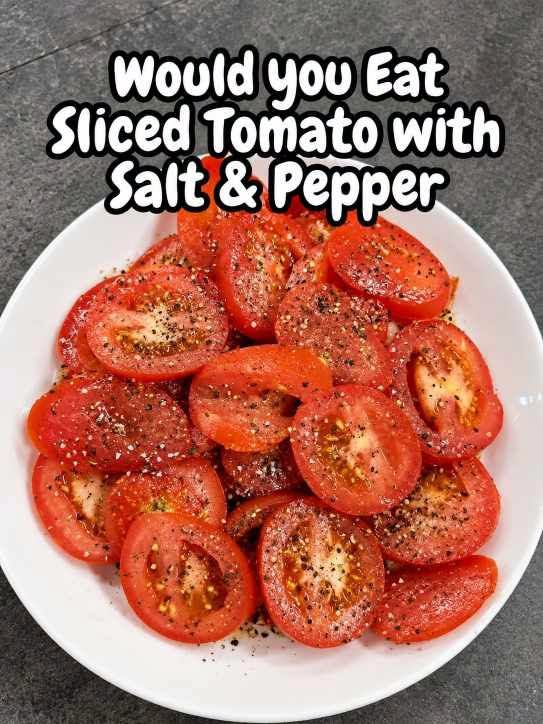
Across Italy, Greece, Spain, and Southern France, the philosophy of food centers on ingredient purity. In Italy, this combination forms the foundation of summer eating. While adding fresh buffalo mozzarella and basil transforms it into an Insalata Caprese, local home cooks frequently omit the cheese altogether. A plate of sun-ripened Roman, Costoluto, or San Marzano tomatoes, sliced thick and seasoned with sea salt, freshly cracked pepper, and a generous thread of peppery extra virgin olive oil, is served alongside crusty bread as a complete, revitalizing antipasto.
In Spain, the same principle underpins pan con tomate, where the seasoned pulp of raw tomatoes is rubbed directly into toasted garlic bread, illustrating that the natural juices released by salt and acid are flavorful enough to serve as a standalone sauce.
The Middle East and Levant
Throughout Levantine cooking, sliced or diced tomatoes seasoned with salt, pepper, and dried herbs like mint or sumac accompany virtually every meal. Sliced tomatoes act as a bright, acidic palate cleanser against rich grilled lamb, creamy hummus, and spiced flatbreads, providing hydration and crisp contrast in arid climates.
5. The Supermarket Tragedy: Why Quality Dictates Everything
There is an indispensable caveat to the perfection of sliced tomatoes with salt and pepper: the quality of the tomato is everything.
In complex culinary recipes—like a slow-simmered bolognese, an Indian curry, or a rich tomato paste—you can hide mediocre, out-of-season produce behind garlic, onions, long cooking times, and heavy spices. But when a dish consists of only three raw ingredients, there is nowhere to hide.
The Industrial "Cardboard" Tomato
Many people who claim they dislike raw tomatoes have never actually eaten a real, ripe garden tomato. Commercial grocery store tomatoes are often cultivated for durability, uniform spherical appearance, and long shelf life rather than flavor.
-
They are frequently picked while completely hard and green so they can survive mechanical harvesting and cross-country shipping in crates.
-
They are chemically ripened off the vine in warehouses using ethylene gas, which turns the skin red but fails to develop the complex matrix of sugars, glutamates, and aromatic volatiles that only sunlight and photosynthesis can produce.
-
Furthermore, commercial tomatoes are frequently subjected to cold storage below $50^\circ\text{F}$ ($10^\circ\text{C}$). Cold temperatures permanently deactivate the enzymes responsible for synthesizing aroma volatiles and cause cell walls to rupture prematurely, leaving the fruit mealy, mushy, and flavorless.
Sprinkling salt and pepper on a refrigerated, out-of-season, pale grocery store tomato yields a watery, chalky, disappointing experience.
The Garden Heirloom
In stark contrast, a sun-warmed heirloom tomato—picked at the absolute peak of ripeness directly from a backyard garden or local farmer's market—is a revelation. Varieties like Cherokee Purple, Brandywine, Green Zebra, or classic Roma possess deep anthocyanin pigmentation, thin tender skins, high natural brix (sugar) levels, and intense savory depth. When sliced warm from the sun and seasoned with flaky sea salt and cracked pepper, it rivals the finest delicacy in world cuisine.
