

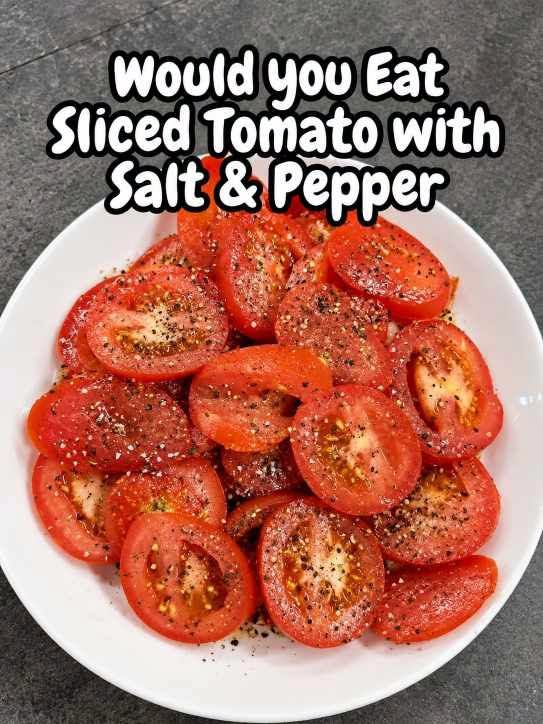
Few dishes in global gastronomy are as universally recognized, instantly assembled, and emotionally evocative as a plate of fresh, ripe sliced tomatoes seasoned simply with salt and cracked black pepper. The viral prompt displaying this vibrant red platter asks an almost rhetorical question: "Would you eat sliced tomato with salt and pepper?" For millions of people across Mediterranean, Southern American, Middle Eastern, and European culinary cultures, the immediate and passionate answer is a resounding affirmative.
At first glance, serving raw sliced tomatoes with just two basic pantry condiments seems almost too elementary to be considered cooking. There is no application of heat, no complex emulsion, no exotic spice blend, and no multi-step reduction. Yet, despite its deceptive simplicity, this combination represents a pinnacle of culinary minimalism. It is a dish where food science, human sensory physiology, agricultural heritage, and summer nostalgia converge on a single plate.
To understand why this humble combination holds such enduring power over the human palate, one must explore the molecular biology of the tomato fruit, the transformative biochemical role of sodium and piperine, the cultural traditions that elevate garden produce, and the sensory mechanics of seasonal eating.
1. The Canvas: The Molecular Anatomy of a Ripe Tomato
To appreciate why salt and pepper work so effectively on a tomato, one must first look at what a ripe tomato actually is from a biochemical perspective. Botanically a berry of the nightshade family (Solanum lycopersicum), the tomato is one of the most chemically complex fruits consumed by humanity.
A vine-ripened summer tomato contains an extraordinary balance of four primary flavor components:
-
Natural Sugars: Predominantly simple hexoses—glucose and fructose—accumulating within the locular gel and pericarp walls as the fruit matures.
-
Organic Acids: Primarily citric acid and malic acid, which provide the bright, sharp, refreshing tang that prevents the sweetness from feeling flat or cloying.
-
Free Glutamates: Tomatoes are naturally packed with free glutamic acid, the very amino acid responsible for the deep, savory fifth taste known as umami. As a tomato ripens from pale green to deep crimson, its free glutamate concentration increases dramatically, reaching levels comparable to parmesan cheese and cured meats.
-
Volatile Aromatic Compounds: Over four hundred distinct volatile chemicals have been identified in tomato aroma, with key contributors like cis-3-hexenal (giving the unmistakable "fresh-cut lawn" and green-stem fragrance), beta-ionone (floral and fruity notes), and 6-methyl-5-hepten-2-one.
When you slice open a fresh tomato, you rupture hundreds of thousands of individual plant cells, releasing these compartmentalized sugars, acids, glutamates, and aromatic vapors into the open air. The flesh is tender yet firm, while the surrounding jelly-like locular cavities hold sweet, acidic juices that instantly coat the tongue.
However, in its raw, unseasoned state, the potential of this complex fruit remains partially locked. The natural sweetness and acidity can sometimes feel isolated, and the human palate needs a chemical key to bridge the gap between sweet fruitiness and deep savory satisfaction. That key is sodium chloride.
2. The Science of the Sprinkle: What Salt Does to a Tomato
Salt is not merely a flavoring agent; it is an active biochemical catalyst that completely restructures how the human mouth experiences food. When coarse salt crystals hit the moist surface of freshly sliced tomatoes, several fascinating physical and chemical reactions occur immediately.
Osmosis and Moisture Extraction
The most immediate physical reaction is osmosis. The interior fluid of tomato cells contains dissolved solutes at a specific concentration. When pure sodium chloride crystals land on the cut surface, they dissolve in the surface moisture, creating a hypertonic environment—an area of much higher solute concentration than inside the plant cells.
To restore equilibrium, water molecules within the tomato cells migrate across the semi-permeable cell membranes toward the exterior surface. This osmotic pull accomplishes two crucial culinary transformations:
-
It draws out cell sap, blending water, organic acids, and free sugars into a concentrated, glistening surface glaze that coats each slice.
-
By releasing excess water from the outer cellular layers, the physical structure of the tomato firmens slightly, concentrating the natural tomato flavor rather than diluting it with intracellular water.
