

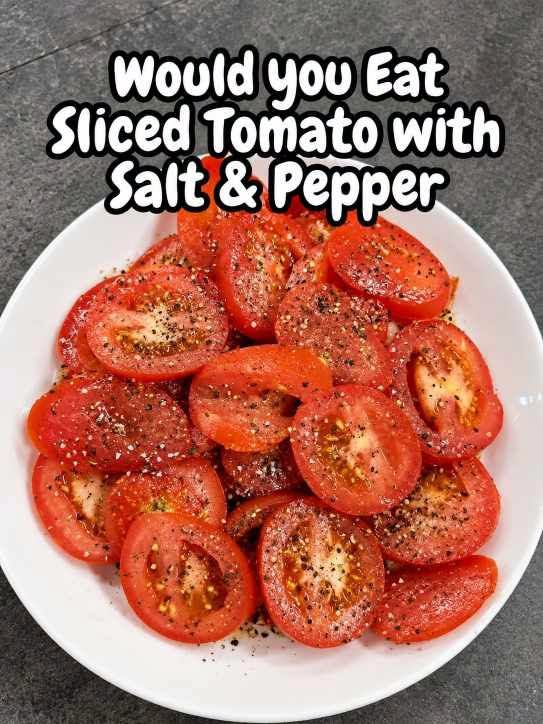
Taste Bud Modulation and Umami Amplification
On the human tongue, salt performs sensory wizardry. Sodium ions ($Na^+$) interact directly with epithelial sodium channels (ENaC) on taste receptor cells. At modest concentrations, salt acts as a selective filter:
-
Bitterness Suppression: It actively dampens the perception of bitter phenolic compounds naturally present in tomato seeds and skins.
-
Sweetness Enhancement: By suppressing bitterness, it allows the natural sweetness of glucose and fructose to register far more prominently on the brain's taste centers.
-
The Umami Synergy: Most importantly, sodium binds synergistically with the free glutamates already abundant in the tomato. When sodium ions and glutamate molecules dock together onto the T1R1/T1R3 umami receptors on your tongue, they trigger an exponential surge in savoriness. A salted tomato does not merely taste "salty"; it tastes exponentially more like a tomato—richer, meatier, and far more satisfying.
3. The Pungent Counterweight: The Role of Black Pepper
While salt brings out the tomato's latent sweetness and savory umami, black pepper (Piper nigrum) introduces dynamic aromatic warmth and structural contrast.
Black pepper owes its distinctive bite to piperine, an alkaloid that stimulates the TRPV1 heat-pain receptors on the human tongue and palate—the same sensory receptors that respond to capsaicin in chili peppers, though with a gentler, more radiant warmth.
Freshly cracked black peppercorns bring a profound aromatic dimension that ground, pre-packaged pepper dust simply cannot provide:
-
Terpenes and Pinene: Deliver sharp, piney, woody, and resinous top notes that echo the green, herbaceous aroma of the tomato plant's vine.
-
Limonene: Adds a subtle citrus undertone that mirrors the natural citric acid of the tomato flesh.
-
Textural Contrast: When freshly cracked, coarse pepper flecks provide tiny, tactile bursts of crunch against the soft, yielding texture of the sliced tomato.
Where the tomato provides cool, sweet acidity and the salt provides rounded savory richness, the pepper adds an earthy, prickling warmth that cleanses the palate after each bite, inviting you to take another slice. It prevents the dish from feeling overly wet or delicate, grounding the bright fruit in robust, rustic complexity.
4. Cultural Heritage: Sliced Tomatoes Across the Globe
The act of eating sliced raw tomatoes seasoned with salt and pepper is not confined to one country; it is an international ritual shared across diverse food cultures.
The American South: The Kitchen Sink Tradition
In the Southern United States, the arrival of the first ripe summer heirloom or beefsteak tomato is treated with near-religious reverence. There is a cherished, multigenerational tradition of standing directly over the kitchen sink—to catch the escaping red juices—eating thick, warm slices of tomato seasoned generously with coarse salt and black pepper straight off a cutting board.
From this ritual sprang the iconic Southern tomato sandwich: thick slabs of salted and peppered garden tomatoes layered between two slices of soft white sandwich bread heavily slathered with mayonnaise. The mayonnaise contributes creamy dairy and egg lipids that carry the fat-soluble flavor compounds, but the undisputed centerpiece remains the seasoned tomato itself.
