

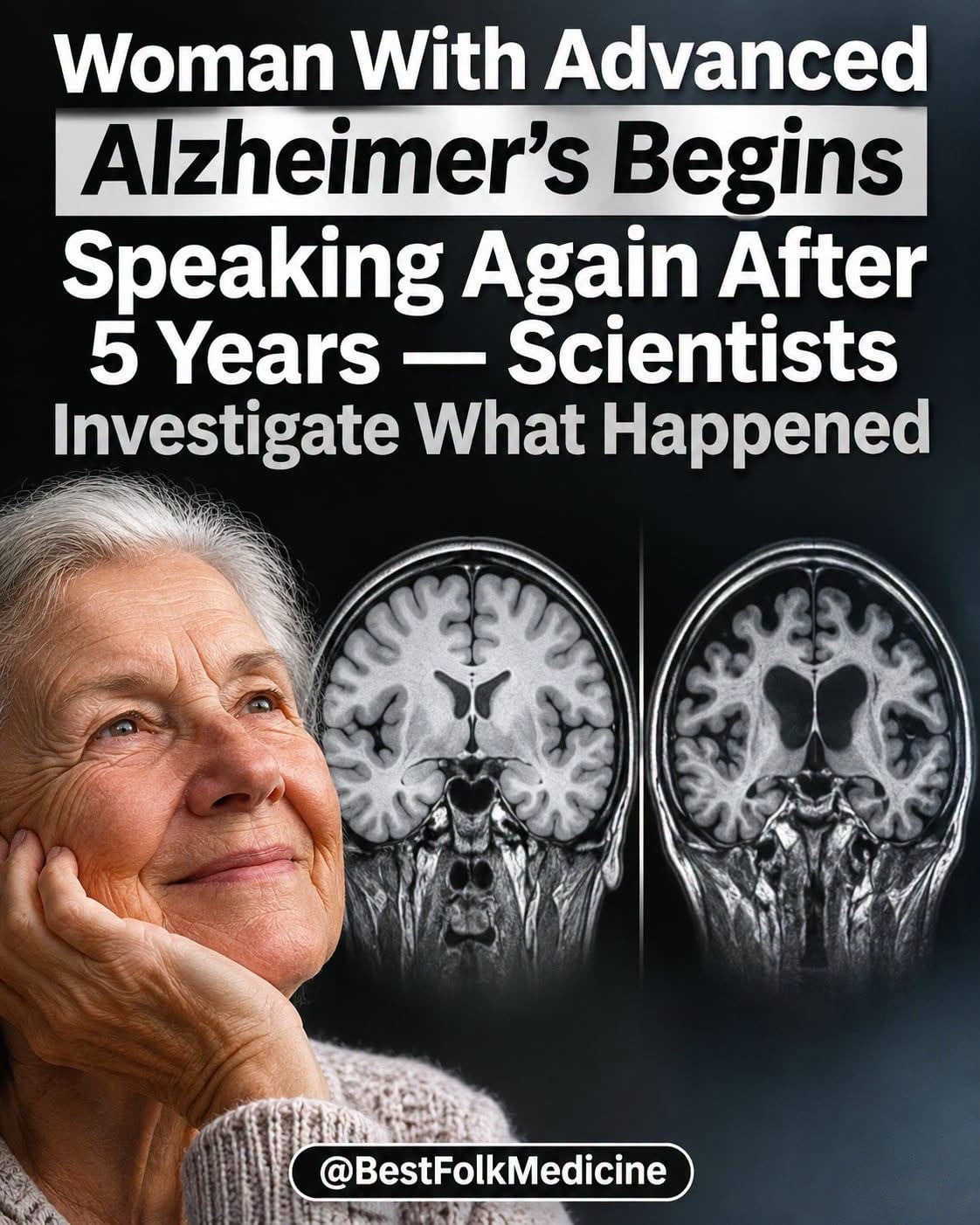
For five years, an elderly woman living with advanced Alzheimer’s disease had barely been able to communicate. Her speech had dwindled to mostly single words, her independence had faded, and everyday activities required constant assistance.
Then something extraordinary happened.
Following an experimental intervention involving a naturally occurring psychedelic compound, the woman began speaking about memories from her past. She reportedly recognized family members more readily, walked with greater independence, and regained abilities that had appeared lost for years.
The changes were so unexpected that researchers documented the case in a scientific journal.
Could the human brain retain abilities that Alzheimer’s disease seems to erase — even in its advanced stages?
A new case report published in May 2026 raises that fascinating question. But scientists emphasize that the findings are preliminary, and the experimental intervention has not been proven to treat or reverse dementia.
The Remarkable Case of an 80-Year-Old Woman With Alzheimer’s
The woman, a Japanese-American patient in her 80s, had been living with Alzheimer’s disease for approximately a decade.
Her condition had gradually progressed to the point where she needed extensive assistance with daily activities.
According to the case report published in Frontiers in Neuroscience, she experienced several severe symptoms:
- Profound memory impairment
- Limited speech, mostly consisting of single words
- Difficulty walking independently
- Loss of bladder control
- Reduced emotional expression
- Difficulty swallowing
- Dependence on caregivers for daily activities
For the previous five years, her ability to communicate had been particularly limited.
At such an advanced stage, significant recovery of lost functions is generally considered unlikely.
That is why the changes subsequently reported attracted scientific interest.
What Happened After the Experimental Intervention?
The researchers documented the woman’s response after she received psilocybin-containing mushrooms.
Psilocybin is a naturally occurring psychedelic compound found in certain mushroom species. It affects serotonin receptors in the brain and can temporarily alter perception, consciousness, and brain network activity.
It is being investigated for several medical applications, particularly certain psychiatric conditions.
However, psilocybin is not an established or approved treatment for Alzheimer’s disease.
Following administration, the woman experienced a concerning acute reaction involving heavy sweating, suspected elevated body temperature, and a prolonged sleep-like state.
Approximately 19 hours later, researchers documented an unexpected change.
She began speaking spontaneously about events from her life.
Instead of communicating almost entirely through isolated words, she reportedly produced extended autobiographical speech.
Over the following days, her caregivers and the researchers observed additional changes.
