

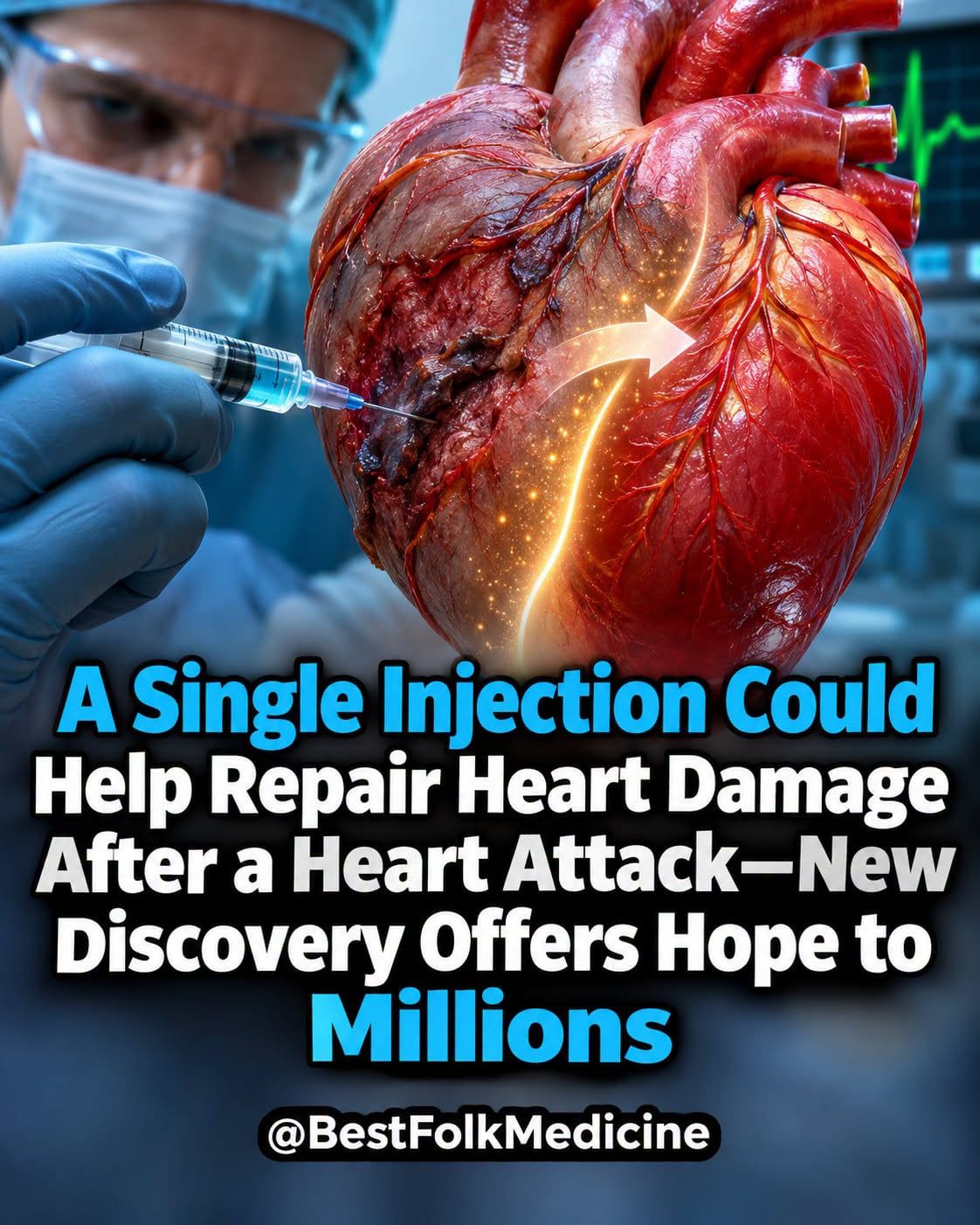
For decades, surviving a heart attack often meant living with permanent damage to the heart muscle. Now, researchers have developed an experimental injection that helped damaged hearts recover in animal studies—and its effects lasted for weeks.
A heart attack can change someone’s life in minutes.
Even when doctors successfully reopen a blocked artery and restore blood circulation, the heart may never fully recover from the damage.
The reason is simple but devastating: adult heart muscle has very limited ability to regenerate.
When heart cells die because they are deprived of oxygen, the damaged areas are often replaced by scar tissue.
Unlike healthy heart muscle, scar tissue cannot contract normally to pump blood.
Over time, this can weaken the heart and increase the risk of heart failure.
But a remarkable new approach may eventually change how doctors help patients recover.
In research published in the journal Science in March 2026, investigators from Columbia University, Texas A&M University, the University of Oxford, and collaborating institutions described an experimental injection that stimulates the body to produce its own heart-protective hormone.
The most intriguing part?
The injection is delivered into an ordinary skeletal muscle, such as a muscle in the arm or leg—not directly into the heart.
And in preclinical experiments, one dose produced biological effects lasting for several weeks.
Why the Heart Struggles to Heal After a Heart Attack
Most people understand that a heart attack occurs when blood flow to part of the heart becomes severely restricted or blocked.
Without adequate oxygen, heart muscle cells begin to suffer damage.
If circulation is not restored quickly, some of those cells die.
Modern emergency treatment has made enormous progress in saving lives.
Doctors can use procedures such as coronary angioplasty and stent placement to reopen blocked arteries.
Medications can also help prevent further clotting, reduce strain on the heart, and lower the risk of future cardiovascular events.
However, restoring blood flow does not automatically restore all the heart muscle that has already been destroyed.
The body’s healing response often produces fibrous scar tissue in place of healthy, contracting muscle.
Scar tissue provides structural support, but it does not function like normal cardiac muscle.
When enough tissue is damaged, the heart’s ability to pump blood effectively may decline.
This is one reason some heart attack survivors eventually develop heart failure.
Researchers have spent years searching for ways to protect vulnerable heart cells, reduce harmful scarring, and improve recovery after a heart attack.
The new experimental therapy represents a different strategy: encouraging the body to manufacture a protective substance for the injured heart.
The New Injection That Turns Muscles Into a Medicine Factory
The treatment relies on a technology called self-amplifying RNA, or saRNA.
RNA is a molecule that carries instructions used by cells to produce proteins.
In this experimental approach, researchers designed RNA instructions that encourage skeletal muscle cells to produce a precursor of a naturally occurring heart-protective hormone.
The hormone is called atrial natriuretic peptide, or ANP.
ANP is normally produced by the heart and helps regulate fluid balance, blood pressure, and cardiovascular function.
It also participates in biological pathways that may protect heart tissue after injury.
The challenge has been delivering enough of the hormone to produce useful effects.
ANP is rapidly broken down in the bloodstream, which makes sustained treatment difficult.
Instead of repeatedly injecting the hormone itself, the research team developed a way for the body to produce it.
After the RNA injection enters skeletal muscle, muscle cells temporarily begin producing the hormone precursor.
That precursor travels through the bloodstream and can be converted into active ANP through biological processes associated with the injured heart.
In other words, the injected muscle becomes a temporary production site for a potentially beneficial therapeutic substance.
This approach could make treatment less invasive than techniques requiring direct delivery into heart tissue.
