

Simple arithmetic problems have a peculiar way of bringing the internet to a complete standstill. Every few months, an innocent-looking handwritten equation jotted down on a piece of lined notebook paper goes viral across social media platforms like Facebook, TikTok, and X. Comments sections quickly swell into battlegrounds containing thousands of heated arguments, conflicting answers, and declarations that modern math has either changed or lost its mind.
One recent puzzle making the rounds features a deceptively straightforward question:
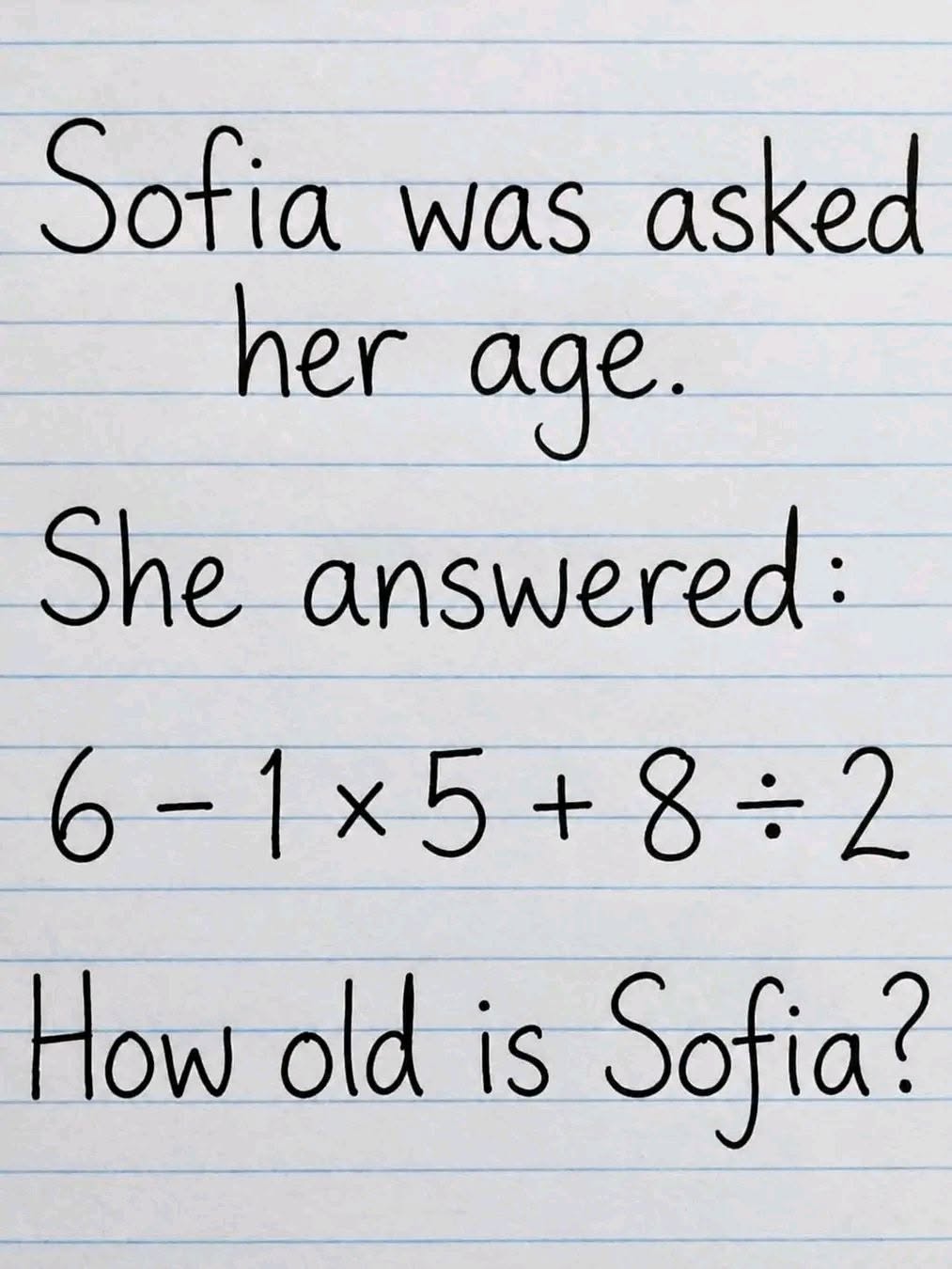
"Sofia was asked her age.
She answered: 6−1×5+8÷26 - 1 \times 5 + 8 \div 2
How old is Sofia?"
At first glance, it looks like elementary school homework. Yet if you scan through the comment section beneath this riddle, you will find people claiming Sofia is 5, 21, 9, 29, 14, or even negative numbers.
So, what is Sofia’s real age, why does such a basic calculation cause so much confusion, and what does this reveal about how human intuition clashes with mathematical rules?
Step-by-Step Solution: Cracking Sofia’s Age
To determine how old Sofia is, we need to evaluate the numerical expression she provided:
In mathematics, operations must be performed in a specific, globally standardized hierarchy known as the Order of Operations (commonly abbreviated as PEMDAS or BODMAS). Without a set hierarchy, mathematical expressions would be ambiguous, producing wildly different outcomes depending on whoever happens to read them.
1. Perform Multiplication and Division First (Left to Right)
Multiplication and division hold equal priority, and both take precedence over addition and subtraction. Scanning the equation from left to right:
-
First multiplication: 1×5=51 \times 5 = 5
-
First division: 8÷2=48 \div 2 = 4
