

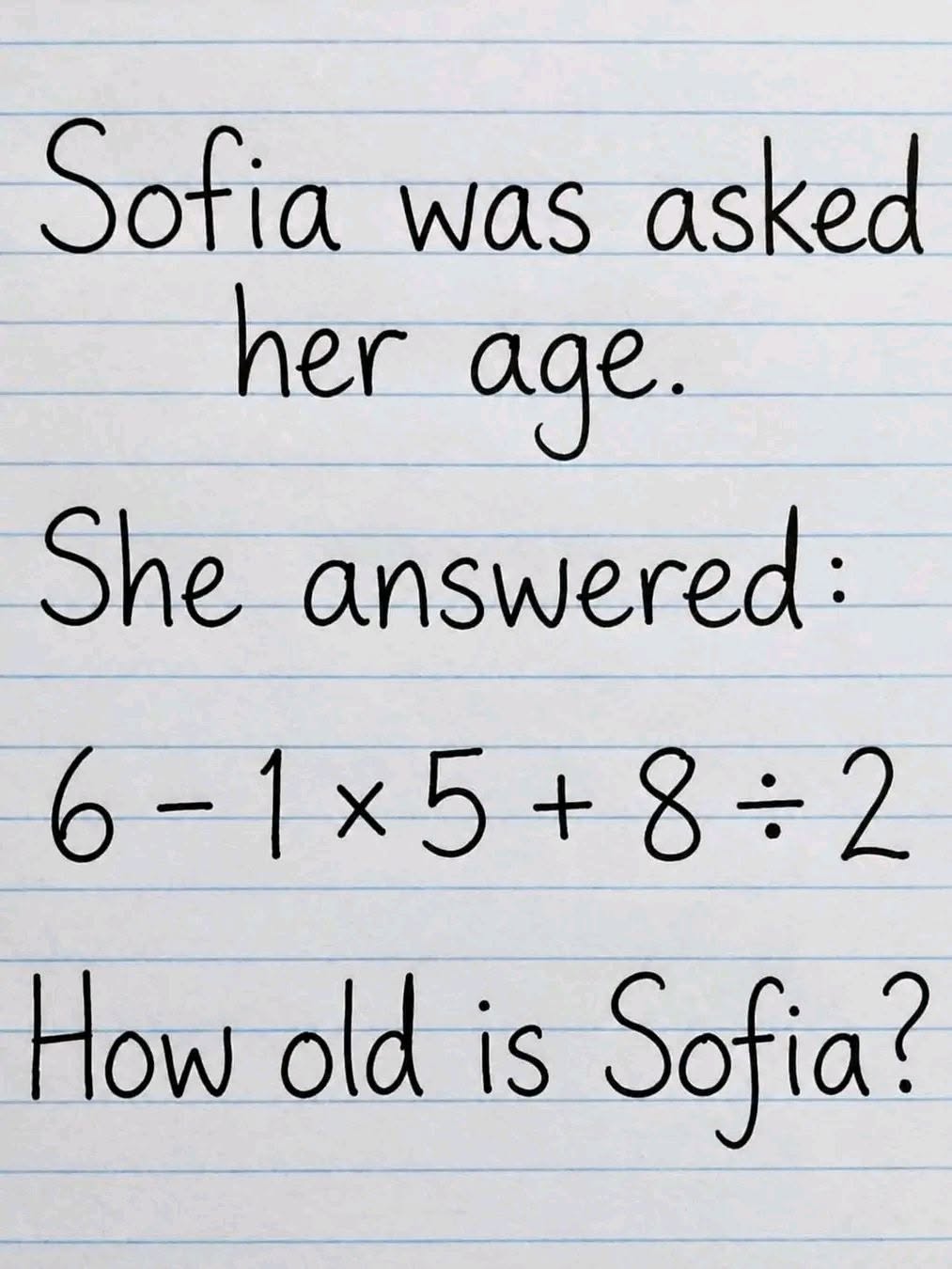
Now we substitute these simplified values back into the original expression:
2. Perform Addition and Subtraction (Left to Right)
Addition and subtraction also hold equal priority to one another. A common trap is assuming that addition must always happen before subtraction simply because "A" precedes "S" in the PEMDAS acronym. In formal arithmetic, once only addition and subtraction remain, you resolve them strictly from left to right:
-
First operation from the left: 6−5=16 - 5 = 1
-
Final operation: 1+4=51 + 4 = 5
Sofia is 5 years old.
The Traps: Why Do So Many People Get Different Answers?
If the math is this straightforward, why does this puzzle generate thousands of disputes online? The errors almost always stem from three predictable cognitive and procedural shortcuts:
1. Reading Math Like a Novel (The Left-to-Right Blindspot)
The most common mistake occurs when readers treat the equation like plain English text, processing numbers sequentially from left to right without applying operational precedence:
-
6−1=56 - 1 = 5
-
5×5=255 \times 5 = 25
-
25+8=3325 + 8 = 33
-
33÷2=16.533 \div 2 = 16.5
Someone following this path concludes that Sofia is 16 and a half years old. While intuitive to human reading habits, this method ignores the fundamental grammar of arithmetic.
2. The Strict PEMDAS Literal Interpretation
Another frequent error happens among adults who vaguely remember the acronym PEMDAS (Parentheses, Exponents, Multiplication, Division, Addition, Subtraction) from grade school, but treat it as a rigid step-by-step checklist rather than grouped pairs:
After computing multiplication and division to get 6−5+46 - 5 + 4, they see the "A" (Addition) before "S" (Subtraction) and calculate the addition first:
-
Add: 5+4=95 + 4 = 9
-
Subtract: 6−9=−36 - 9 = -3
This yields an impossible answer: Sofia is negative three years old. The mistake here is failing to realize that subtraction binds to the negative sign of the term, or forgetting that addition and subtraction share equal standing and must be evaluated left to right.
3. Associative Grouping Confusion
Others accidentally group the operations by gut feeling:
Because the handwritten note contains no parentheses, adding arbitrary groupings fundamentally alters the mathematical statement Sofia made.
Why Do Puzzles Like This Go Viral?
Viral arithmetic puzzles are engineered to trigger high social engagement. Understanding why they spread so rapidly sheds light on both web content dynamics and human psychology:
Low Barrier to Entry
Anyone who has completed primary school feels equipped to answer basic addition, subtraction, multiplication, and division. Unlike advanced calculus or abstract algebra, this puzzle invites everyone to participate regardless of educational background.
