

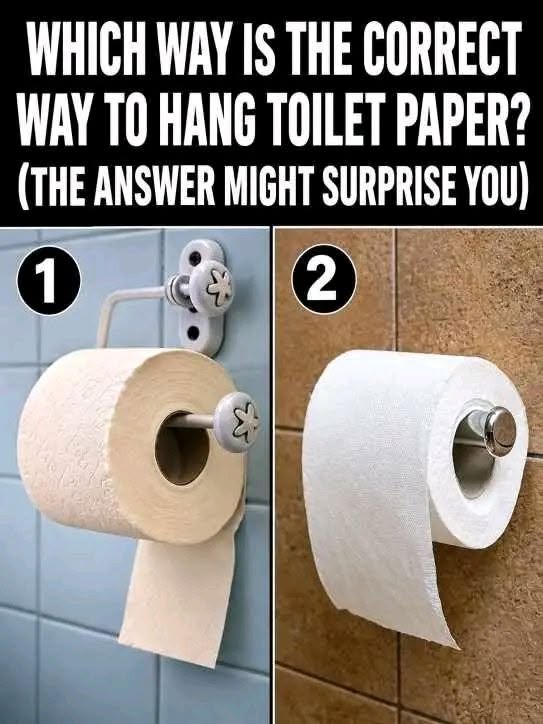
Few everyday domestic topics incite as much passionate disagreement, household friction, and viral social media debate as the orientation of a toilet paper roll. Displayed clearly in countless online polls and household discussions, the choice boils down to two distinct configurations: Position 1 (Under), where the loose end hangs against the wall, or Position 2 (Over), where the paper drapes freely over the front.
While it might seem like a trivial preference, the question of whether a roll should hang "over" or "under" has spawned academic surveys, ergonomic evaluations, patent investigations, hygiene studies, and psychological analyses. When looking at the historical record, microbial science, and user ergonomics, there is a clear, definitive standard—even if a vocal minority remains loyal to the alternative.
1. The Definitive Answer: The 1891 Patent
The most conclusive piece of objective evidence in the debate dates back more than a century to the man who popularized perforated rolled toilet paper: Seth Wheeler.
Before the late 19th century, commercial toilet paper was commonly sold in individual flat sheets in boxes (pioneered by Joseph Gayetty in 1857). In 1871, Seth Wheeler, founder of the Albany Perforated Wrapping Paper Company, patented wrapped and perforated rolls of paper. Two decades later, Wheeler sought to improve the roll mechanism to make dispensing individual sheets easier without tearing or unraveling.
On December 22, 1891, Wheeler was granted U.S. Patent No. 465,588 for an improved toilet paper roll. Accompanying the patent application were detailed technical diagrams illustrating how the roll was designed to operate on a spindle.
Every single schematic figure in Wheeler’s original patent clearly illustrates the paper hanging Over (Position 2). The patent text specifies that the end of the roll hangs away from the cylinder, allowing the user to grasp the outermost edge without touching the rest of the roll or dragging the paper across the mounting surface. From an engineering and design standpoint, the creator's intended orientation has been documented for over 130 years: Position 2 is the original, intended way.
2. Hygiene and the Microbiology of the Bathroom Wall
While history establishes original intent, modern biology and infection control provide the most compelling argument for Position 2 (Over).
Bathrooms are high-humidity environments with elevated concentrations of airborne microbes, aerosolized water droplets (often distributed via the "toilet plume" when flushing without closing the lid), and surface contamination. The wall directly behind a toilet paper dispenser is one of the least frequently sanitized vertical surfaces in residential and commercial restrooms.
