

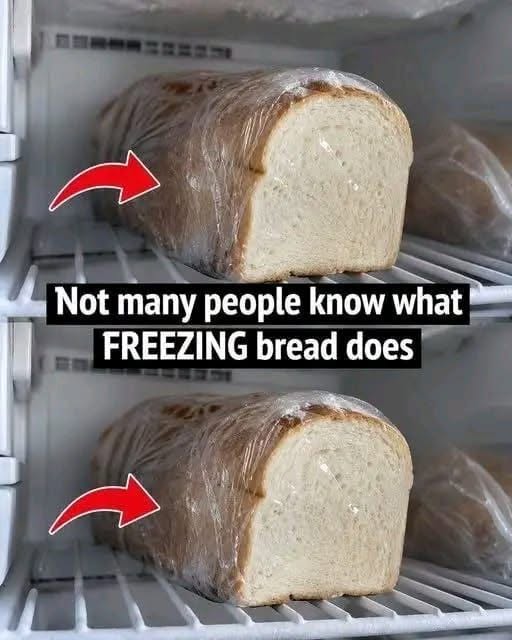
That viral meme showing a tightly wrapped loaf of bread resting on a freezer shelf touches on one of the most surprising, research-backed intersections between food chemistry and human metabolism. While millions of households stash bread in the freezer purely as an economic habit to prevent mold and cut down on grocery waste, the physical transition that occurs when baked starches freeze reaches far deeper than mere preservation.
Freezing fundamentally alters the molecular architecture of bread. It changes how human digestive enzymes interact with carbohydrates, lowers postprandial glucose spikes, nurtures the gut microbiome, and—when done correctly—keeps the crumb tasting as fresh as the day it came out of the oven.
Understanding the full picture requires exploring the biochemical mechanisms at play, the metabolic evidence, and the kitchen techniques that make freezing bread genuinely transformative.
1. The Chemistry of Baking and Gelatinization
To grasp what happens when bread freezes, you first have to understand what happens when it bakes.
Raw wheat flour is packed with microscopic, tightly packed granules of starch, consisting of two primary glucose polymers:
-
Amylose: Long, linear chains of glucose molecules packed densely together.
-
Amylopectin: Large, highly branched polymers of glucose.
In their raw, unheated state, these starch granules are semi-crystalline and difficult for human salivary and pancreatic enzymes (such as alpha-amylase) to break down. When flour is mixed with water and subjected to the high heat of an oven (typically $180^\circ\text{C}$ to $220^\circ\text{C}$ / $350^\circ\text{F}$ to $425^\circ\text{F}$), a process called starch gelatinization occurs:
-
Water penetrates the outer walls of the starch granules.
-
The heat breaks the intermolecular hydrogen bonds holding the amylose and amylopectin chains in crystalline alignment.
-
The granules swell dramatically, absorb water, and rupture, releasing disordered starch polymers into an open, gelatinous matrix.
This gelatinized matrix is what gives freshly baked bread its soft, pillowy crumb. Because the glucose chains are unfolded, exposed, and hydrated, digestive enzymes can access them almost instantaneously. When you eat a slice of fresh, warm white bread, your enzymes cleave those open starch chains into simple glucose rapidly, leading to a steep, sharp spike in blood glucose and a subsequent surge in insulin.
2. Retrogradation: How Freezing Rebuilds Starch
When bread cools down and sits in sub-zero temperatures, the opposite reaction takes place. This process is known as starch retrogradation.
As the temperature drops below freezing, the energetic movement of molecules slows down dramatically. The dissolved amylose and linear regions of amylopectin begin to re-align. Instead of remaining loose and readily digestible, the chains drift back toward one another, forming tight, ordered double helices stabilized by dense networks of hydrogen bonds.
In everyday cooking, this recrystallization is partly responsible for bread becoming firm or stale. When accelerated and locked into place by freezing temperatures, this crystalline rearrangement creates a specialized structural compound known as Resistant Starch Type 3 (RS3).
