

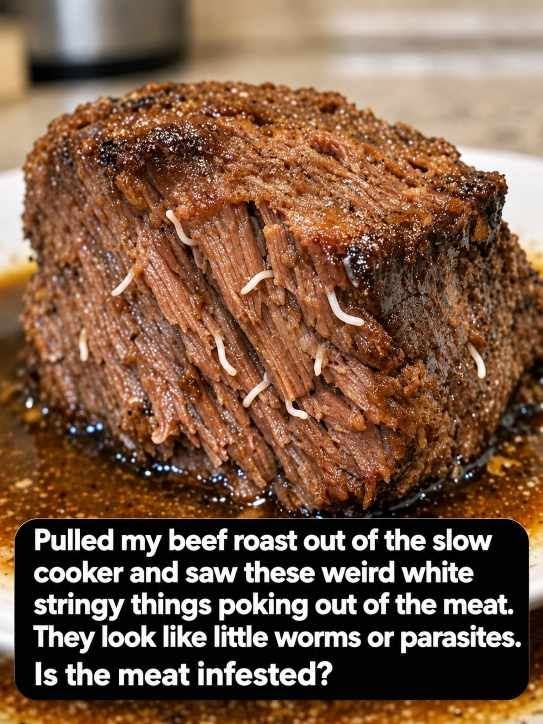
The Resistance of Elastin and Blood Vessel Walls
While collagen happily melts away into rich gelatin, the blood vessels and certain specialized ligaments are made of an entirely different structural protein called elastin, along with dense basement-membrane proteins like laminin and proteoglycans.
As its name suggests, elastin is an elastic, rubbery structural polymer designed to expand and snap back under physical force. In living cattle, arterial walls must stretch with every beat of the heart to accommodate pressurized blood flow without rupturing. To perform this vital function, vascular walls are heavily reinforced with cross-linked elastin fibers.
Unlike collagen, elastin is chemically impervious to standard culinary cooking temperatures. It does not dissolve in water, it does not melt into gelatin, and it does not break down at 200 degrees Fahrenheit. It remains firm, flexible, resilient, and insoluble even after ten hours of continuous simmering.
The Physics of Slow Cooking: Why They Poke Out
Knowing that blood vessels do not melt explains why they survive cooking, but why do they actively protrude outward in such bizarre, worm-like tendrils?
This phenomenon is the result of mechanical displacement driven by differential shrinkage.
1. Muscle Contraction and Moisture Expulsion
A pot roast is composed of thousands of individual muscle fibers primarily made of the contractile proteins actin and myosin. As meat cooks and its internal temperature rises past 140 degrees Fahrenheit (60 degrees Celsius), these proteins denature, coagulate, and shrink in all three dimensions—shortening lengthwise and pulling together laterally.
During this shrinkage, the muscle fibers contract tightly like a wrung-out sponge, expelling intracellular water into the surrounding slow-cooker pot. A typical beef roast can lose between 20 percent and 35 percent of its physical volume through moisture loss during braising.
2. The Extrusion Effect
While the beef muscle shrinks and recedes inward, the elastin-rich blood vessel walls inside the muscle do not shrink nearly as much. Because the surrounding meat contracts and pulls back, the rigid, rubbery vessels are physically squeezed out of the vascular channels they normally occupy.
Think of it like stepping onto a wet tube of toothpaste: as the surrounding pressure increases and the space diminishes, the inner material has nowhere to travel except outward toward the path of least resistance. The ends of the vascular tubes are extruded out through the surface of the meat grain, creating the pale, curving tendrils that look so strikingly like parasites.
Addressing the Fear: Could It Actually Be Parasites?
It is natural to question whether real parasites can appear in retail beef. Food safety education has trained consumers to be vigilant against pathogens, and the visual similarity between these vessels and nematodes is undeniable. However, a closer look at veterinary parasitology clarifies why this fear is unfounded.
