

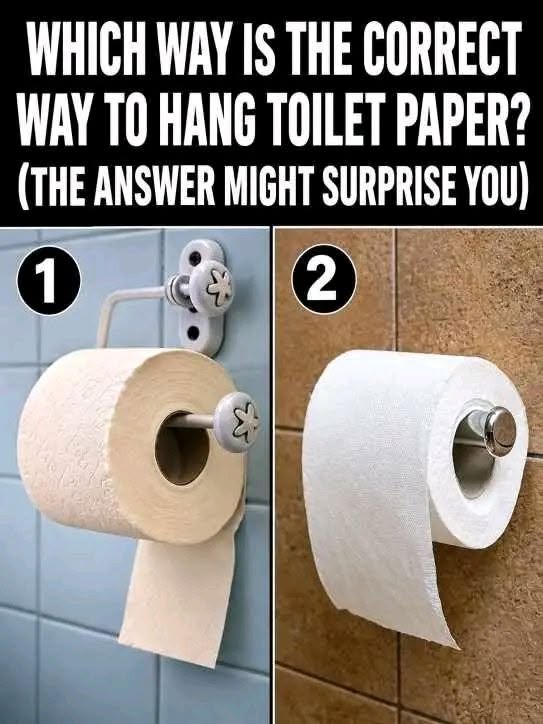
6. The Psychology of the "Roll Reverser"
What makes this topic such a frequent lightning rod for debate? Psychologists categorize the toilet paper question alongside minor domestic conventions—like loading a dishwasher or squeezing toothpaste from the bottom versus the middle—that serve as proxies for broader personality traits and control dynamics.
-
Habitual Conditioning: For many, the choice has little to do with rational analysis and everything to do with childhood environment. People often duplicate whatever orientation was standard in the household where they grew up.
-
Conscientiousness and Order: Position 2 presents a crisp, hotel-like aesthetic where patterned toilet paper or decorative embossing faces outward toward the guest, appealing to high aesthetic conscientiousness. Position 1, by contrast, conceals patterns and presents a flatter, utilitarian profile.
-
The "Micro-Control" Phenomenon: Domestic life is filled with uncontrollable stressors, from work demands to finances. Changing a toilet paper roll to one's preferred orientation offers an immediate, tangible sense of order and micro-control over one's immediate physical environment.
The Verdict
When evaluating history, health, and functionality, the question is settled:
-
Position 2 (Over) is the mathematically, historically, and hygienically superior method. It honors the original 1891 patent design, protects users from touching germ-laden bathroom walls, provides superior dispensing visibility, and aligns with the preferences of roughly three-quarters of the population.
-
Position 1 (Under) remains a valid, functional workaround primarily for homes managing curious pets, mischievous toddlers, or moving vehicles.
Unless your cat is actively unrolling your paper stock into the hallway, the proper way to hang toilet paper is unambiguously Position 2: Over.
