

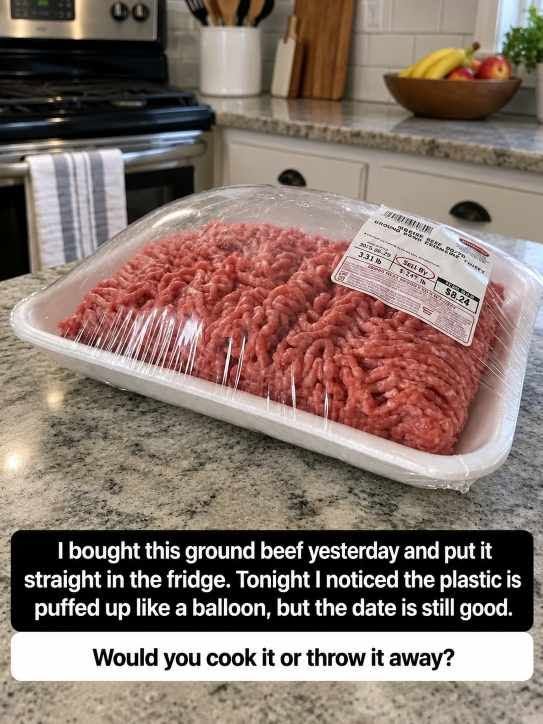
Possibility B: Microbial Gas Production (Spoilage)
The package shown in the image is not a rigid MAP container; it is a standard, porous supermarket foam tray overwrapped with thin, hand-stretched polyvinyl chloride (PVC) cling film, weighed and labeled at the store butcher counter.
Standard retail cling film is permeable to oxygen and is not engineered to hold high internal pressure. If a standard cling-wrapped foam tray inflates into a tight, domed balloon after sitting in a home refrigerator, the gas was generated internally by actively reproducing microorganisms.
When bacteria feed on the proteins, carbohydrates, and moisture within raw meat, their metabolic pathways break down organic substrates through fermentation and respiration. As a byproduct of their metabolism, these bacteria release volatile gases, including:
-
Carbon dioxide ($CO_2$)
-
Hydrogen gas ($H_2$)
-
Methane ($CH_4$)
-
Hydrogen sulfide ($H_2S$) and other volatile sulfur compounds
As billions of bacterial cells multiply inside the package, the volume of expelled gas increases until the stretchy plastic wrap expands upward under pneumatic pressure.
2. The Vulnerability of Ground Beef vs. Whole Cuts
To understand why ground beef spoils so much faster and more dramatically than a steak or roast, one must examine its microscopic surface area.
STEAK / WHOLE CUT:
┌───────────────────────────────┐
│ Contaminants on Surface Only  │ ← Exterior exposed to air/knives
│                               │
│ Sterile, Dense Muscle Fiber   │ ← Interior remains anaerobic & sterile
└───────────────────────────────┘

GROUND BEEF:
┌─┬─┬─┬─┬─┬─┬─┬─┬─┬─┬─┬─┬─┬─┬─┬─┐
│x│x│x│x│x│x│x│x│x│x│x│x│x│x│x│x│ ← Trimmings mixed together; surface
├─┼─┼─┼─┼─┼─┼─┼─┼─┼─┼─┼─┼─┼─┼─┼─┤   bacteria distributed uniformly
│x│x│x│x│x│x│x│x│x│x│x│x│x│x│x│x│   throughout the entire mass of meat.
└─┴─┴─┴─┴─┴─┴─┴─┴─┴─┴─┴─┴─┴─┴─┴─┘
When an animal is processed, bacteria naturally present on the hide, hooves, and processing environment (such as Pseudomonas, Lactobacillus, Leuconostoc, Escherichia coli, and Salmonella) land almost exclusively on the exterior surface of the muscle meat. The interior of intact muscle tissue remains largely sterile. When searing a steak, the high surface heat instantly pasteurizes those surface bacteria, which is why a steak can be safely enjoyed rare or medium-rare on the inside.
Ground beef, however, undergoes an intensive mechanical transformation:
-
Trimmings from multiple areas (or even multiple cattle) are combined.
-
The meat is pushed through commercial grinding plates and blades.
-
Every surface microbe is blended uniformly throughout the entire mass.
-
Grinding creates an immense exponential increase in exposed surface area, coats the particles in cellular fluids, and introduces oxygen into the mixture.
This turns ground beef into an optimal growth medium for bacteria: abundant surface area, optimal water activity ($a_w \approx 0.99$), near-neutral pH ($5.5\text{--}6.2$), and rich pools of amino acids and minerals. Once bacteria begin to replicate within ground beef, the population doubles exponentially every 20 to 30 minutes under warm conditions.
