

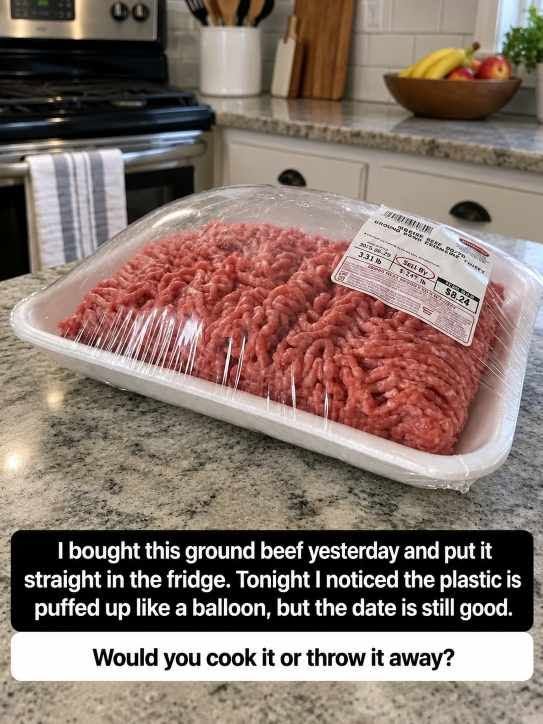
It is a familiar and unsettling kitchen scenario: you purchase a package of fresh ground beef from the supermarket, slide it into the refrigerator, and pull it out a day or two later only to discover that the plastic wrap has swollen tight like a pressurized balloon. You check the label immediately. The "Sell-By" or "Best-If-Used-By" date is still days away. The meat may even retain a relatively vibrant pink or red hue.
This visual disconnect immediately triggers a dilemma: Is this the normal result of commercial packaging technology, or is it a sign of bacterial contamination? If cooked thoroughly to the recommended internal temperature, is it safe to eat, or should it be discarded?
While the desire to avoid wasting expensive groceries is understandable, a puffed-up meat package on a standard styrofoam tray is a clear, visual warning sign from food microbiology. Navigating this situation safely requires understanding packaging technologies, bacterial gas production, cold chain failures, and the biochemical reality of ground meat.
1. Why Is the Packaging Swollen? The Two Competing Explanations
When food packaging inflates unexpectedly, it is caused by the accumulation of gas inside a sealed enclosure. In the commercial meat industry, gas inside a package comes from only two possible origins: intentional industrial gas flushing or uncontrolled microbial respiration.
Possibility A: Modified Atmosphere Packaging (MAP)
In modern commercial meat distribution, some products are packaged using Modified Atmosphere Packaging (MAP). In this process:
-
Meat is placed inside a rigid plastic container or heavy barrier film.
-
Ambient air is evacuated and replaced with a precisely calibrated mixture of purified food-grade gases—typically high oxygen ($70\%\text{--}80\%$) to maintain oxymyoglobin (the bright cherry-red color consumers prefer), blended with carbon dioxide ($20\%\text{--}30\%$) to inhibit aerobic spoilage bacteria.
-
In other MAP variants, an anaerobic mixture of nitrogen and carbon dioxide is used to prevent oxidation entirely.
MAP packages often look slightly pillow-like or taut straight off the grocery shelf because they were sealed under positive gas pressure at the processing plant. However, MAP packaging relies on heavy, thick, rigid plastic barriers sealed with specialized hermetic film.
