

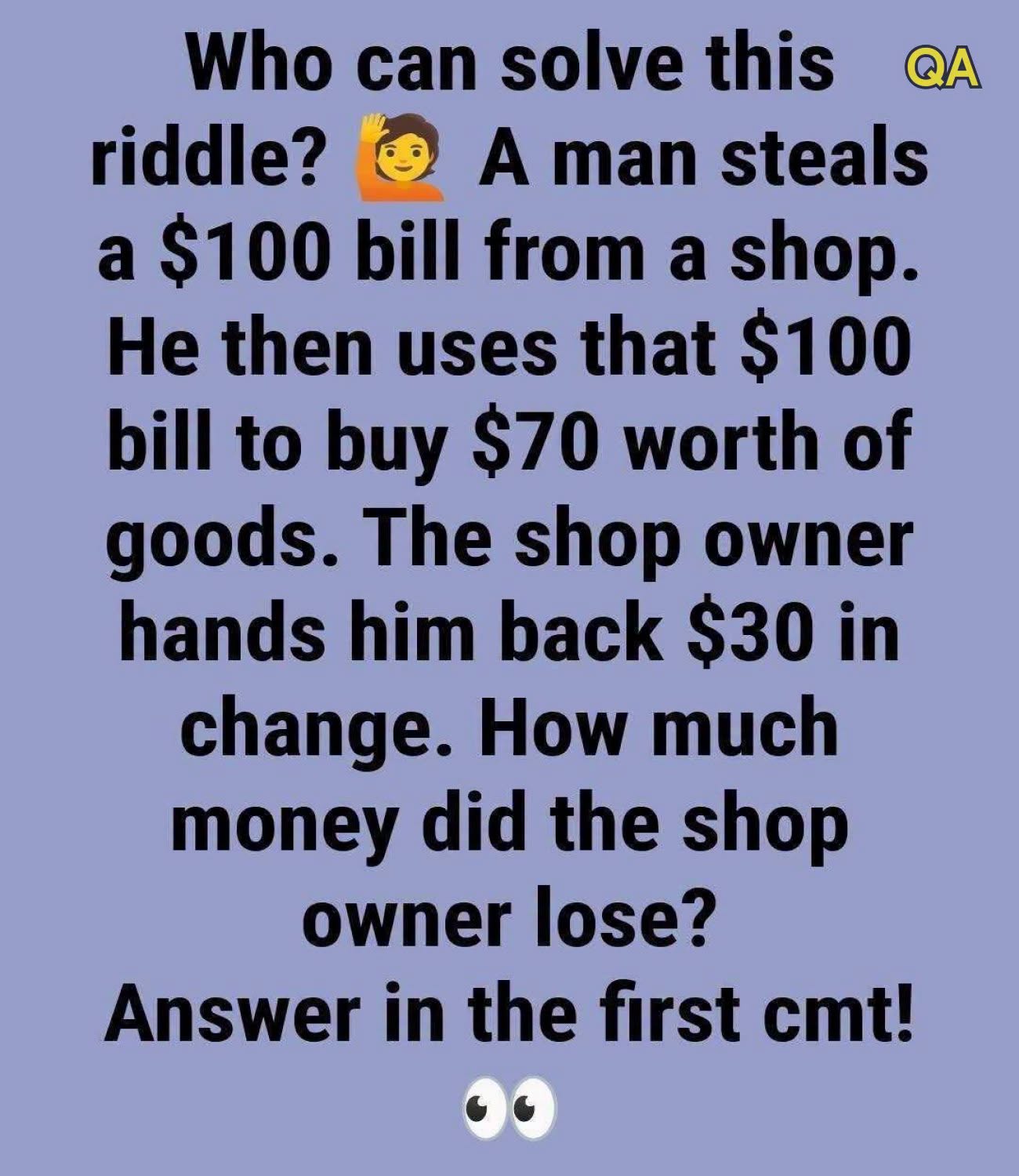
Why People Often Answer $200
The incorrect $200 answer usually comes from adding all three figures in the story:
$100 stolen + $70 merchandise + $30 change = $200
The problem is that the $70 and $30 already account for the final consequence of the returned $100 bill. The customer uses the bill to obtain merchandise and cash change totaling $100. Adding the original $100 again treats one bill as if it disappeared twice.
The person leaves with items worth $70 and $30 in cash. The combined value they leave with is $100. That is the shopkeeper’s final loss.
Another Way to Check the Answer
A quick reality check can confirm the result. Ask one question: what does the person have when they leave the shop?
They have:
- $70 worth of merchandise
- $30 in cash
The total value taken away is $100. Since the shopkeeper has received no additional legitimate value in exchange, the business is down by $100.
This approach is particularly helpful in word problems because it focuses on the final state rather than every temporary step. It also avoids confusion caused by repeated references to the same money.
What This Brain Teaser Teaches About Financial Reasoning
Although this is a simple puzzle, it illustrates several useful concepts found in everyday math, personal finance, retail operations, and introductory accounting.
Follow Value, Not Just Numbers
Numbers in a story are not always separate amounts that should be added together. In this example, the same $100 bill appears twice: first when it is removed from the register and again when it is returned as payment. Recognizing that these two references describe the same bill is essential.
Compare the Beginning and End
Looking at the final position often provides the clearest answer. At the end, the shopkeeper has $30 less cash and $70 less inventory. That comparison produces the correct result without needing to overcomplicate the events in between.
Avoid Double-Counting
Double-counting occurs when the same item, amount, or transaction is included more than once in a calculation. It can cause errors in simple puzzles as well as in budgets, invoices, business reports, and household expense tracking.
