

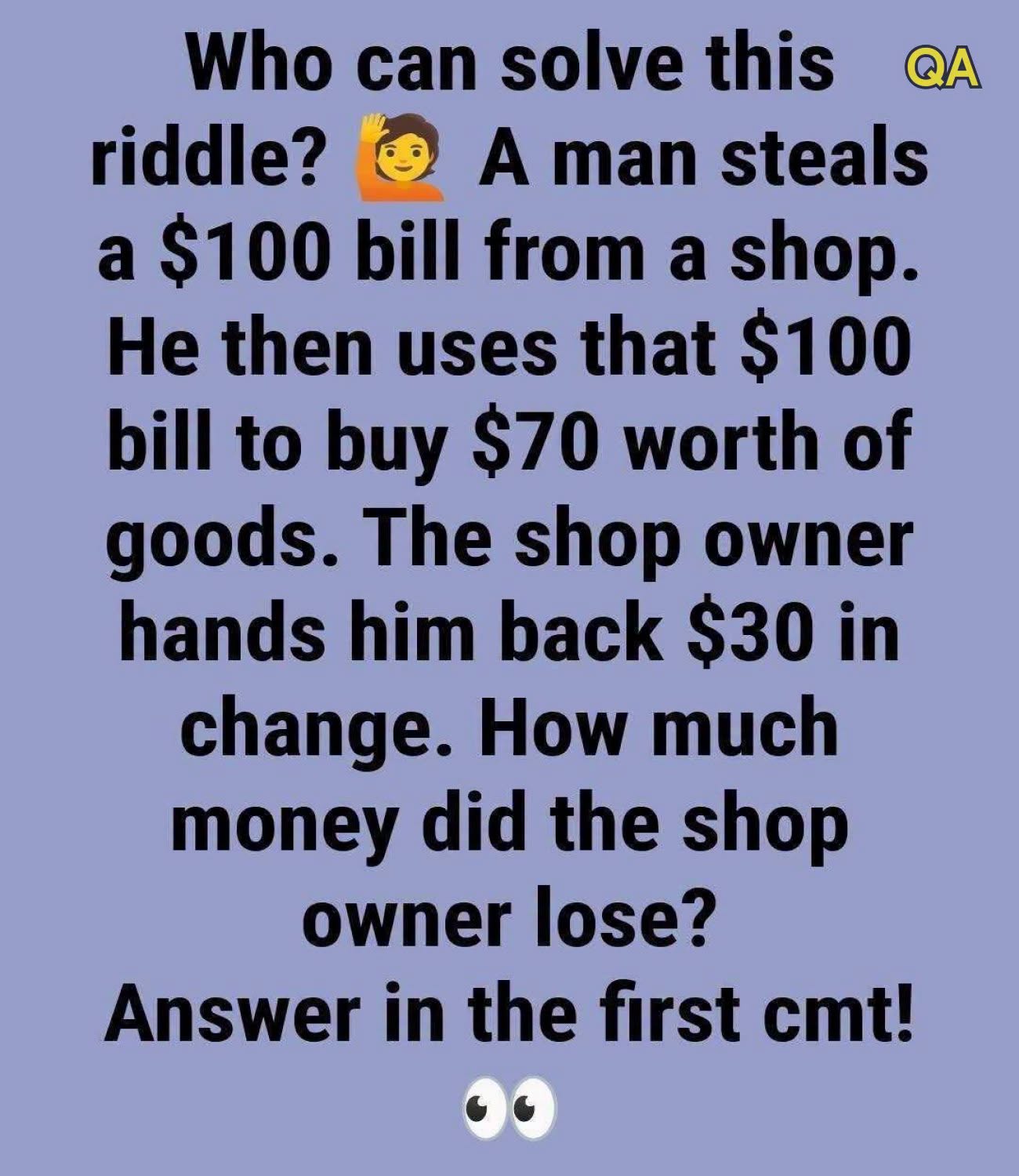
Tracking the Shopkeeper’s Cash Step by Step
Following the cash movement is one of the easiest ways to solve the puzzle accurately.
Step 1: The $100 Bill Is Taken
When the $100 bill is removed from the cash register, the shopkeeper is temporarily down $100 in cash.
Cash change at this moment: -$100
Step 2: The Same $100 Bill Returns as Payment
The customer gives the same $100 bill back to the shopkeeper. The shopkeeper accepts it as payment for $70 in merchandise.
At this point, the original missing $100 has returned to the register. The temporary cash loss from the first step has been reversed.
Cash change from the original bill: $0 overall
Step 3: The Shopkeeper Gives $30 in Change
Because the merchandise costs $70 and the customer presents a $100 bill, the shopkeeper gives $30 back.
This $30 does not return to the business. It is a final cash loss.
Final cash change: -$30
Tracking the Merchandise Value
The shopkeeper also gives the customer $70 worth of merchandise. That merchandise is no longer in the shop, and no legitimate payment was ultimately received for it.
Merchandise change: -$70
When the lost cash and lost merchandise are combined, the outcome is simple:
Cash loss: $30
Merchandise loss: $70
Total loss: $100
A Balance Sheet View of the Puzzle
Another useful method is to think of the business as having two categories of assets: cash and inventory. Before the event begins, the shopkeeper has a certain amount of money in the register and a certain amount of merchandise on the shelves.
After the event ends:
- The $100 bill is back in the register.
- $30 has been paid out as change.
- $70 worth of inventory has left the store.
Because the original bill has returned, it does not reduce the final value of the shopkeeper’s assets. The reduction comes only from the $30 paid in change and the $70 in merchandise no longer held by the business.
This kind of reasoning is related to a basic accounting principle: financial outcomes should be evaluated by comparing the starting position with the ending position. Temporary movements of money may matter for cash handling, but they do not necessarily represent a final gain or loss.
