


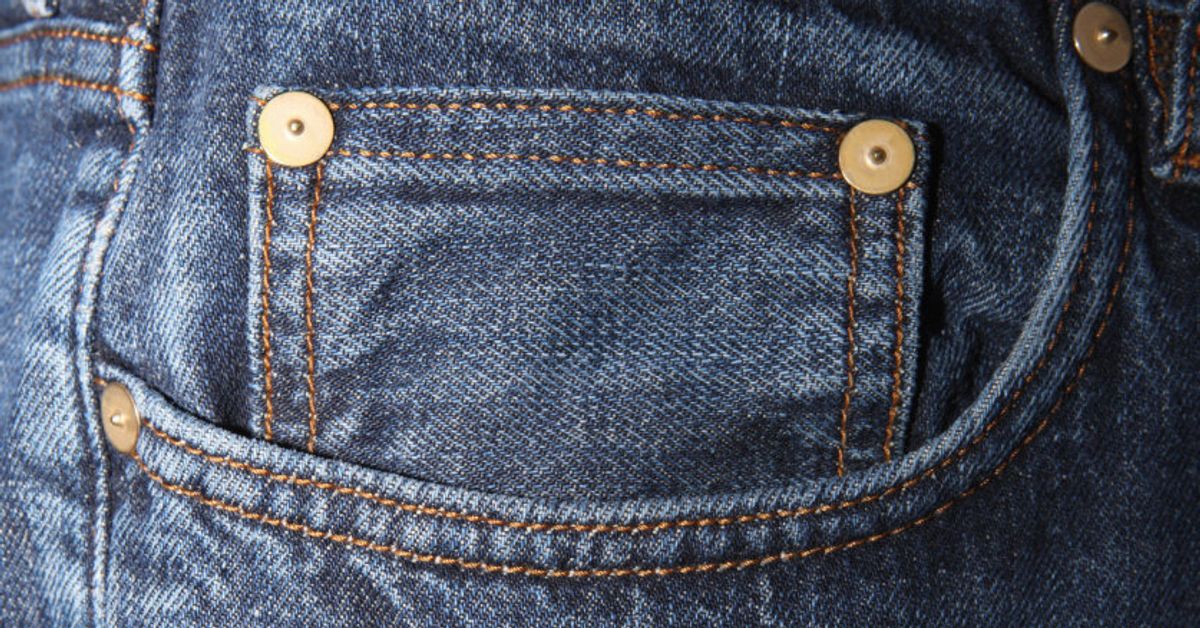
Have you ever reached into your jeans and wondered why there is a tiny pocket hidden inside the larger pocket on the right side?
It is so small that most people barely notice it. You might have used it for loose change, a folded receipt, or a small object you did not want to lose. Perhaps you have even wondered why clothing designers continue adding it when modern jeans already have several larger pockets.
But this little detail is not simply a random decoration.
It has a history stretching back more than 150 years, to a time when people carried an everyday accessory that most of us rarely use today: the pocket watch.
That tiny piece of denim was originally designed for a practical purpose. Although the way we dress and the objects we carry have changed dramatically, the pocket has survived as one of the most recognizable details of classic jeans.
Its story reveals something interesting about fashion: sometimes, the smallest design features have the longest histories.
The Original Purpose: A Safe Place for a Pocket Watch
The small pocket inside the right front pocket of traditional jeans is commonly called the watch pocket. Its original purpose was straightforward: to provide a convenient place to keep a pocket watch.
To understand why this mattered, it helps to imagine everyday life in the late nineteenth century.
Wristwatches were not yet the familiar everyday accessories they would eventually become. Portable timepieces were commonly carried in pockets, often attached to a chain. A pocket watch was useful for checking the time, especially for people whose work required them to follow schedules.
However, carrying a delicate watch in an ordinary trouser pocket could be inconvenient. It might move around, become scratched by other objects, or be difficult to reach quickly.
A separate, smaller compartment offered a more suitable place to keep it.
When Levi Strauss & Co. developed its early riveted denim work trousers, the small pocket became part of the design. According to the company’s own historical account, the original pants included two front pockets, a small watch pocket above the larger right front pocket, and one back pocket.
The design was not intended to make jeans look more fashionable. It was a practical feature created for the needs of people who wore durable work clothing.
Today, that same little compartment remains on countless pairs of jeans, even though its original purpose is no longer part of most people’s daily routines.
How Blue Jeans Became an Everyday Classic
The history of the tiny pocket is closely connected to the development of modern blue jeans.
In the early 1870s, a tailor named Jacob Davis was looking for a way to make work trousers stronger. Customers needed clothing that could withstand demanding physical activities, and ordinary pocket openings were particularly vulnerable to tearing.
Davis developed a method of reinforcing important stress points with small metal rivets.
He later approached Levi Strauss, a San Francisco businessman who supplied him with fabric, about working together to patent the idea.
Their partnership led to a significant moment in clothing history.
On May 20, 1873, Levi Strauss and Jacob Davis received U.S. Patent No. 139,121 for an improvement in fastening pocket openings. The reinforced trousers that followed became the foundation of the blue jeans we recognize today.
