

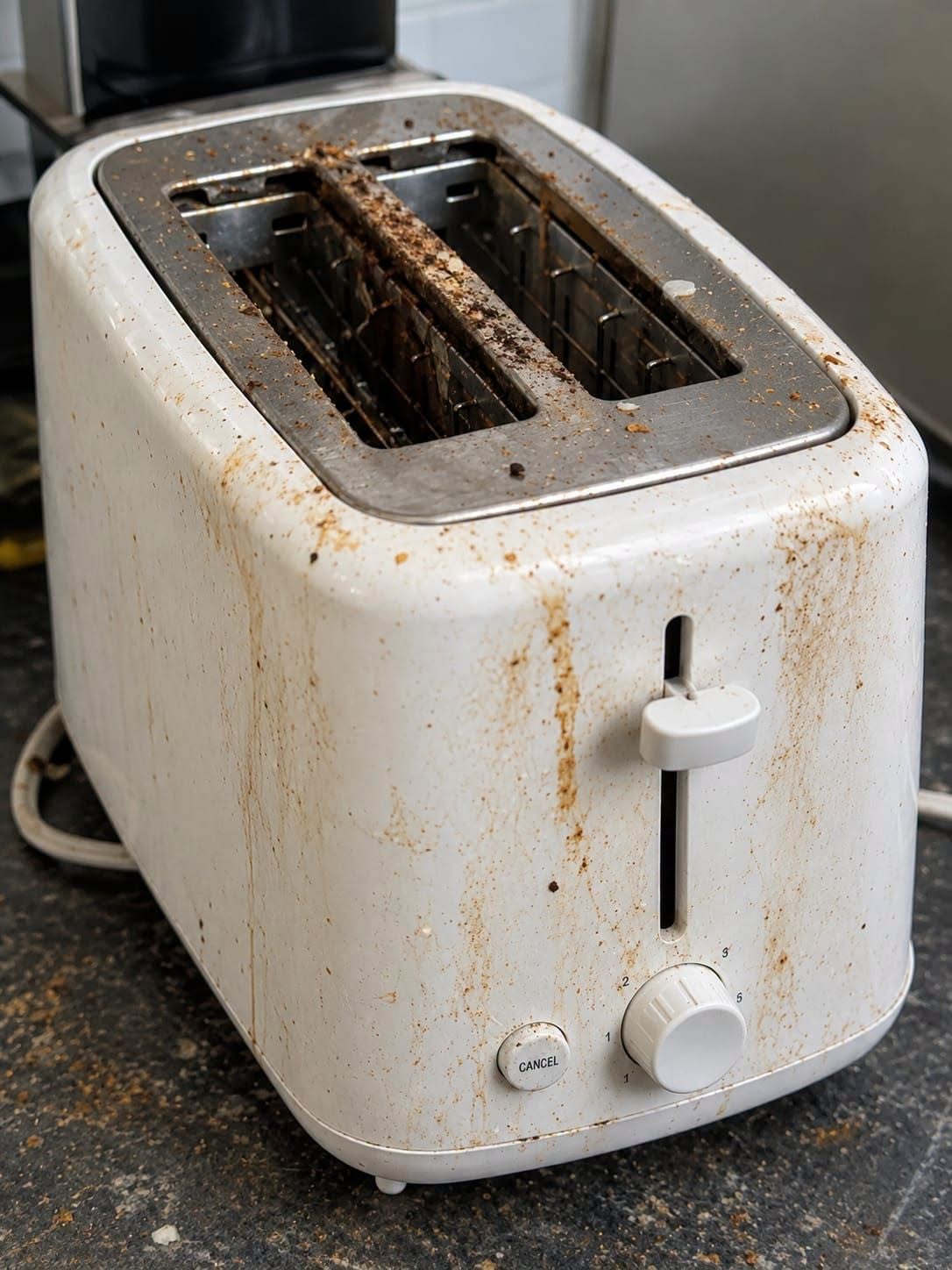
In almost every modern kitchen, the two-slot pop-up toaster holds prime countertop real estate. It is one of the most frequently used small appliances in the home, relied upon daily for morning bagels, artisanal sourdough, frozen waffles, and quick afternoon snacks. Yet, when people wipe down their kitchen surfaces, sanitize cutting boards, scrub sinks, and mop floors, the toaster is almost universally overlooked. At most, it receives a casual exterior wipe with a damp rag while sitting in plain view, coated in aerosolized cooking grease, kitchen dust, and stubborn brown splatters.
Take a look inside the vertical slots of an average household toaster, however, and you will find an alarming scene: charred black remnants clinging to delicate heating wires, a dense layer of stale crumbs decomposing at the base, and baked-on grease encrusting the inner metal guides.
Many people dismiss this neglect under the comforting assumption that high heat sterilizes everything. Because the toaster glows red-hot during operation, it seems logical that any microbes or impurities must simply burn away into harmless ash.
Unfortunately, this assumption is false. A neglected toaster is not merely an aesthetic eyesore; it is a genuine fire hazard, a haven for nocturnal household pests, a source of toxic carcinogenic chemical vapors, and a primary culprit behind stale, bitter-tasting breakfast food. Understanding the biology, chemistry, and mechanics of toaster degradation reveals why regular cleaning is indispensable—and how a few simple minutes of maintenance can restore your appliance to peak hygiene and safety.
1. The Fire Hazard Hiding on Your Counter
The single most urgent reason to clean your toaster is not microbial; it is fire prevention.
Every time bread is lowered into a toaster, the outer crust dries out and sheds microscopic fragments, seeds, flour dust, and larger flakes of crust. While some of these particles fall directly into the removable crumb tray at the bottom, a substantial percentage catches on the internal carriage tracks, heating coils, and structural brackets inside the chassis.
The Fuel-Rich Combustion Chamber
Over weeks and months of daily use, this fallen debris forms a dense, dehydrated bed of dry organic matter sitting mere millimeters beneath live electrical elements. Standard household toasters operate using nichrome (nickel-chromium) wire ribbon filaments wrapped around mica insulator sheets. When powered, these wires glow red-hot, reaching operating temperatures between $600^\circ\text{F}$ and $1,200^\circ\text{F}$ ($315^\circ\text{C}$ to $650^\circ\text{C}$).
Under these extreme temperatures:
-
Dry bread crumbs undergo rapid pyrolysis, releasing flammable carbonaceous gases.
-
Bread varieties containing high fat, butter, cheese, or sugar (such as brioche, croissants, or frosted pastries) drip oils and sugars directly onto the glowing elements.
-
These trapped fats and dry crumbs reach their spontaneous auto-ignition point.
According to municipal fire department statistics and consumer safety commissions, uncleaned toasters and toaster ovens are consistently ranked among the leading kitchen appliance causes of residential structure fires. A sudden puff of smoke or flare-up inside the slots can quickly ignite paper towels, wooden cabinets, or grease deposits located directly above or behind the unit. Regularly clearing the crumb accumulation removes the fuel source, eliminating this danger entirely.
2. The Pest Magnet: An All-Night Buffet for Cockroaches and Mice
Kitchen pests do not need large quantities of food to survive; they require consistent, secluded, and undisturbed nourishment. A toaster packed with stale bread crumbs and resting on a quiet countertop in a dark kitchen is an ideal ecosystem for insects and rodents.
Why Pests Love Toasters
-
Shelter and Warmth: After a toaster runs, its internal metal frame and ceramic insulators retain residual warmth for hours, creating a cozy shelter during cool evenings.
-
Continuous Organic Food Supply: The crumb tray contains pure carbohydrates, sesame seeds, poppy seeds, and sugar deposits that can sustain entire insect colonies for weeks.
-
Nocturnal Invasions: Cockroaches (Blattella germanica) and ants possess flattened, flexible exoskeletons that allow them to slip effortlessly through the top bread slots, bottom ventilation louvers, and carriage lever tracks of your toaster. In homes with mouse activity, rodents regularly climb onto kitchen counters specifically to lick grease splatters and forage for seeds inside toaster openings.
When pests enter an appliance, they do not merely eat; they leave behind droppings, shed skins, regurgitated fluids, and pathogenic bacteria such as Salmonella enterica and Escherichia coli.
When you slide a fresh slice of bread into the slot the following morning, that bread rests directly against the surfaces where pests walked and fed hours earlier. While the nichrome wires get hot, the bread racks, crumb tray, and metal guide walls often do not reach sustained pasteurization temperatures throughout the entire cycle, creating a direct vector for cross-contamination.
