

Have you ever wondered if one of your organs could repair itself after losing a large part of its tissue? The human body is full of amazing abilities, from healing a small cut on your finger to repairing damaged muscles after exercise. But one organ has a particularly impressive ability: it can grow back after a significant portion of it has been removed.
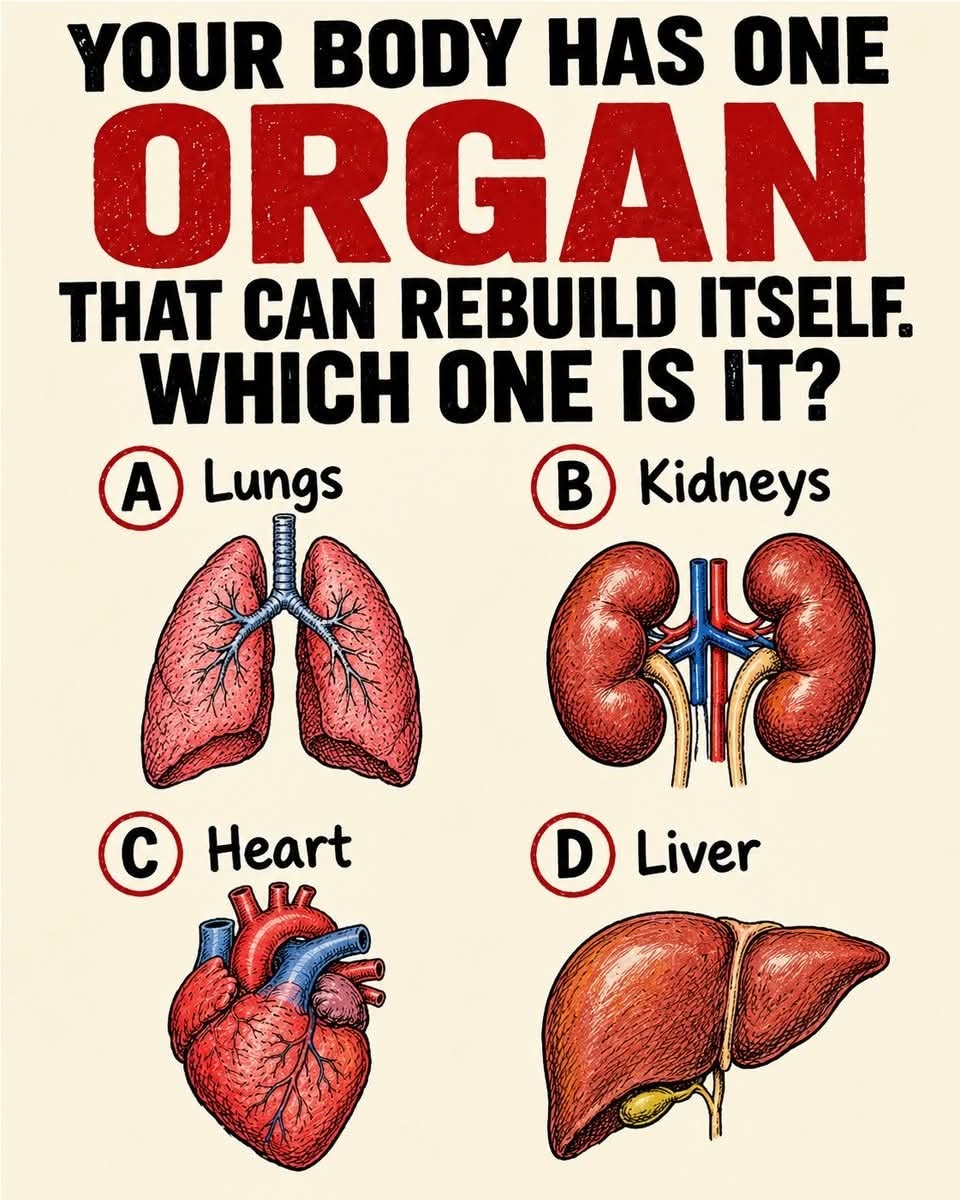
Look at the four options in the picture: lungs, kidneys, heart, and liver. All four organs are essential for keeping you alive, but only one is famous for its remarkable ability to regenerate. Can you guess which one it is?
Before revealing the answer, let’s take a closer look at how these organs work and why this ability is so special.
Four Organs, Four Essential Jobs
First, consider the lungs. Every time you breathe, your lungs bring oxygen into your body and remove carbon dioxide, a waste gas produced by your cells. They can recover from certain types of damage, and some lung tissues can repair themselves. However, the lungs cannot normally regrow large amounts of lost tissue in the same way the liver can.
Next are the kidneys, two bean-shaped organs that act like your body’s natural filters. They remove waste products and excess water from your blood, help control blood pressure, and maintain the balance of important minerals. Although the kidneys can repair some minor damage, their ability to replace lost filtering units is very limited. Once many of these structures are permanently damaged, the kidneys cannot simply grow new ones to restore their original function.
Then there is the heart, the powerful muscle that pumps blood throughout your body. It delivers oxygen and nutrients to your organs and tissues every second of your life. Unfortunately, when part of the heart muscle is seriously damaged, such as during a heart attack, the body usually replaces much of the injured area with scar tissue rather than fully rebuilding the original muscle. The heart has some limited repair abilities, but it cannot regenerate large areas of lost tissue.
Finally, we come to the liver. This organ sits in the upper-right part of your abdomen, just beneath your ribs. It performs hundreds of important jobs, including processing nutrients, breaking down harmful substances, producing bile to help digest fats, and making proteins needed for blood clotting.
What makes the liver different is its extraordinary capacity to regenerate.
