

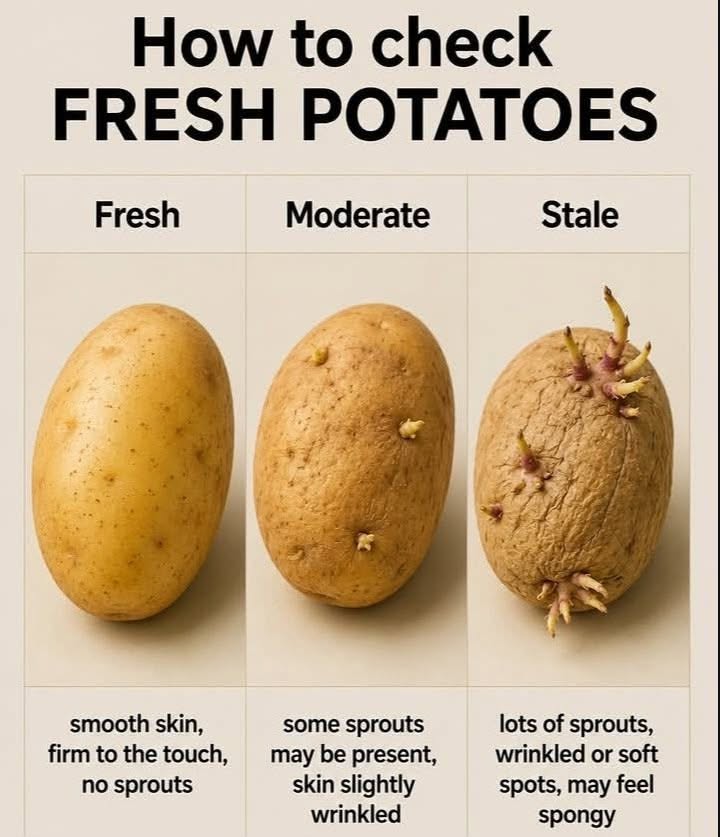
♻️ Don’t Let Food Waste Make the Decision for You
There’s a temptation to either throw away every potato that develops a tiny sprout or, at the other extreme, keep potatoes far beyond the point where they’re worth eating.
The better approach is to inspect them individually.
A firm potato with a couple of small eyes is very different from a soft, moldy, heavily green potato covered in long sprouts.
Use your eyes, hands, and common sense—and when a potato is clearly deteriorating, don’t take chances.
🥔 So Which Potato in the Picture Would You Throw Out?
Looking at the progression from A through G, the potatoes go from barely sprouted to heavily sprouted.
That’s exactly why this makes such a fun kitchen question:
At what point would YOU stop eating it?
Would you use A, B, C, D, or E?
Would F make you hesitate?
Or would G go straight into the compost or trash? 😂🥔
There isn’t necessarily one visual cutoff that applies perfectly to every potato—the potato’s firmness, color, mold, decay, and overall condition matter too.
👇 Let’s settle the great potato debate!
A — No problem!
B — Still good!
C — I’d trim it!
D — Maybe…
E — Probably not!
F — Too far gone!
G — Absolutely not!
Which letter would make you throw your potato away? 🥔👇
