

The Opposite Danger: The Myth of the Zero Percent Calibration
For decades, early consumer electronics used Nickel-Cadmium (NiCad) and Nickel-Metal Hydride (NiMH) batteries. These older chemistries suffered from the infamous "memory effect": if they were not completely drained to zero percent before recharging, they gradually lost the ability to access their full capacity.
This legacy habit led millions of people to believe that letting a smartphone run down to zero percent until it dies is healthy maintenance.
In modern lithium-ion chemistry, this belief is completely false and actively harmful.
Dropping a lithium battery to absolute zero percent pushes the cell into a state of severe under-voltage. If an internal cell voltage drops below roughly 2.5 to 3.0 volts:
-
The copper current collector on the anode can begin to dissolve into the liquid electrolyte.
-
When the battery is eventually recharged, that dissolved copper can precipitate out as microscopic metallic needles known as dendrites.
-
These sharp metallic dendrites can pierce through the delicate polymer separator, causing an internal microscopic short circuit, rapid overheating, or permanent cell death.
While modern phones shut down automatically before reaching true physical zero volts, allowing your battery gauge to hit zero percent stresses the chemical stability of the electrodes almost as severely as holding it at one hundred percent.
The Recommended Charge Level: The 20-80 Rule
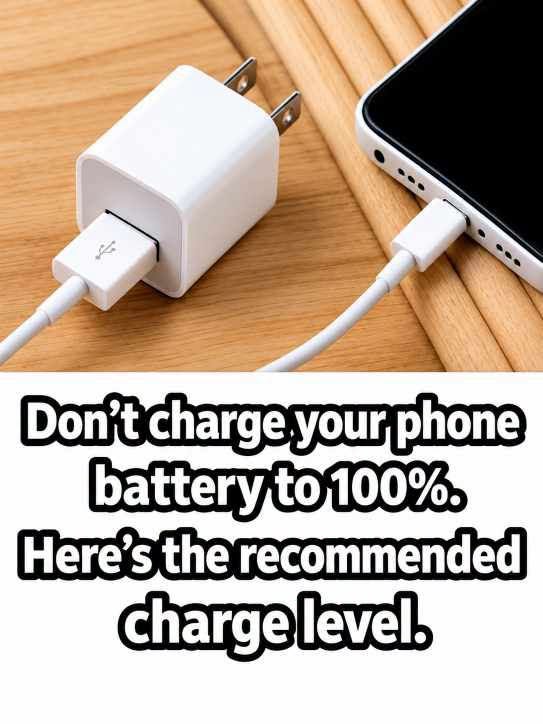
Given the physical strains present at both extremes of the charging spectrum, battery engineers, materials scientists, and major hardware manufacturers agree on an optimal daily operating window: The 20-80 Rule.
Operating between twenty percent and eighty percent state of charge delivers the best balance of daily usability and long-term chemical preservation:
-
Lower Boundary (20%): Plugging your phone in when it drops to twenty or twenty-five percent prevents the cell from entering the deep-discharge stress zone where copper dissolution and extreme electrode contraction occur.
-
Upper Boundary (80%): Disconnecting the charger when the battery hits eighty to eighty-five percent prevents the high-voltage threshold (typically exceeding 4.10 to 4.15 volts) where rapid SEI thickening, electrolyte decomposition, and cathode structural breakdown accelerate.
                     THE BATTERY STRESS SPECTRUM
┌─────────────────────────────────────────────────────────────┐
│ 0% - 20%   : HIGH STRESS ZONE (Deep discharge & under-voltage)│
├─────────────────────────────────────────────────────────────┤
│ 20% - 80%  : OPTIMAL HEALTH ZONE (Low chemical stress)       │
├─────────────────────────────────────────────────────────────┤
│ 80% - 100% : HIGH STRESS ZONE (High voltage & SEI thickening) │
└─────────────────────────────────────────────────────────────┘
Electrochemical testing shows that cycling a lithium-ion cell between zero and one hundred percent typically yields between 300 and 500 complete discharge cycles before the cell degrades to eighty percent of its original rated capacity (roughly one to two years of daily use).
In contrast, restricting the charge cycle between twenty percent and eighty percent reduces the depth of discharge and lowers operating voltage, allowing the same cell to deliver 1,000 to 1,500 cycles before experiencing equivalent degradation. By simply avoiding the top twenty percent and bottom twenty percent, you can more than double the useful operational lifespan of your hardware.
Thermal Degradation: The Multiplier of Battery Wear
Voltage stress is only half of the degradation equation; the other critical variable is heat.
Chemical reaction rates roughly double with every ten-degree Celsius increase in temperature, following the Arrhenius equation. When a battery is subjected to elevated heat while concurrently held at a high state of charge, degradation accelerates exponentially.
Common habits that subject smartphone batteries to damaging thermal loads include:
