

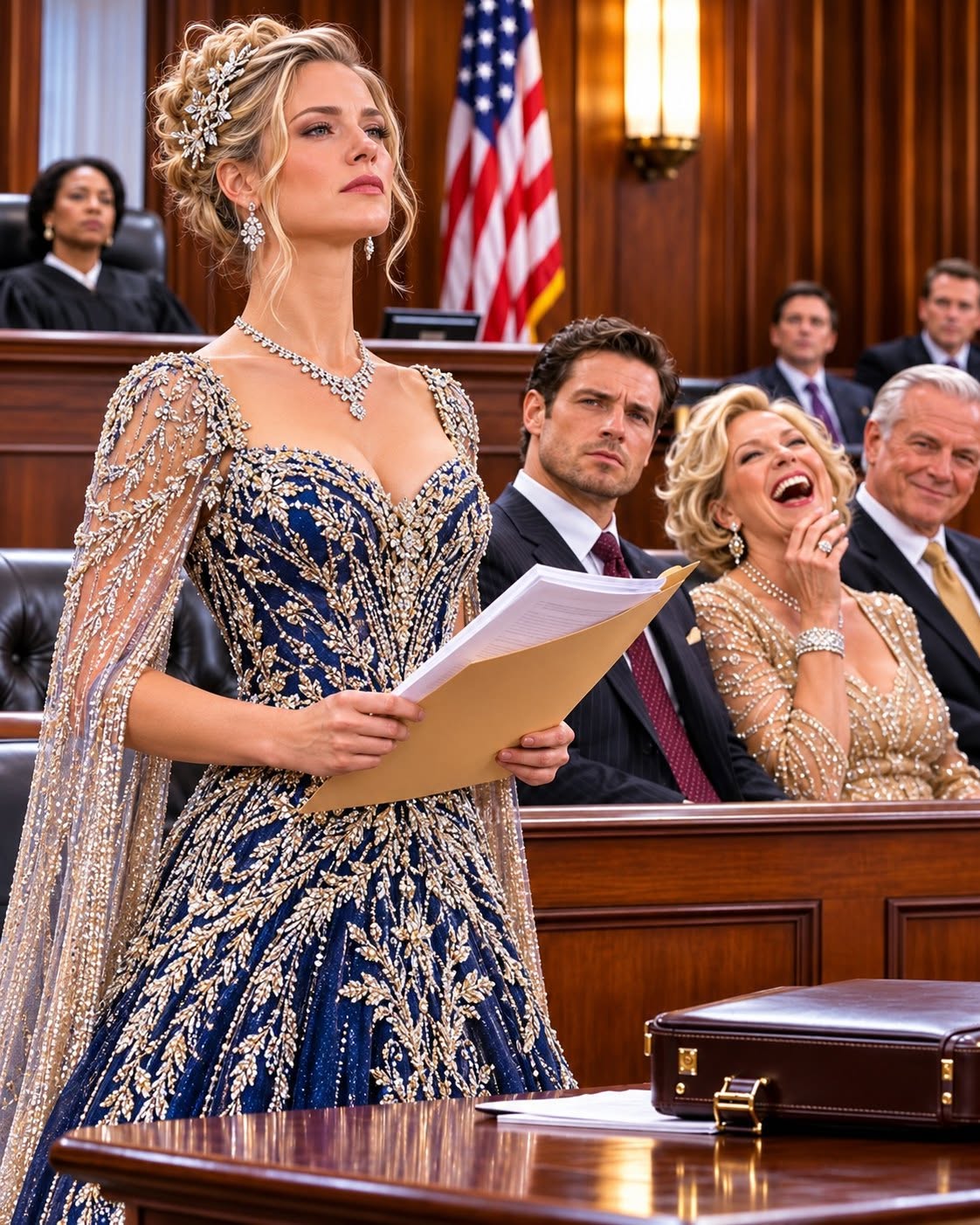
Stephen Calder rose so quickly that his chair scraped against the courtroom floor.
For a moment, no one spoke.
Judge Porter looked from him to me, then down at the slim folder beneath my hand.
“Mr. Calder,” she said, her voice even, “you will wait until I ask you to address the court.”
He sat again, though the color had drained from his face.
Andrew’s confident expression had vanished.
He stared at the folder as if he could see through its cover and make the pages disappear.
Ruth, who had been leaning toward Frank with a knowing smile, sat very still.
I drew out the first document and placed it on the table before me.
“Your Honor, this is my sworn financial disclosure, prepared in response to the proposed settlement.”
Judge Porter accepted the copy offered by the clerk.
“It appears to be a financial statement,” she said.
“Yes, Your Honor, and it differs in several important ways from the financial information attached to the agreement Mr. Calder submitted.”
Calder stood again, more carefully this time.
“Your Honor, we have no objection to reviewing the parties’ financial materials, but this is not the time to turn a routine settlement hearing into a broad inquiry.”
“A routine settlement hearing requires accurate information,” Judge Porter replied.
She scanned the first page in silence.
The room seemed to contract around the quiet scratch of the clerk’s pen.
I kept my hands folded, though my fingertips had gone cold.
I had imagined this moment many times during the sleepless nights before court.
In none of those imaginings had I felt as small as I did now, standing in a room where the man I had once trusted looked at me as though I had become a stranger.
Judge Porter turned a page.
“Mr. Calder, the proposed agreement lists no contribution from Mrs. Ellison to the household’s financial management or to the business-related expenses.”
“That is correct, Your Honor,” Calder said. “Mr. Ellison’s position is that his wife was not employed during the marriage and did not contribute financially.”
“I did not say I contributed through wages,” I answered.
Judge Porter looked up.
“Explain the distinction.”
“For years, I handled household bills, reconciled statements, arranged travel, and kept records for business events and family expenses,” I said. “Some of those tasks were personal, some were connected to Andrew’s work, and some involved his parents. The agreement treats all of that as though it never happened.”
Andrew shifted in his chair.
“Mara,” he said under his breath, “that isn’t what we’re here to discuss.”
Judge Porter’s eyes moved to him.
“Mr. Ellison, you will have an opportunity to respond.”
The calm in her voice made his interruption seem louder than it had been.
I looked down at the financial disclosure, following the lines I had checked and checked again.
It would have been easy to focus on every cold phrase in the settlement.
It would have been easier to point out that the document described our marriage as though I had occupied the house without touching anything inside it.
But the first issue was simpler, and more difficult to ignore.
“Your Honor, the agreement presented to the court bears a signature attributed to me,” I said. “I did not sign it, authorize anyone to sign it, or agree to its terms.”
A faint stir moved through the gallery.
Ruth’s bracelet gave a small, bright click against the arm of her chair.
Calder stood, but Judge Porter raised one hand.
“Mr. Calder, have you examined the original agreement?”
“We filed the signed version provided to us by my client,” he said. “I have not personally compared it to any original household records.”
“Do you have the original with you?”
“I believe it is in our case file.”
“Then it will remain in the court’s custody until the signature issue is examined.”
Calder’s jaw tightened.
Andrew leaned toward him and whispered something I could not hear.
The attorney answered without turning his head.
Judge Porter looked back at me.
“Mrs. Ellison, what records do you have that are relevant to your statement?”
I lifted the folder.
“I brought copies of the disclosures I prepared, the household records I maintained, and several documents that show the signature on the agreement is not consistent with my own.”
“Do you have the original documents?”
“Some of them, Your Honor.”
“And have they been altered or removed from their usual storage?”
“No.”
The answer came quickly, because I had asked myself that question a dozen times before leaving home.
I had not secretly signed anything.
I had not altered anything.
I had kept copies of records that Andrew had repeatedly asked me to organize, review, and save.
At the time, he had called it being careful.
Later, he had called it my hobby.
Judge Porter closed the agreement and set it aside.
“This matter cannot proceed as an ordinary uncontested settlement today,” she said. “I am pausing consideration of the proposed agreement. Both parties are to preserve all original documents relating to the agreement, their financial disclosures, and the accounts identified in the filings.”
The word pausing did not sound dramatic, but Andrew seemed to hear something much larger in it.
“Your Honor,” he said, standing, “I want to be clear that I believed the agreement was properly prepared.”
“I am not making a finding about how it was prepared,” Judge Porter replied. “That is why I am ordering preservation and disclosure.”
His mouth closed.
Calder rose again.
“May I request that the court limit production to the materials relevant to the agreement?”
“You may make that request in writing,” Judge Porter said. “For now, each party will provide complete records supporting the financial information used in the proposed settlement, including records of accounts and transfers identified in those disclosures.”
Calder glanced at Andrew.
That glance was brief, but it carried the first hint of something I had not expected to see from him: uncertainty.
The judge turned to the clerk, who began noting the order.
“Mr. Ellison, do you understand?”
“Yes, Your Honor.”
“Mrs. Ellison?”
“Yes.”
“Both parties will avoid altering, deleting, or disposing of relevant records. The court will set a further date after the parties have complied.”
The hearing had lasted only minutes, but when Judge Porter called a recess, the room seemed to release a breath it had been holding.
I sat down slowly.
My knees had begun to tremble, though I hoped no one noticed.
The folder remained open before me, the documents squared neatly inside.
I had spent years learning that composure was not the absence of fear.
Sometimes it was simply the choice to keep speaking while fear sat beside you.
Andrew crossed the aisle before I could gather my papers.
“Can we talk?” he asked.
His voice was low, controlled, almost familiar.
I looked at him and remembered the kitchen where he had left the divorce papers beside my coffee.
I remembered his eyes staying on his phone while I tried to understand what the pages said about our life.
“I don’t know what there is to talk about,” I said.
“We can’t do this in front of everyone.”
“You brought the agreement to court in front of everyone.”
His gaze flicked toward the gallery.
Ruth had stood and was speaking quietly with Frank.
Calder had moved toward the clerk’s desk, already asking about the custody of the original paperwork.
Andrew lowered his voice.
“I didn’t know you were going to challenge it this way.”
“I told you I hadn’t signed it.”
“You said you wouldn’t sign it.”
