

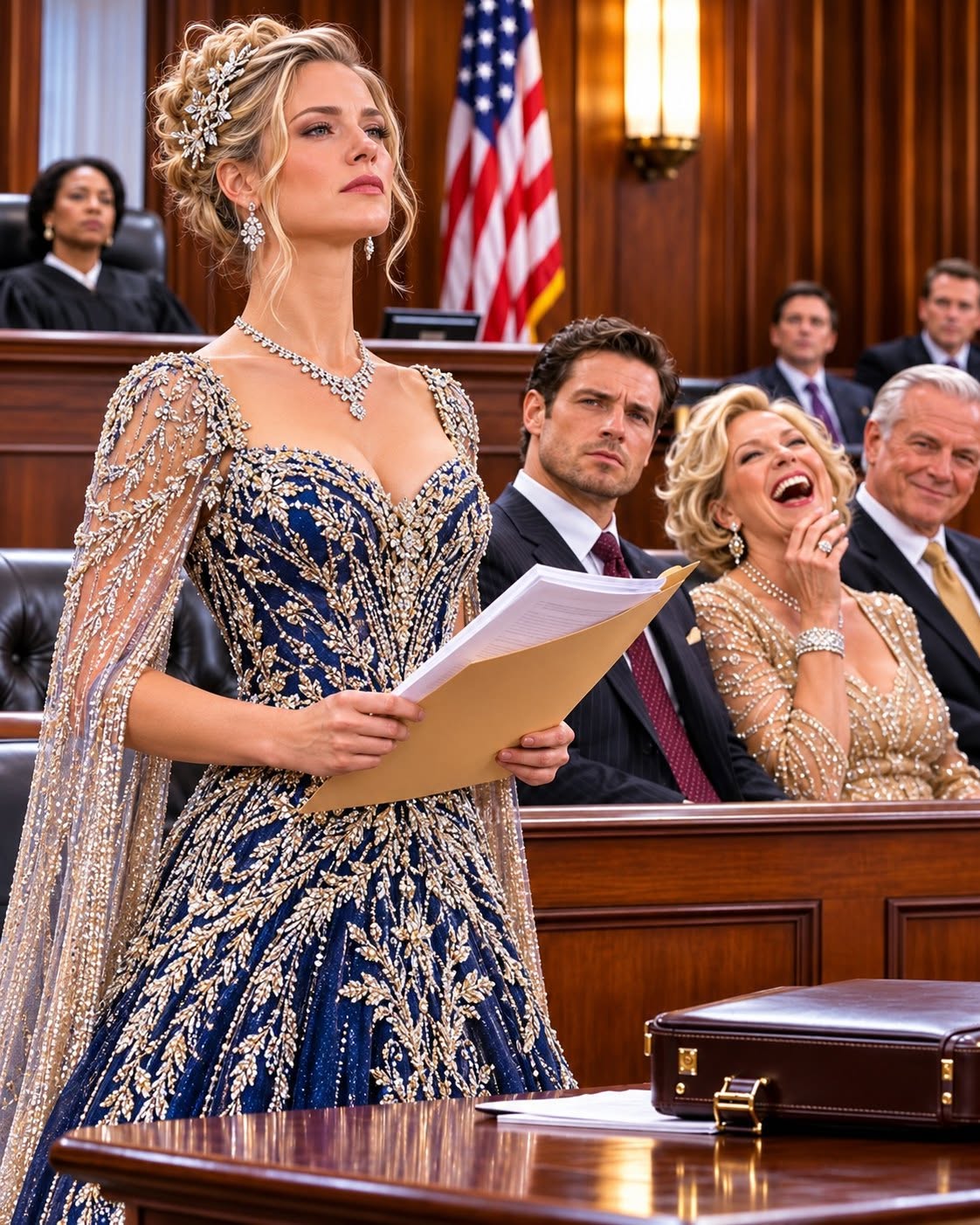
“I said I wouldn’t sign it because the information was wrong.”
He rubbed the bridge of his nose.
For the first time that morning, I saw the strain beneath his expensive suit.
It did not make the hurt smaller.
It only made the person who had caused it look more human.
“I thought we could resolve this without making it worse,” he said.
“You thought I would accept it without asking what it meant.”
“That isn’t fair.”
I looked at him.
“Is it true that you believe I contributed nothing to our marriage?”
He didn’t answer.
The silence hurt more than a quick denial would have.
For a second, I almost reached for the words that might have made the conversation easier.
I could have reminded him of the evenings I spent checking event invoices after he came home exhausted.
I could have listed the appointments I arranged for Frank, the flights I rebooked when his mother was ill, the bills I paid from the account Andrew handed me and then forgot to ask about.
But if I had to prove that I had lived beside him, then listing the proof would not repair what was broken.
“I don’t want to argue in this hallway,” I said.
He nodded, but his face remained closed.
“Calder says the judge is going to ask for more records than we expected.”
“Then we’ll provide them.”
“Some of those records involve my parents.”
“I know.”
He studied my expression, perhaps looking for an accusation.
I had one.
I had several.
But I did not yet know which questions deserved to be asked, or which answers I was prepared to hear.
“You brought all those files?” he asked.
“I brought what the court needed.”
“You kept copies?”
The question came too quickly.
Something in his voice changed—subtle, almost lost beneath the hallway noise.
I held his gaze.
“Yes.”
“Of everything?”
“Of what I handled.”
He looked away toward the courtroom doors.
I had never thought of the copies as a secret.
They were duplicates of things I had been asked to manage, kept because Andrew once told me that careful people saved receipts and statements.
Then he began saying I had never managed them.
I had stopped mentioning the files.
Not because I wanted to trap him, but because I was tired of being told that what I remembered had never happened.
“Andrew,” I said, “why does that bother you?”
“It doesn’t.”
But his answer arrived before the question had fully settled between us.
Before I could ask again, Ruth came toward us with Frank at her side.
She looked first at Andrew, then at me, her expression tightened into an effort at civility.
“This is becoming much more complicated than it needs to be,” she said.
“Judge Porter ordered records,” I replied. “We’ll provide them.”
Ruth’s lips pressed together.
“People have disagreements during divorce. There’s no need to make it a spectacle.”
“I didn’t make the agreement.”
“I’m sure there’s some misunderstanding.”
The words were smooth, but the certainty beneath them was not.
She seemed less interested in what had happened than in keeping it from becoming something other people could see.
Frank rested a hand on her arm.
“Ruth, let them speak for themselves.”
She turned to him, surprised by the quiet correction.
He rarely contradicted her in public.
“I am only trying to prevent this from becoming ugly,” she said.
“Then we should start with the truth,” Frank replied.
His eyes met mine.
There was no warmth in them, exactly, but there was something I had not seen from him before: uncertainty about whether the story he had been told was complete.
Ruth looked back at me.
“You know Andrew has been under pressure,” she said. “He has always tried to keep things stable for this family.”
“I know he has tried to keep things from me.”
“That is not the same thing.”
“No,” I said. “It isn’t.”
For a moment, the four of us stood close enough to hear the courthouse clock mark the hour.
Andrew’s face had turned pale beneath the courtroom lights.
He looked tired now, not smug, and the change made my anger more complicated rather than less.
I had once known the small habits that gave him away.
The way he pressed his thumb against his wedding ring when he was anxious.
The way he paused before telling me something he believed would disappoint me.
His hand moved toward the ring, then stopped.
Ruth saw it too.
“Andrew,” she said quietly, “we should leave.”
He did not move.
“Your Honor’s order means we have to preserve everything,” I told him. “There’s no point pretending we can make this disappear.”
“I’m not pretending that.”
