

If you grew up when I did, castor oil probably came with a shudder. In my house, it was the dreaded spoonful somebody swore would “clean you out,” and for years I assumed that was simply what castor oil was for. But over time, and after plenty of trial, error, and stained pillowcases, I learned that most folks are using it the wrong way entirely. It has its place, but only when you respect what it is: a very thick plant oil with a few practical uses and some very real safety limits.
So if you’ve got a bottle tucked in the bathroom cabinet, here’s the right way to use it. I’m going point by point through the mistakes I see most often, including the hard no’s, the one honest exception where there is one, and the exact amounts, timing, and common-sense cautions I wish somebody had explained to me years ago.
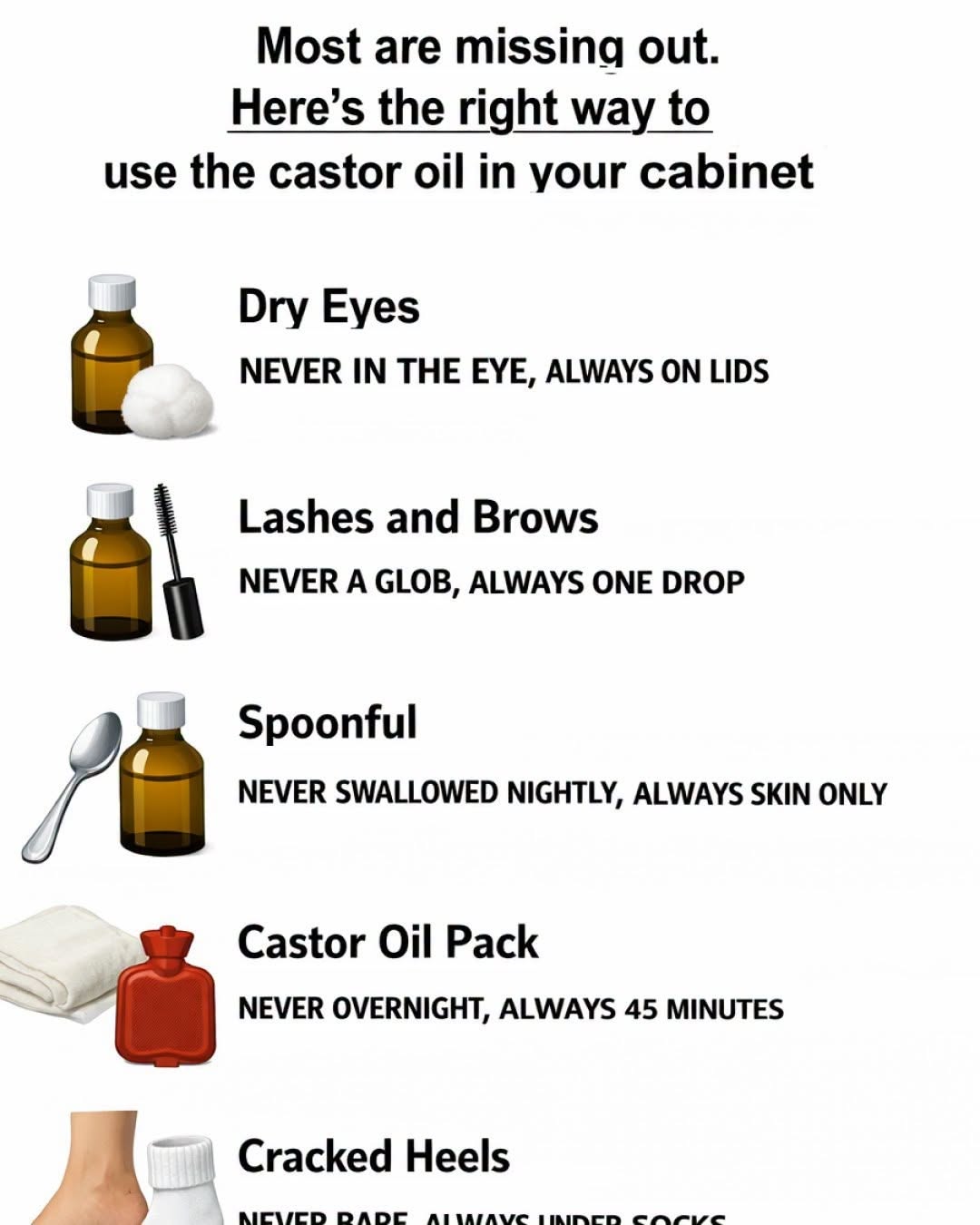
1. For dry eyes, never put plain castor oil in the eye, always use it on the lids
This is one of the biggest misunderstandings. Plain bottled castor oil is not sterile, and the eye is too delicate for that gamble. Putting drops straight into the eye can blur your vision, sting, and irritate the surface. The safer at-home way is external only: wash your hands, place 1 small drop on a clean fingertip or cotton swab, and smooth it along the closed upper and lower lids at bedtime, no more than once nightly. Keep it on the skin, not in the eye.
There is one honest exception: pharmacy-made eye drops that contain castor oil and are specifically labeled for eye use. Those are sterile and formulated for the eye itself. But a regular bottle from your cabinet is not the same thing, and I would not treat it like one.
2. For lashes and brows, never use a thick glob, always use one drop total
I know the temptation is to slather it on and hope for better lashes by morning, but that is where trouble starts. Too much oil migrates into the eyes while you sleep and can also sit heavy around the follicles, trapping debris and clogging pores. One drop total is plenty for both brows, or one drop total for both lash lines, 2 to 4 nights a week. I like to put that single drop on a clean spoolie or cotton swab and brush off the excess before applying.
The exception is simply this: if one drop feels like too much, use less, not more. A barely coated brush is enough. The goal is a light film, not a shiny layer that can run.
3. Never take castor oil nightly by mouth; use it on skin only
I’m going to be plain here because this old remedy has hung on far too long. Castor oil by mouth is a harsh stimulant laxative. It can cause cramping, urgent diarrhea, nausea, and dehydration, especially in older adults who do not bounce back from fluid loss as easily. That means it is not something to take nightly, “for regularity,” or just because you feel sluggish. For routine home use, keep it on the skin only.
There is one honest exception: a clinician may tell someone to take an oral castor oil product for a very specific short-term reason, following the package or medical directions exactly. Outside that, I would not use it as a home habit. And in pregnancy, avoid it entirely by mouth, because it can trigger contractions. That caution deserves to be said plainly.
4. For a castor oil pack, never leave it on overnight, always stop at 45 minutes maximum
This is another place where “more” is not better. A castor oil pack should not be an all-night affair. Long heat exposure can irritate skin, and if you’re using a heating pad or hot water bottle, there is a real burn risk, especially if you doze off. Keep sessions to 20 to 45 minutes, 2 to 4 times a week at most, and use gentle warmth rather than high heat.
The exception is a room-temperature pack with no heat, but even then I would still cap it at about 45 minutes. Once skin gets slick, occluded, and warm for too long, irritation becomes much more likely than benefit.
