

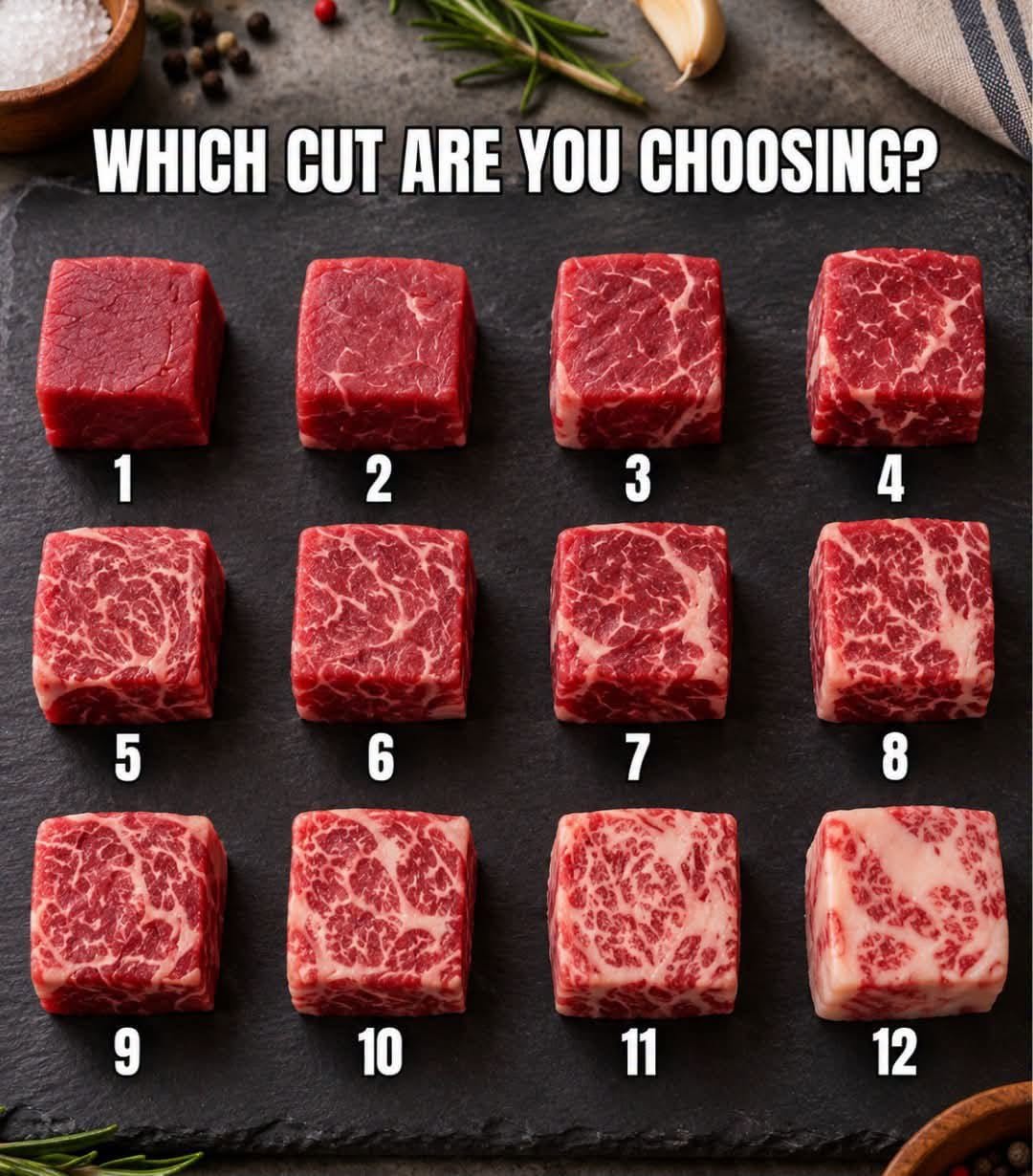
🥩 3–4: Light to Moderate Marbling
Now we’re starting to see more of those little white streaks.
This is where the steak begins to look noticeably more marbled without becoming overwhelmingly fatty.
For someone who wants a balance between lean beef character and richness, this can be an appealing range.
🥩 5–6: The Classic Steak Look
Now we’re getting into the territory that many people immediately associate with a beautiful steak.
The marbling is obvious.
There are white lines running throughout the red muscle rather than just a few isolated flecks.
When cooked properly, this kind of beef can deliver a satisfying combination of:
Beefy flavor + richness + juiciness.
🥩 7–8: Serious Marbling
Now the steak starts looking luxurious.
There is significantly more intramuscular fat, and the white marbling becomes a major visual feature.
For people who love rich steaks, this is where things get exciting. 🤤
It’s also where cooking becomes particularly important.
You want enough heat to develop a delicious crust while allowing the steak’s internal fat to render appropriately.
🥩 9–10: Marbling Lover’s Territory
We’re getting into seriously fatty beef now.
The meat looks almost patterned with white veins.
If you love buttery, rich steak, this may look absolutely incredible.
But if you’re someone who prefers a leaner, more straightforward beef flavor, you might look at this and think:
“That’s a little too much.”
And that’s perfectly reasonable.
🥩 11–12: Maximum-Richness Territory
At the highest end of the image, the marbling is extremely prominent.
There is so much visible intramuscular fat that the meat almost looks artistic.
This is the point where the question changes from:
“Does this steak have enough marbling?”
to:
“How much richness do I actually want?”
More isn’t automatically better for every person or every cut.
🔥 Why Does Marbling Matter So Much?
Think about cooking a steak.
You put it into a hot pan.
The surface develops a browned crust.
Inside, the steak heats up.
As the fat within the muscle warms, some of it renders.
That combination of beef + rendered fat + browning is a huge part of why a well-marbled steak can taste so rich.
USDA explains that Prime beef has abundant marbling, while Choice has less and Select has less again; USDA also notes that Select beef can be fairly tender but may have less juiciness and flavor because it has less marbling. (AMS)
So marbling isn’t merely something that looks pretty in a photograph.
It is one of the characteristics used in beef quality grading.
