

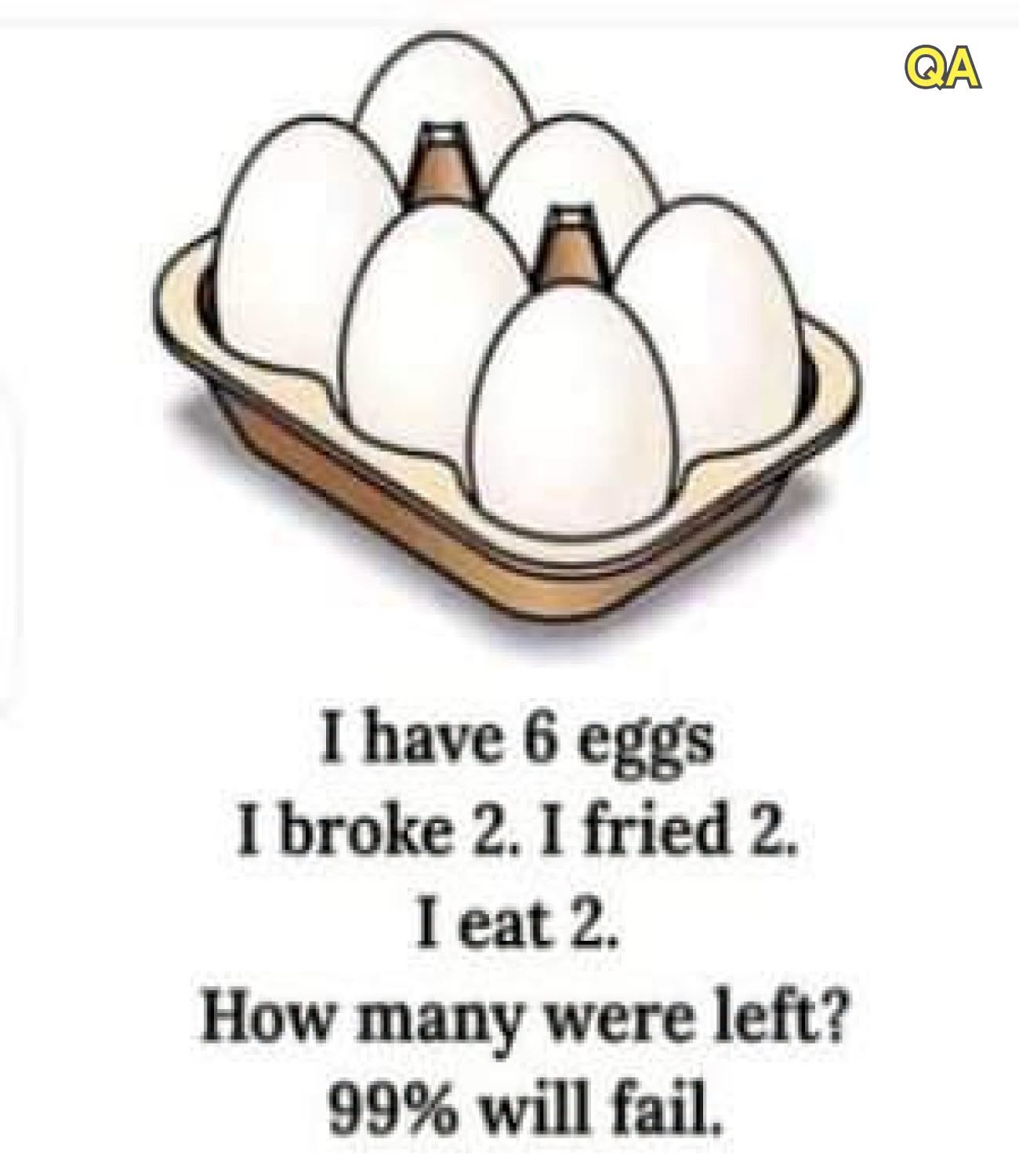
Why Frying an Egg Does Not Create a Second Loss
Frying an egg is another transformation. The egg is cooked, but it is still the same egg that was previously broken. If the two broken eggs are fried, the number of eggs has not changed. There are simply four raw, unbroken eggs and two cooked eggs.
A common mistake is to treat each verb in the puzzle as an instruction to subtract a new pair of eggs. That would count the same eggs multiple times. In basic arithmetic and logical reasoning, an item should only be removed once unless the wording clearly says that different items are used at each stage.
For example, consider the sentence: “I picked two apples, washed two apples, and ate two apples.” Most readers would understand that the same two apples were picked, washed, and eaten. It would be unreasonable to assume that six separate apples were involved without additional information. The egg puzzle follows the same logic.
The Correct Answer: Four Eggs Remain
Under the usual interpretation, the sequence is straightforward:
- You begin with 6 eggs.
- You break 2 of those eggs.
- You fry those same 2 broken eggs.
- You eat those same 2 fried eggs.
- You have 4 eggs remaining.
The four remaining eggs are presumed to be unbroken and uncooked because they were not used in the preparation of the meal. The two eggs that were broken, fried, and eaten are no longer available.
This answer reflects the intended logic of the riddle. The wording is concise because it invites the reader to recognize that one pair of eggs can move through several actions in sequence.
Could There Be Other Interpretations?
In strictly formal terms, the wording does not explicitly state that the broken eggs, fried eggs, and eaten eggs are the same eggs. A reader could construct a less typical scenario in which different eggs were used at each step. For instance, a person could break two eggs, fry two other eggs, and eat two additional eggs. In that case, the final result would depend on exactly which eggs remained available and whether the broken eggs were discarded or retained.
However, this interpretation is not how classic versions of the puzzle are generally intended to be solved. Everyday language relies on reasonable context. Because frying ordinarily requires eggs to be broken first, and because eating naturally follows cooking, the simplest and most coherent assumption is that the same two eggs are involved throughout.
Good problem-solving often involves identifying the interpretation that best fits the ordinary meaning of the words, while avoiding unsupported assumptions. Here, the ordinary sequence is break, fry, and eat the same two eggs.
