

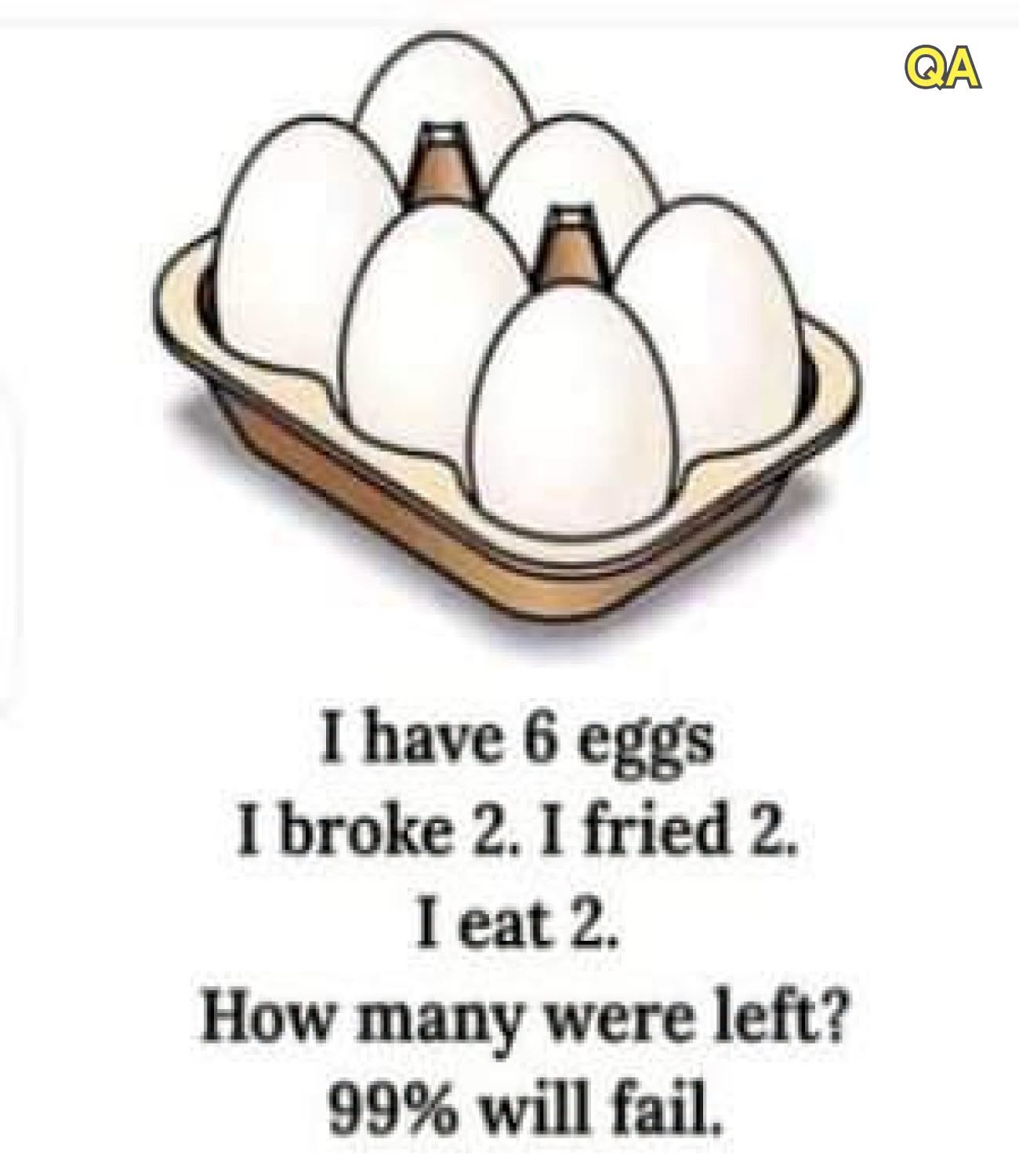
You Began with 6 Eggs

You began with 6 eggs.
You broke 2 eggs.
You fried 2 eggs.
You ate 2 eggs.
This short egg puzzle is a familiar example of a question designed to test careful reading rather than complicated mathematics. At first glance, the sequence may seem to require subtracting two eggs three separate times. That approach would suggest that no eggs remain. However, breaking and frying eggs do not necessarily remove them from the total number of eggs you possess. The key action that permanently reduces the number of eggs available is eating them.
The standard answer is that 4 eggs are left, assuming the two eggs that were broken were then fried and eaten. This is the most natural interpretation because an egg is normally broken before it is fried, and a fried egg is normally eaten afterward. The same two eggs can therefore be involved in all three actions.
Understanding the Six-Egg Puzzle
Word puzzles involving food, objects, or everyday activities often rely on the difference between an item’s condition and its existence. An egg can be intact, broken, cooked, or eaten. These descriptions do not all affect the count in the same way. Breaking an egg changes its physical state. Frying it changes its state again. Eating it is the step that removes it from the collection.
