

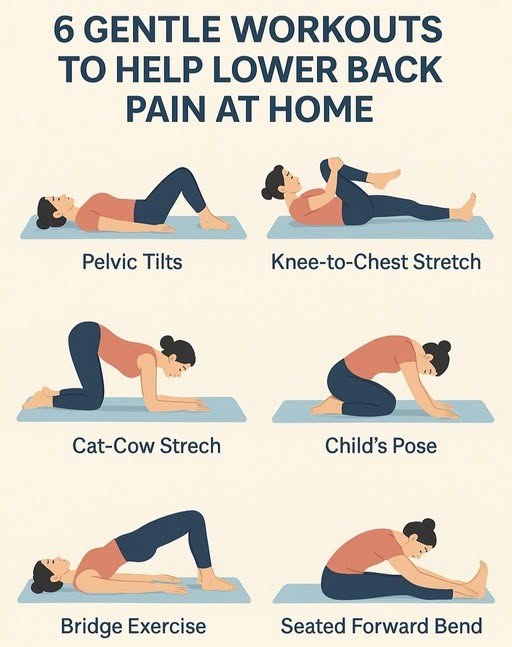
- Lie on your back with both knees bent.
- Slowly bring one knee toward your chest.
- Hold your thigh or shin and gently guide the knee closer.
- Hold for 15–30 seconds without forcing the movement.
- Lower your leg and repeat on the opposite side.
You can also bring both knees toward your chest if that position feels comfortable.
Why it may help: The movement stretches muscles around the hips and lower back. It may feel soothing for people whose symptoms improve with gentle forward bending.
3. Cat-Cow Stretch: Improve Spinal Mobility
The cat-cow stretch is a gentle movement that takes the spine through two comfortable positions.
How to do it:
- Start on your hands and knees.
- Place your hands beneath your shoulders and your knees beneath your hips.
- Slowly round your back upward, gently tucking your chin.
- Next, lower your abdomen slightly and gently lift your head and tailbone.
- Move slowly between the two positions.
- Repeat 8–10 times.
Why it may help: This movement encourages spinal mobility, warms up the back muscles, and may reduce stiffness.
4. Child’s Pose: Relax the Back and Hips
Child’s pose is a resting position that gently stretches the back and hips. It may be comfortable for people who tolerate forward bending.
How to do it:
- Begin on your hands and knees.
- Slowly move your hips backward toward your heels.
- Extend your arms forward.
- Lower your chest toward the floor as far as comfortable.
- Rest your forehead on the floor or a cushion.
- Hold for 15–30 seconds while breathing naturally.
Why it may help: This position provides a gentle stretch through the back and hips and may help some people relax tight muscles.
If kneeling is uncomfortable, use a cushion for support or skip this exercise.
5. Bridge Exercise: Strengthen Your Glutes
The bridge is a strengthening exercise rather than a stretch. It targets the gluteal muscles, which help control movement around the pelvis and hips.
How to do it:
