

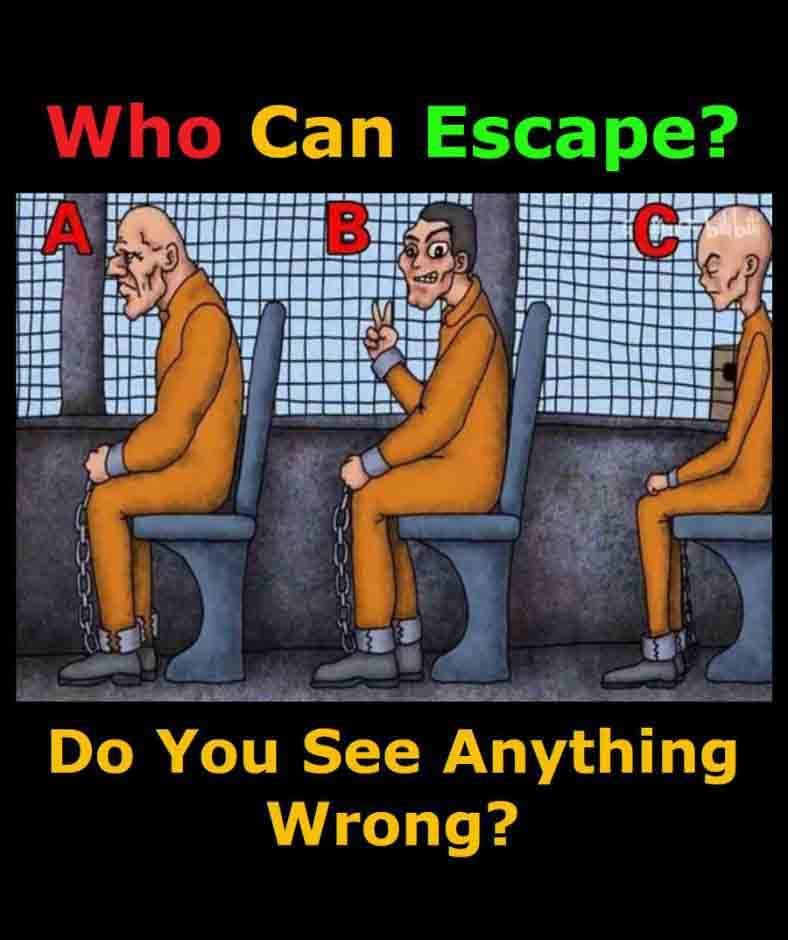
9. The Psychology of Visual Distraction
Visual distractions are not always obvious.
Sometimes an image contains a large, colorful object that attracts attention even though it has little relevance to the puzzle.
Designers use this technique to guide the viewer's gaze.
Bright colors, strong contrasts, unusual shapes, and human faces naturally attract attention. A puzzle may place these elements near the center of the image while hiding the important clue in a less noticeable area.
This does not mean every colorful object is a deliberate distraction. Some illustrations are simply crowded or poorly designed.
Still, it is useful to recognize how visual attention works.
When solving a puzzle, try looking beyond the most dramatic elements.
Examine the edges of the image. Check the background. Look at hands, feet, clothing, shadows, and the relationships between objects.
Sometimes the most important clue is not the object that attracts the most attention but the detail that appears almost insignificant.
10. Gestalt Principles: How the Brain Organizes What We See
The psychology of visual perception includes a group of ideas commonly known as Gestalt principles.
These principles describe how people naturally organize visual information into meaningful patterns.
Several are especially relevant to puzzles.
Figure and ground: We distinguish a main object from its background. Some hidden-object puzzles make this difficult by blending the target into the surrounding shapes.
Similarity: Objects that look alike are often perceived as belonging together. A puzzle may use this tendency to hide one object that differs slightly from the others.
Proximity: Objects positioned close together are often interpreted as a group. A visual puzzle may use spacing to suggest relationships that are not actually present.
Closure: The brain tends to complete incomplete shapes. This allows us to recognize familiar objects even when parts of their outlines are missing.
Continuity: We naturally follow lines and patterns that appear to continue in a particular direction.
These tendencies make visual perception efficient, but they can also lead us to interpret an image incorrectly.
For example, two overlapping lines may appear to form one continuous shape, even when they represent separate objects.
Understanding these principles can help explain why some visual riddles feel confusing even when the clues are visible.
11. Why Hidden Clues Are So Satisfying to Discover
There is a special kind of satisfaction that comes from finding a clue that was visible all along.
Before discovering it, the picture may seem confusing. Afterward, the answer can appear almost obvious.
This experience is sometimes described as an insight or an "aha" moment.
The solver suddenly connects pieces of information that previously seemed unrelated.
For example, a person may spend several minutes examining a picture without noticing an unusual sleeve. Once the clue is identified, the relationship between the clothing and the escape question becomes clear.
The pleasure comes partly from the change in understanding.
A difficult problem becomes manageable, and the solver experiences a sense of resolution.
This is one reason people enjoy riddles even when they do not have prizes or practical consequences.
The activity creates a small intellectual challenge followed by the satisfaction of understanding something that was initially unclear.
12. Patience Is an Important Part of Problem-Solving
Modern digital life encourages immediate responses.
We scroll quickly, switch between applications, and expect information to appear almost instantly. As a result, some people may find it uncomfortable to spend several minutes examining a single picture.
Puzzles encourage a different rhythm.
They invite us to stop, look carefully, and resist the temptation to choose the first answer.
Patience is particularly important when the clue is small or when the image contains several possible interpretations.
A useful approach is to divide the task into stages.
First, examine the overall scene. Then inspect individual characters or objects. Next, compare their relevant features. Finally, return to the question and evaluate the evidence.
This process may take longer than guessing, but it makes the reasoning more transparent.
Patience is also valuable in work, education, and relationships. Many problems become more manageable when people take enough time to understand the circumstances before responding.
13. How to Solve a "Who Can Escape?" Puzzle Step by Step
Although the exact answer to a visual puzzle depends on the illustration and its intended clues, there is a systematic method that can help.
Step One: Understand the Situation
Begin by identifying what the image represents.
Are the characters inside a room? Are they restrained? Are they standing near an exit? Are there objects that may help or prevent escape?
Avoid assuming that the scene is more complicated than it appears.
Step Two: Identify the Restrictions
Ask what is preventing each character from escaping.
Possible restrictions might include locked doors, physical restraints, limited movement, obstacles, or a lack of access to necessary objects.
The important point is to identify the actual barrier rather than focusing on superficial appearances.
Step Three: Examine Each Character Individually
Look at the characters one at a time.
Check their hands, clothing, posture, footwear, and relationship to nearby objects.
In a puzzle that uses clothing as a clue, pay attention to sleeves, cuffs, buttons, knots, and anything that appears unusually loose or secure.
