

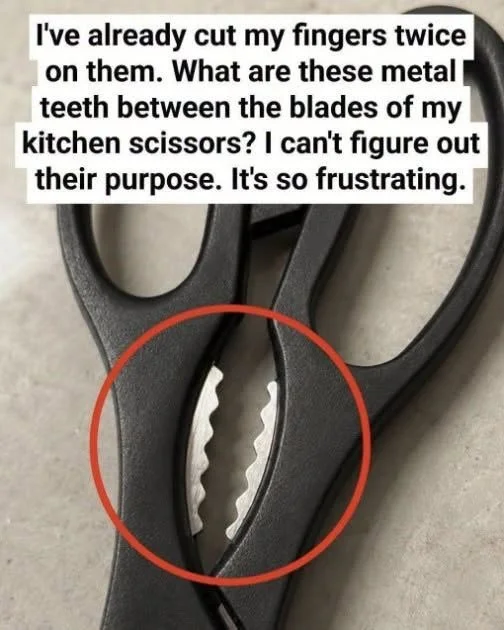
Kitchen scissors are a workhorse tool in any home, used for everything from snipping herbs to opening stubborn packaging. But if you look closely at the inner edge of the blades, just below the pivot point, you will often find a small, jagged section with a distinct row of metal teeth. For many people, this feature is a source of confusion and even frustration—a sharp, serrated ridge that seems to serve no obvious purpose and has a tendency to catch the skin. A viral post from a frustrated user who had cut their fingers twice on this very feature perfectly captures the common sentiment: what on earth is this toothed part actually for?
The answer is surprisingly practical, and once you understand it, the design of your kitchen scissors will suddenly make a lot more sense. That toothed section is not a manufacturing flaw or an accidental hazard. It is a highly specialized, multi-functional feature known as a bone notch, a crimper, or a screw-top gripper. Its primary purpose is to grip and hold slippery, hard-to-hold objects, allowing you to perform tasks that would be difficult or dangerous with a regular blade. Understanding its function can not only prevent accidental cuts but also unlock a range of clever kitchen hacks you never knew you were missing.
The Primary Purpose: Gripping Slippery Items
The toothed section is designed to act as a set of miniature pliers. When you close the scissors, the serrated teeth interlock, providing a secure grip on smooth, round, or slippery objects that would otherwise slide away from a smooth blade.
Opening Screw-Top Bottles
One of the most common and useful applications for this feature is opening tightly sealed screw-top bottles. Whether it is a bottle of wine, a jar of pasta sauce, or a new bottle of cooking oil, the rubberized or toothed grip of the scissors can provide the extra traction needed to break the seal. You simply clamp the teeth around the cap and twist. The serrations bite into the plastic or metal cap, allowing you to apply torque without your hand slipping. This is a particularly valuable hack for individuals with limited hand strength or arthritis, for whom opening jars can be a daily struggle.
Pulling Stubborn Corks
For those who enjoy a glass of wine, the toothed section can serve as an emergency corkscrew. If you find yourself without a proper corkscrew, you can use the teeth of the scissors to grip the cork firmly. By twisting and pulling simultaneously, you can often extract the cork without breaking it. It is not as elegant as a dedicated corkscrew, but it is a practical solution in a pinch.
