

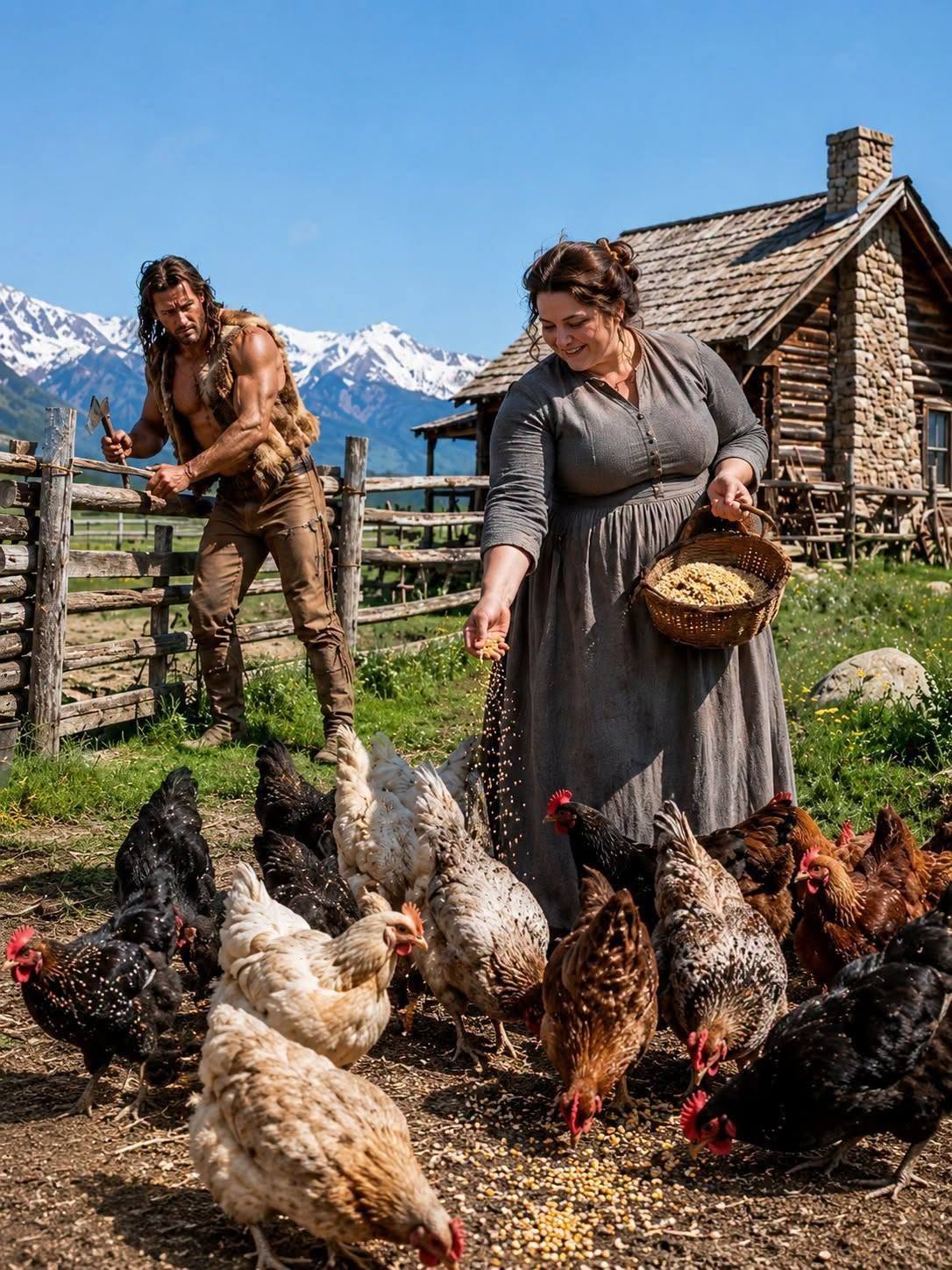
“We can begin small.”
He studied the catalog.
“What do you have in mind?”
Martha explained that the field could be divided into sections.
One would be planted with a hardy forage crop.
Another would be used for vegetables.
The remaining area would be allowed to recover through rotation.
They would need manure, compost, and careful water management.
Griffin listened.
Then he nodded.
“All right.”
Martha looked up.
“Just like that?”
“Just like that.”
She smiled.
“You’re becoming dangerously reasonable.”
“I’ve been spending too much time with a woman who keeps a ledger.”
They began preparing the field as soon as the ground softened.
Clara Bell helped them choose seeds.
Elias Boone offered advice about the best planting schedule.
Griffin built a simple irrigation channel from the repaired spring.
It was hard work.
But it was work with a purpose.
The ranch was becoming something more than a place where cattle survived until they could be sold.
It was becoming a small, diversified homestead.
Then, in early spring, the county court delivered its final judgment in the civil case.
Caldwell’s claims against the Broken Spur were dismissed.
The fraudulent loan was declared invalid.
The altered accounts were rejected.
And Griffin received a formal ruling confirming that the ranch belonged to him free of the disputed transfer.
Martha read the decision twice.
Then she placed it in the velvet ledger.
Griffin watched her.
“Is that the end?”
“Of this case, yes.”
“What about Caldwell?”
“The criminal charges remain.”
He nodded.
That afternoon, the two of them rode to the western pasture.
The creek had begun to run again.
It was not a strong stream, but the snowmelt had filled the shallow channel.
Griffin dismounted and stood beside the water.
His father had always said the creek was the heart of the ranch.
For years, Griffin had believed that heart had stopped.
Martha joined him.
“It is coming back,” she said.
“Slowly.”
“Most worthwhile things do.”
He looked at her.
“I have been thinking about something.”
“That sounds dangerous.”
“I want to change the ranch name.”
She raised an eyebrow.
“Why?”
“Because the Broken Spur sounds like a place that has already lost.”
Martha considered that.
“What would you call it?”
Griffin looked toward the hills.
“Maybe the Tucker Homestead.”
“That sounds rather ordinary.”
“Then you choose.”
She thought for a moment.
“Why not keep the name?”
“Broken Spur?”
“Yes. It reminds us what happened here.”
Griffin looked at the creek.
“And what should it remind us?”
“That something broken can still be useful. A broken spur can be repaired. A broken fence can be rebuilt. A broken business can be restored.”
She looked at him.
“And sometimes the things people consider worthless are simply waiting for someone to understand their value.”
Griffin smiled.
“Then the Broken Spur stays.”
When they returned to the cabin, a letter was waiting.
It came from Samuel Whitcomb.
Caldwell had agreed to a plea arrangement after the prosecution presented Sloan’s testimony and the original accounting records.
The criminal proceedings would continue under the terms of the agreement.
Caldwell would be required to repay victims, surrender properties acquired through fraudulent transfers, and serve a substantial period in prison.
Sloan had also agreed to cooperate and accept responsibility for his own role.
The prosecutor expected several other families to recover land or receive compensation.
Griffin read the letter slowly.
Then he looked at Martha.
“It is really happening.”
“Yes.”
“All those years.”
She closed the ledger.
“All those years.”
He reached for her hand.
“I wish my father could have seen this.”
Martha squeezed his fingers.
“I think he would have understood.”
That night, they sat together beside the kitchen stove.
Griffin had prepared supper.
It was not particularly good.
The potatoes were overcooked, and the bread was slightly burned.
Martha ate without complaint.
Then she looked at him.
“Are you trying to poison me?”
He laughed.
“I thought I was making dinner.”
“Then you should be grateful I have experience with difficult situations.”
He reached across the table.
She took his hand.
Outside, the wind moved gently across the pasture.
The cabin was still small.
The roof still needed work.
But the table was warm, the shelves were full, and the future no longer seemed like a debt waiting to be collected.
