

“I didn’t ask.”
Her expression softened.
“You may ask next time.”
He nodded.
“Then I will.”
She smiled.
It was a small moment.
But it mattered.
Three days later, Samuel Whitcomb arrived with more encouraging news.
The prosecutor had obtained additional documents from Caldwell’s office.
They included records showing that several foreclosure notices had been prepared before the borrowers had actually missed their payments.
Some had been sent to incorrect addresses.
Others had never been mailed.
The documents also showed that Caldwell had instructed Sloan to prepare duplicate loan agreements for selected properties.
One of those agreements was Griffin’s.
The criminal investigation was expanding.
But there was still a problem.
Everett Sloan remained missing.
Without him, Caldwell’s defense could argue that the fraudulent entries had been made by a dishonest employee acting independently.
Martha examined the records.
“Where did Sloan live?”
Whitcomb gave her an address in Laramie.
“His wife and children remain there, but he has not returned.”
Martha studied the documents.
“Does he have family elsewhere?”
“I don’t know.”
She looked again at the letter.
The date was September twenty-third.
The instruction referred to securing the Tucker deed before winter.
Then she noticed a small notation at the bottom.
A payment had been made to a freight company in Cheyenne.
The amount was exactly the cost of transporting a trunk and two passengers.
Martha tapped the page.
“Mr. Whitcomb, I believe Sloan has left the county.”
“Where would he go?”
“Wherever Caldwell sent him.”
She examined the freight receipt more carefully.
The destination was a railway depot in Denver.
Whitcomb immediately contacted the prosecutor.
An investigator was sent to Denver.
Three days later, Sloan was located in a boardinghouse.
He initially refused to speak.
But when he learned that Pike and Nora had testified, and that Caldwell was attempting to blame him for everything, he changed his mind.
Sloan agreed to return.
His testimony confirmed that Caldwell had personally ordered the false accounts.
He also admitted that he had prepared the forged loan agreement.
The case against Caldwell became much stronger.
But the banker was not the only person facing consequences.
Walter Hensley, the county recorder’s clerk, was investigated for accepting the disputed deed after the injunction.
He admitted that Caldwell’s cousin had promised him money to process the document quickly.
The filing was canceled.
Hensley resigned.
The county began reviewing other property transfers handled through the same office.
For the first time, Caldwell could no longer control every part of the process.
Then came the final confrontation.
One afternoon, Griffin was repairing a section of fence when he saw Caldwell riding toward the ranch.
The banker dismounted near the porch.
He looked older than he had a month earlier.
His expensive coat was dusty.
His expression was still hard, but the confidence had begun to fade.
“I want to speak with you.”
Griffin kept working.
“Then speak.”
Caldwell glanced toward the cabin.
“Alone.”
“No.”
The banker looked irritated.
“I have an offer.”
Griffin set down his hammer.
“What kind?”
“I will reduce your debt by half. You will withdraw your complaint, and we will put this business behind us.”
Griffin stared at him.
“You are still trying to buy your way out.”
“I am trying to prevent unnecessary damage.”
“To whom?”
“To everyone.”
Griffin shook his head.
“My father spent his final months believing he had failed this ranch. You made him think his work meant nothing.”
Caldwell said nothing.
“You took money from people who trusted you. You sold their cattle for less than they were worth. You changed their records and threatened their families.”
“Business is not a charity.”
“No. But neither is theft business.”
Caldwell stepped closer.
“Your wife has filled your head with foolishness.”
Griffin’s expression hardened.
“My wife helped me see what was right in front of me.”
He picked up the hammer.
“Now you can take your offer and leave.”
Caldwell mounted his horse.
“You will regret this.”
Griffin watched him ride away.
That evening, Martha found him sitting at the kitchen table.
“What happened?”
“He offered to forgive half the debt.”
“What did you say?”
“No.”
She nodded.
“Good.”
Griffin looked at her.
“Are you not going to ask whether I considered it?”
“I know you.”
He reached for her hand.
“I am beginning to think you know me better than I know myself.”
She smiled.
“That is because I keep the books.”
For the first time in years, Griffin laughed without bitterness.
Winter arrived early.
Snow covered the hills, and the nights grew bitterly cold.
The Broken Spur was not yet prosperous, but it was no longer collapsing.
The well had been repaired.
The fences were secure.
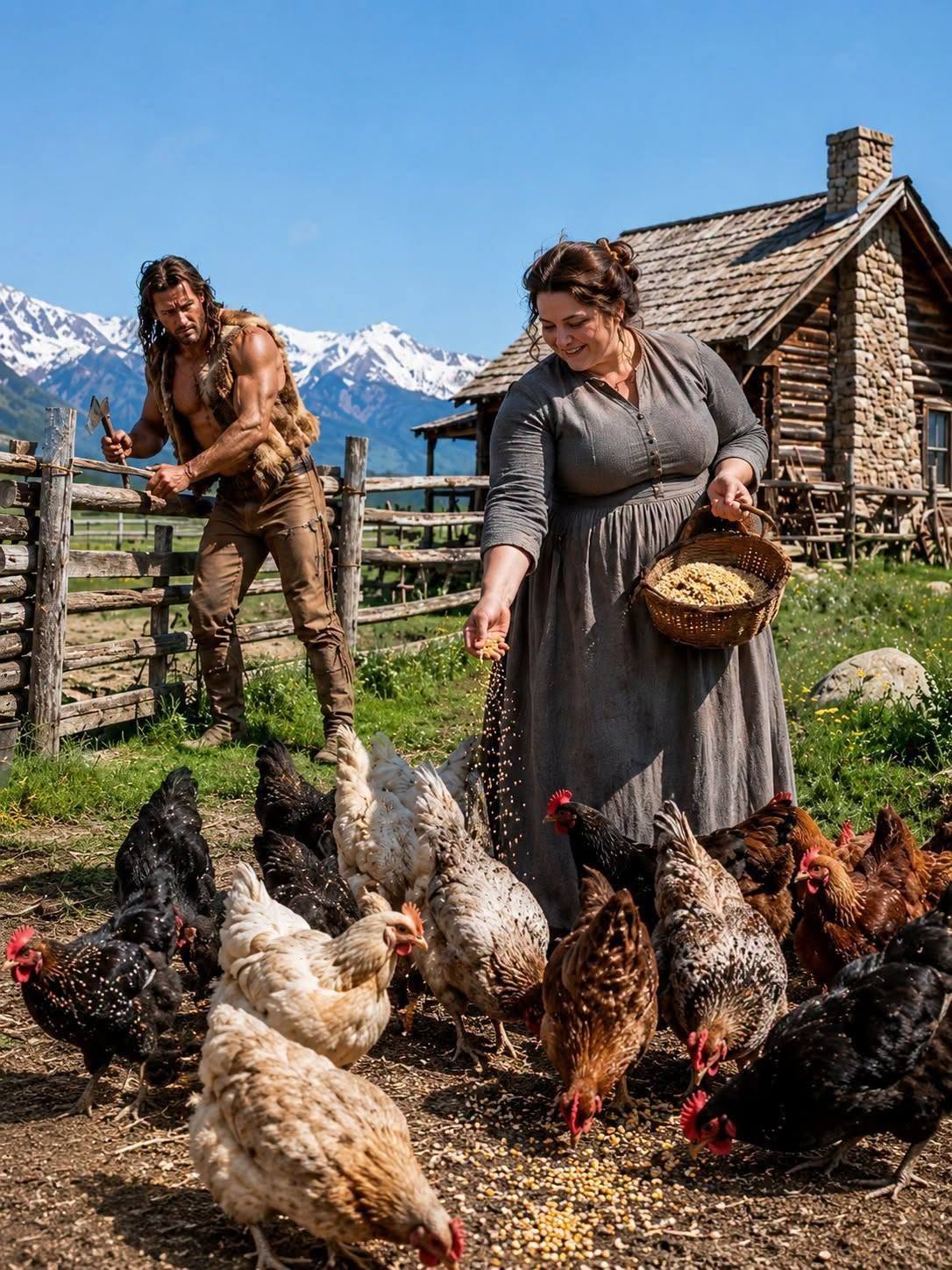
The chickens were healthy.
The dairy cow was producing enough milk for the household and a growing number of customers.
The cattle had been reduced to a manageable herd, and Griffin had negotiated a fair sale with an independent buyer in Cheyenne.
For the first time, he knew exactly how much money he would receive.
Martha recorded every payment.
She also helped the neighboring ranchers organize their own accounts.
Word spread that the woman with the velvet ledger could uncover mistakes that had cost families years of savings.
At first, people came only to ask questions.
Then they began bringing documents.
Martha never charged the poorest families for her help.
She simply asked them to bring every receipt they could find and tell the truth about what had happened.
Griffin sometimes joked that his wife had become the unofficial accountant of Laramie County.
Martha corrected him.
“Unofficial, perhaps. But certainly not unpaid.”
He laughed.
By December, the prosecutor had filed formal charges against Caldwell and Sloan.
The allegations included fraud, forgery, falsification of financial records, and attempted unlawful transfer of property.
Caldwell’s attorneys tried to delay the proceedings.
But the evidence was extensive.
Several former employees testified.
The shipping records were authenticated.
The bank confirmed that the alleged twelve-hundred-dollar loan had never been issued.
The county recorder’s office confirmed that the disputed deed had been submitted after the injunction.
The judge ruled that the original foreclosure claim against Griffin was invalid.
The unauthorized charges were removed from the account.
The disputed deed was voided.
Griffin’s property remained his.
The financial review also established that Caldwell had overcharged the Broken Spur by more than seven hundred dollars, in addition to the fabricated loan and other improper deductions.
The money was ordered credited back to the ranch.
But the victory did not restore everything.
The hay destroyed by the fire was gone.
Several cattle had died during the drought.
The northern pasture needed months of repair.
Griffin still had work ahead.
One morning, he found Martha in the barn examining the old seed catalog.
“What are you planning now?”
“Spring.”
“That is a broad subject.”
She showed him a page containing information about hardy grains and forage crops.
“I have been thinking about the eastern field.”
Griffin frowned.
“That field has never produced anything worth harvesting.”
“Because it has never been properly managed.”
“The soil is poor.”
“Then we improve it.”
“With what money?”
