

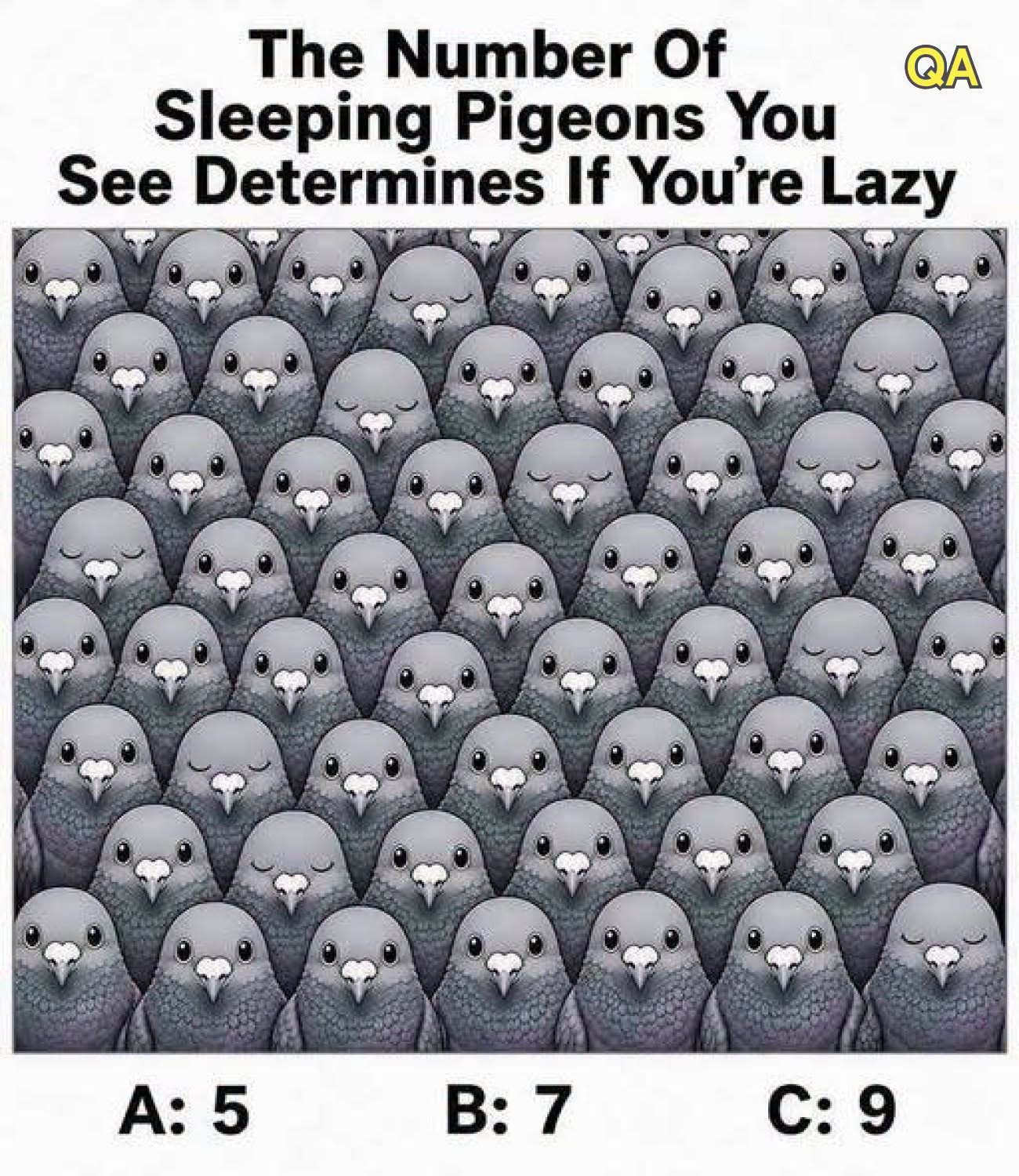
Some visual puzzles take only a few seconds to try, yet they can lead to surprisingly interesting conversations. A pigeon-counting image is a simple example: viewers look at the same scene, try to count the birds, and often report different numbers at first glance. One person may immediately identify five pigeons, while another notices seven or nine after a quick scan.
The appeal is easy to understand. These puzzles invite people to slow down, look again, and compare what they noticed. They can also offer a practical reminder that visual attention is selective. Human eyes may receive a large amount of information at once, but the brain does not consciously process every detail equally or at the same speed.
It is important, however, to keep the result in perspective. A pigeon-counting puzzle is not a scientific personality test, an intelligence assessment, or a diagnostic tool. Seeing a particular number first does not reveal a fixed trait, predict future success, or measure cognitive ability. It is best understood as a light observation exercise that illustrates how people can approach the same image in different ways.
How the Pigeon-Counting Visual Test Works
The basic instruction is straightforward: look at the image and ask yourself how many pigeons you noticed first. The first number that comes to mind may reflect the most visually prominent birds, the general pattern of the scene, or the area where your attention landed first.
Some viewers count the most obvious figures and stop. Others naturally scan from left to right, top to bottom, or around the edges of the image. A person may also notice shapes that overlap, blend into a background, or appear less distinct because of scale, contrast, shadows, or the quality of the screen.
For that reason, a second look frequently produces a different answer. This does not mean that the first answer was wrong in a meaningful personal sense. It simply shows that attention can shift. Once viewers know they are expected to find more birds, they often search more systematically and become more likely to identify smaller or less prominent elements.
Several ordinary conditions can influence what someone sees first:
- Image size and resolution on a phone, tablet, or computer screen
- Brightness, contrast, and ambient lighting
- Viewing distance and visual comfort
- The amount of time spent looking at the image
- Whether the viewer is distracted, tired, or in a hurry
- Previous experience with “find the object” or counting puzzles
These factors make visual puzzles entertaining, but they also explain why they should not be treated as formal tests. A standardized psychological assessment requires carefully designed tasks, consistent conditions, validated scoring, and expert interpretation. A social-media-style image puzzle does not provide those safeguards.
