

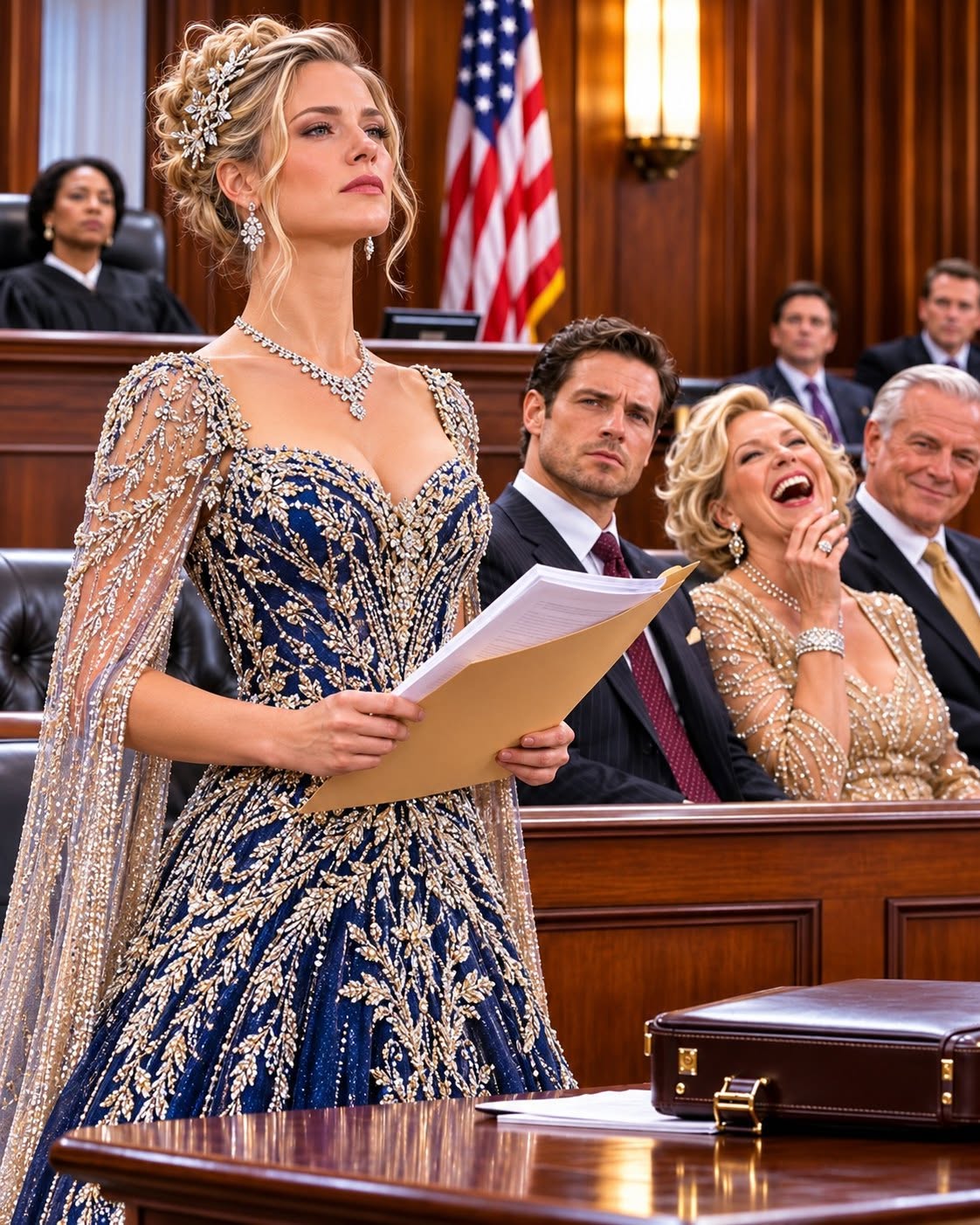
He looked toward the courtroom doors.
“Because I was afraid it would take too long.”
“To do what?”
“To settle the divorce.”
“And you thought the best way to make it faster was to pretend I had agreed?”
“I didn’t think of it like that.”
“How did you think of it?”
He looked down.
“As one more thing we could correct once the rest was handled.”
I felt the old reflex rise in me, the impulse to help him find a cleaner explanation.
I let it pass.
“Did Ruth tell you to use my signature?”
“No.”
“Did she know the agreement had been filed?”
“She knew I wanted to protect the house.”
“That is not what I asked.”
“I don’t think she knew about the signature.”
He spoke carefully, but this time there was no attempt to hide behind his mother.
“I was the one who wanted the quick settlement,” he said. “I was the one who believed if I could keep the numbers simple, no one would have to look at everything.”
“No one?”
“You. My parents. Me.”
“You thought I was dangerous because I would notice what you left out.”
“I thought you would see everything I had failed to do.”
“That isn’t dangerous.”
“I know that now.”
The courtroom doors opened.
Calder stepped into the corridor with a folder in his hands and asked Andrew to speak with him.
Andrew looked at me once before he went.
I could not read the expression on his face.
It might have been apology.
It might have been fear of what the documents would confirm.
Judge Porter entered a few minutes later and called us into the courtroom.
Calder stood beside Andrew, the file laid open before him.
He looked older than he had at the first hearing, though nothing about his appearance had changed.
“Your Honor,” he began, “after reviewing the materials produced by Mrs. Ellison and comparing them with our records, my office has identified serious concerns about the agreement that was filed.”
Judge Porter waited.
Calder swallowed.
“I was aware that Mrs. Ellison had not approved the terms.”
The words fell into the room with a quiet finality.
Andrew turned toward him.
Calder did not look back.
“I should not have allowed the agreement to be submitted as executed without confirming her authorization,” he said. “I am withdrawing as counsel and will provide the court with the complete file, including all drafts and communications.”
Judge Porter’s expression remained measured.
“Did you knowingly submit a document bearing a forged signature?”
“I cannot make that determination without a formal examination of the original,” Calder said. “But I acknowledge that I received a communication stating Mrs. Ellison had not approved the agreement, and I failed to resolve that conflict before the filing.”
The admission made my fingers curl against the edge of the table.
Judge Porter asked that the original agreement be placed under seal for examination.
She also instructed Calder to preserve all electronic files and to provide a complete chronology of the agreement’s preparation.
Then she looked at Andrew.
“Mr. Ellison, did you authorize anyone to sign this document on your wife’s behalf?”
“No, Your Honor.”
“Did you authorize anyone to copy her signature onto the agreement?”
“No.”
“Did you know the agreement was being filed as signed?”
“I believed it had been signed.”
“Even after telling your attorney that Mrs. Ellison had not approved the terms?”
Andrew closed his eyes briefly.
“I believed she might have signed the final version after we last spoke.”
“Did she tell you that?”
“No.”
“Did you ask her?”
“No.”
Judge Porter let the answer stand.
She did not raise her voice or offer judgment.
She simply wrote something down, and the scratch of her pen sounded heavier than any reprimand.
The court ordered the parties to provide full financial records and directed the clerk to arrange for examination of the original signature page.
The hearing ended without a ruling about who had placed the signature on the agreement.
Outside the courtroom, Calder approached me.
“Mrs. Ellison, I owe you an apology.”
I waited.
“I received clear information that you had not approved the terms,” he said. “I should not have allowed the document to be filed as completed without speaking to you directly.”
“Why didn’t you?”
“I trusted the information that the signed page had been obtained after the draft was prepared.”
“But you had been told I had not approved it.”
“Yes.”
“Did you ask Andrew who signed it?”
“I asked whether the parties had finalized the terms. He said he believed you had.”
“Did you ask to speak to me?”
“No.”
The answer was simple.
It carried the same weight as every other time someone had decided what I knew or wanted without asking me.
“I understand you’re withdrawing,” I said.
“I am.”
“Are you cooperating with the court?”
“I will provide everything requested.”
He sounded ashamed, but shame could not tell me whether he had finally understood what he had done.
“I’m sorry,” he said again.
I nodded once.
“I’ll read whatever you submit.”
Calder stepped away.
Andrew remained near the hallway window, watching the daylight shift across the courthouse floor.
“Was it you?” I asked.
“Was what me?”
“The signature.”
“No.”
“Do you know who copied it?”
“No.”
“Do you know how they got the old form?”
He looked toward the courtroom, then back at me.
“I sent that form to Mom years ago.”
“I found the email.”
“I didn’t know she kept it.”
“Do you think she used it?”
“No.”
“You answered quickly.”
“Because she wouldn’t.”
“Wouldn’t she?”
“I don’t know,” he said. “I don’t want to believe she would.”
That was not the same as knowing.
I held the folder against my side.
“Did she ever talk to you about the agreement?”
“She told me not to bring you into the financial problems.”
“That is what you told me before.”
“There’s more.”
He looked exhausted, his shoulders held in place by habit rather than confidence.
“Tell me.”
“She said you would see the whole situation clearly and realize how badly we had handled it.”
“Ruth said that?”
“She said you would know what the accounts meant.”
“And what did you think that meant?”
“I thought you would look at the debts, the care payments, the house, and the settlement and understand there was no safe way through.”
“You thought I would leave.”
“I thought you might.”
“So you tried to make a decision for me before I could make one for myself.”
“Yes.”
The answer came without qualification.
For the first time in weeks, I believed he had heard the question.
“You were afraid I would see that your family was in trouble,” I said. “You did not consider that I might have helped.”
“I should have.”
“Instead, you used my past as a reason to keep me outside the truth.”
“I know.”
“Did you ever think that I might have stayed because I loved you, not because I failed to notice things?”
His eyes met mine.
“I did.”
“And then you chose not to trust it.”
“Yes.”
He did not ask me to forgive him.
That was a small mercy.
We stood together in the corridor, separated by the width of an arm and the weight of seven years.
The family’s financial trouble might have begun with care bills, fear, and an old house they wanted to protect.
The forged signature was something else.
It was a choice made by someone, and the court still had to find out who.
I looked at Andrew and saw the person I had married beneath the man who had tried to settle our life without my consent.
I could still feel affection for him.
I could no longer confuse affection with trust.
“I’ll give the court everything I have,” I said.
“I know.”
“And you need to do the same.”
“I will.”
“Not only what helps your parents.”
“Everything.”
He nodded, then took a step back.
I watched him leave with the empty space at his side where his attorney had stood only that morning.
When I returned home, the appointment book remained open on the dining table.
Ruth’s note was still visible beneath Andrew’s, two sentences written years apart and carrying the same fear.
Mara must not be involved.
Don’t tell Mara until it’s settled.
I turned the pages carefully, looking for anything else that might explain how the agreement had come to carry my signature.
Near the back, a folded sheet had been tucked into the binding.
It was a printout of an email chain, its edges worn as if it had been handled several times.
The first message was from Ruth to Andrew, dated the week before Calder sent the draft agreement.
I started reading.
I know you want to protect the house, it began.
But Mara must not find out how close we are to losing it until everything is settled.
Andrew’s reply appeared beneath it.
She already knows something is wrong.
Then Ruth had written one final line.
If she sees the real numbers, she will leave before we can save anything.
I read the words again, feeling the ground shift beneath the story I had been telling myself.
At the bottom of the printout, someone had added a handwritten note in the margin.
I recognized Ruth’s handwriting at once.
Use the old signature page only if the agreement cannot wait.
My phone rang before I could move.
Ruth’s name appeared on the screen.
I looked from the note to the phone, then answered.
“Ruth,” I said, “what does this mean?”
For a moment, there was only silence.
