

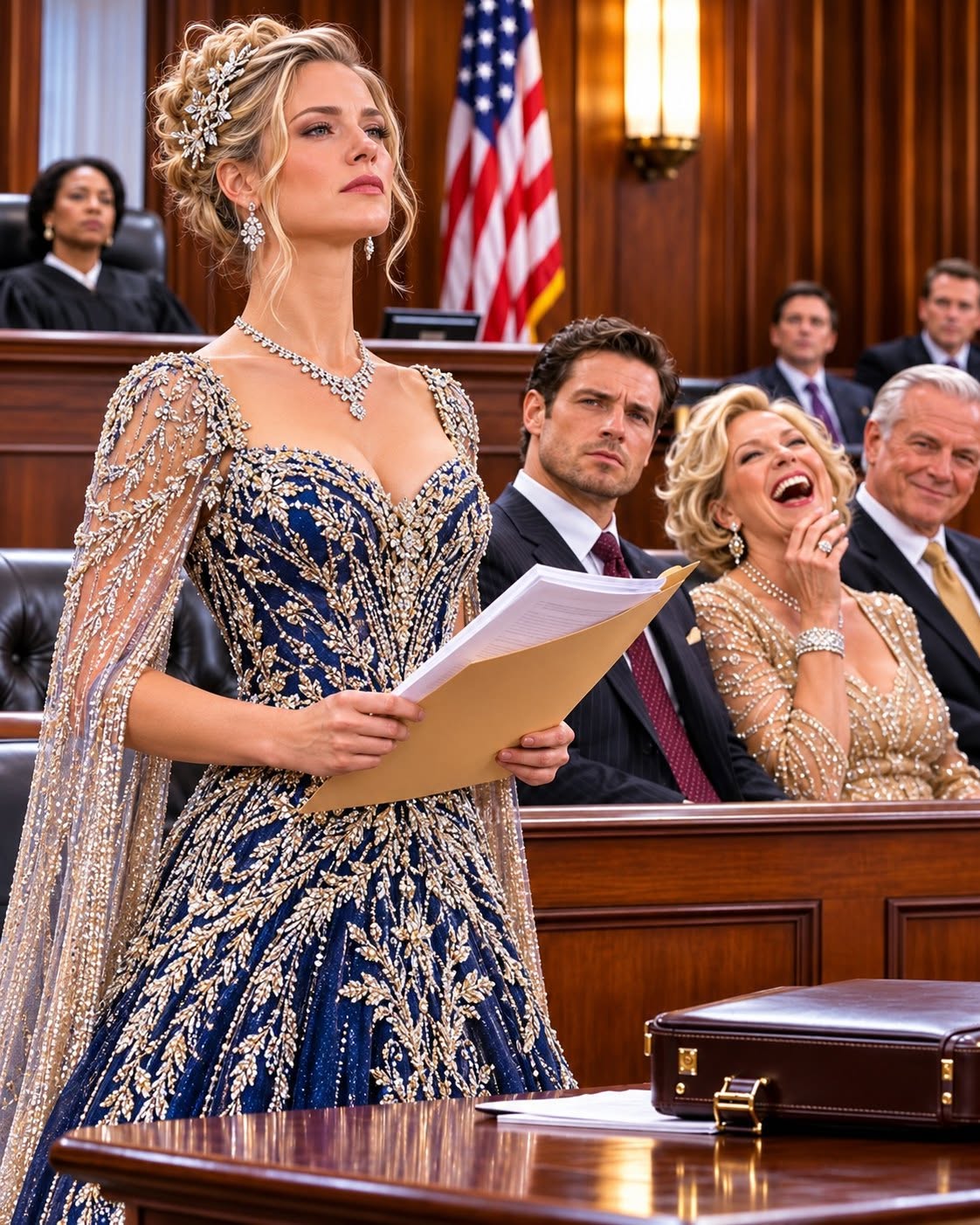
A sad, almost grateful expression crossed her face.
“I’ve been thinking about what you said,” she continued. “About being useful and being welcome.”
I waited.
“I thought if I thanked you, I had treated you well.”
“Those are not the same thing.”
“No. They aren’t.”
She turned the bag in her hands.
“I made Andrew believe the family would fall apart if you knew the truth. I thought I was protecting him and Frank. I didn’t understand that I was asking him to protect us by making you smaller.”
The words came slowly, as if she had to set each one down and leave it there.
“I don’t know if you can forgive me,” she said.
“I’m not ready to answer that.”
“I understand.”
“Ruth, whether I forgive you or not, you still need to tell the truth about the agreement.”
“I will.”
“And you need to stop making decisions about what I can handle.”
“I will.”
I could see the effort it took her not to ask me to make the moment easier.
She did not ask.
That was something.
Andrew came down the corridor with a new folder under his arm.
When he saw us, he stopped.
Ruth moved a step aside, leaving room between them.
“I told the court I knew you hadn’t approved the terms,” he said to me. “I told them I let the filing go forward because I thought it could be corrected later.”
“Did you tell them you believed the signature was real?”
“Yes. I also said I never asked you to sign it and never authorized anyone to copy it.”
“Did you tell them you sent the household file to your mother?”
“Yes.”
“What did the court say?”
“They said the document examiner will need the original materials and a complete chain of custody.”
“And?”
“I’ll provide everything I have.”
He glanced toward Ruth.
She did not look away.
For a moment, I saw how much the two of them wanted me to decide which one to blame.
It would have been easier to give them an answer.
It would have let them arrange themselves around my judgment, one guilty and one forgiven, while I carried the rest.
“I’m not going to decide what happened based on who is most afraid,” I said.
Andrew lowered his gaze.
“I understand.”
“Do you?”
“Yes.”
“I will cooperate with the examination. I will ask for a fair division. I will not pretend the agreement was a mistake that hurt no one.”
“I know.”
“And I am not going to promise that there will be no consequences.”
“I’m not asking you to.”
His voice was quiet, and he sounded as though he meant it.
Ruth’s fingers tightened around the bag.
“I’m sorry,” she said.
I looked at her.
“I know.”
“That doesn’t mean it’s all right.”
“No.”
The words sat between us without being softened.
A clerk passed through the corridor carrying a stack of files, and the ordinary motion reminded me that the courthouse did not pause for any family’s grief.
I gathered my papers and began walking toward the exit.
Andrew did not follow.
Ruth did not call after me.
That restraint felt more respectful than any promise they had made.
Outside, the afternoon was bright and cold.
I stood on the courthouse steps with the folder held against my chest and considered what I wanted the next year of my life to look like.
I did not want revenge.
I did not want the court to turn my pain into a weapon someone else could wield on my behalf.
But I also did not want a gentle ending purchased with my silence.
The distinction had taken me a long time to understand.
Choosing not to pursue the harshest penalties would not mean the signature did not matter.
It would mean I had decided what I wanted the law to accomplish, rather than letting anger decide for me.
I could ask for full disclosure, an equitable division, and a written acknowledgment that Andrew had let a false agreement be presented in my name.
I could require him to tell Frank and Ruth what the accounts actually showed.
I could leave the marriage without declaring the betrayal forgiven.
When I returned home, I sat at the dining table and opened a blank document.
For nearly an hour, I wrote and rewrote the terms I believed I could live with.
I asked for all financial records, including the statements for the account used to pay Frank’s care.
I asked for a fair division of the marital assets based on complete disclosure.
I asked that the agreement filed under my name be formally rejected and that any new agreement be signed in person after independent review.
I asked Andrew to acknowledge in writing that I had not signed the original and that he had failed to stop it from being submitted.
I added that he must explain the family’s financial situation directly to his parents, without asking me to soften or carry the message.
Then I wrote one final paragraph.
I would not ask the court to pursue the harshest available penalties if the parties fully cooperated, the false agreement was withdrawn, and every term was corrected with no further concealment.
My hands rested on the keyboard.
It was not absolution.
It was a boundary with a door in it, though I did not know whether anyone would walk through.
The next morning, I sent the draft proposal to the court’s facilitator and copied the new attorney Andrew had retained.
Then I printed it, signed the cover page, and placed the original in my folder.
There was one more thing I needed to do.
I called Frank and Ruth together.
Frank answered first, his voice rough with fatigue.
“Is everything all right?”
“I’m not sure yet,” I said. “But I need both of you to hear what I’m asking Andrew to do.”
Ruth came on the line, and I explained the terms.
I did not tell them I was trying to save the family.
I did not tell them I had forgiven anyone.
I told them I wanted a fair settlement, complete records, and the truth spoken plainly.
Frank was quiet.
Ruth said, “Andrew should have done that without you asking.”
“Yes.”
“He will,” Frank said. “I’ll make sure he understands.”
“You shouldn’t have to make sure.”
“No,” he replied. “I suppose I shouldn’t.”
When I ended the call, Andrew’s new attorney sent a message asking whether I could attend a meeting that afternoon.
I agreed.
The meeting took place in a small conference room at the courthouse, with the facilitator, Andrew, his attorney, and me.
Ruth and Frank were not there.
Andrew had brought a box of statements, tax records, and receipts from the care provider.
The box was labeled in his handwriting.
For the first time, he had gathered the records instead of asking me to do it.
We reviewed the account transfers one by one.
The money had gone to Frank’s care, as Andrew had said.
The statements also showed that the payments had strained the shared account more than he had admitted.
Several bills had been paid late.
A small credit balance had grown larger.
The house was not in immediate danger of foreclosure, but the family had been closer to financial trouble than Ruth had allowed herself to say.
No hidden wealth waited beneath the transactions.
No simple answer made the secrecy harmless.
The facilitator read my proposal aloud, pausing at the paragraph about the penalties.
Andrew listened without interrupting.
When she finished, he turned toward me.
“I can agree to the disclosure and the fair division,” he said. “I can write the acknowledgment.”
“Can you tell your parents the full numbers?”
“Yes.”
“Without blaming the care costs, me, or the court?”
“Yes.”
“Can you state plainly that you let the agreement be filed even though you knew I had not approved it?”
He looked down at the page.
Then he looked back at me.
“Yes.”
The facilitator asked whether he accepted the condition that the original agreement be formally rejected and replaced only after complete disclosure.
“I do,” he said.
I waited for the relief I thought I might feel.
It did not come.
Instead, there was a quiet sadness, like the last light leaving a room that had already been empty for some time.
The facilitator asked whether I wished to proceed under the proposed terms.
“I do,” I said. “But I am not agreeing that the signature question is settled.”
“Understood,” she replied.
Andrew’s attorney wrote that qualification into the meeting notes.
Andrew signed beneath it, his own name clear and unhurried.
For a moment, I watched the pen lift from the paper.
The whole meeting seemed to narrow to that simple movement.
A real signature.
A visible choice.
An acknowledgment that words put on paper could not be treated as a substitute for consent.
The facilitator collected the pages.
“We’ll prepare a revised draft based on these terms,” she said. “The court will review the examiner’s report before the next hearing.”
Andrew closed the box of records.
“I’m going to tell my parents tonight.”
“Tell them everything,” I said.
“I will.”
“Even if the truth makes them angry?”
“Yes.”
“Even if they ask you to keep it quiet?”
He paused.
“Yes.”
That answer might have come too late to save our marriage.
It did not come too late to matter.
I stood, gathering my folder.
Andrew remained seated.
“I don’t expect you to forgive me,” he said.
“Then don’t ask me to.”
“I won’t.”
“I need you to understand that choosing a negotiated resolution is not the same as saying you did nothing wrong.”
“I understand.”
“And I’m not doing this to protect you from embarrassment.”
“I know.”
“I’m doing it because I want the settlement to tell the truth and because I don’t want revenge to decide my life.”
He nodded.
“I’m sorry I made you carry all of this alone.”
For once, I did not answer with comfort.
“I was alone in it,” I said. “That’s true.”
He accepted the sentence.
We left the conference room in separate directions.
At home, I placed the signed meeting notes beside the old appointment book.
Ruth’s note remained visible: Mara must not be involved.
Beside it sat Andrew’s handwritten line: Don’t tell Mara until it’s settled.
I had begun to think of both sentences as the beginning of the agreement, though neither one proved who had assembled my signature page.
The next day, the court clerk called.
“The examiner has finished the initial comparison,” she said. “Judge Porter has received the report.”
“Can you tell me what it says?”
“I’m not authorized to interpret it, but the report identifies a second source document that appears to have been used when the signature block was assembled.”
My hand tightened around the phone.
“What second source?”
“There’s a page in the file that appears to have been printed from a household scan, not from the emergency contact form you provided.”
“What page?”
“I can only tell you that Judge Porter has asked everyone to attend a hearing tomorrow.”
“Did the examiner identify who made the scan?”
“Not yet.”
The call ended, and I sat down slowly.
Andrew had agreed to the settlement terms.
Ruth had admitted writing the note.
Calder had withdrawn and surrendered his file.
The court had preserved the original agreement.
Still, some part of the signature trail remained unknown.
The next morning, Judge Porter began by confirming that the financial settlement could proceed on the corrected terms, subject to final review.
Then she held up a page from the examiner’s report.
“The signature on the agreement appears to have been copied from a household document,” she said. “But it was not copied directly from the emergency contact form Mrs. Ellison provided.”
My mouth went dry.
Andrew looked at Ruth.
Ruth stared at the page.
Judge Porter continued.
“The source appears to be a second scan, made several years later and retained with the financial records.”
She turned to the clerk.
The clerk placed a copy in front of me.
I recognized the page before I read the heading.
It was a household form I had filled out for Andrew, one he had asked me to complete because he said he needed to keep our records in order.
At the bottom, beside a list of accounts and emergency contacts, was my signature.
Above it, in Andrew’s handwriting, was a note I had never seen before.
If we ever need to move quickly, use this page.
Andrew’s face drained of color.
But Ruth was the one who whispered, “That isn’t the note I wrote.”
