

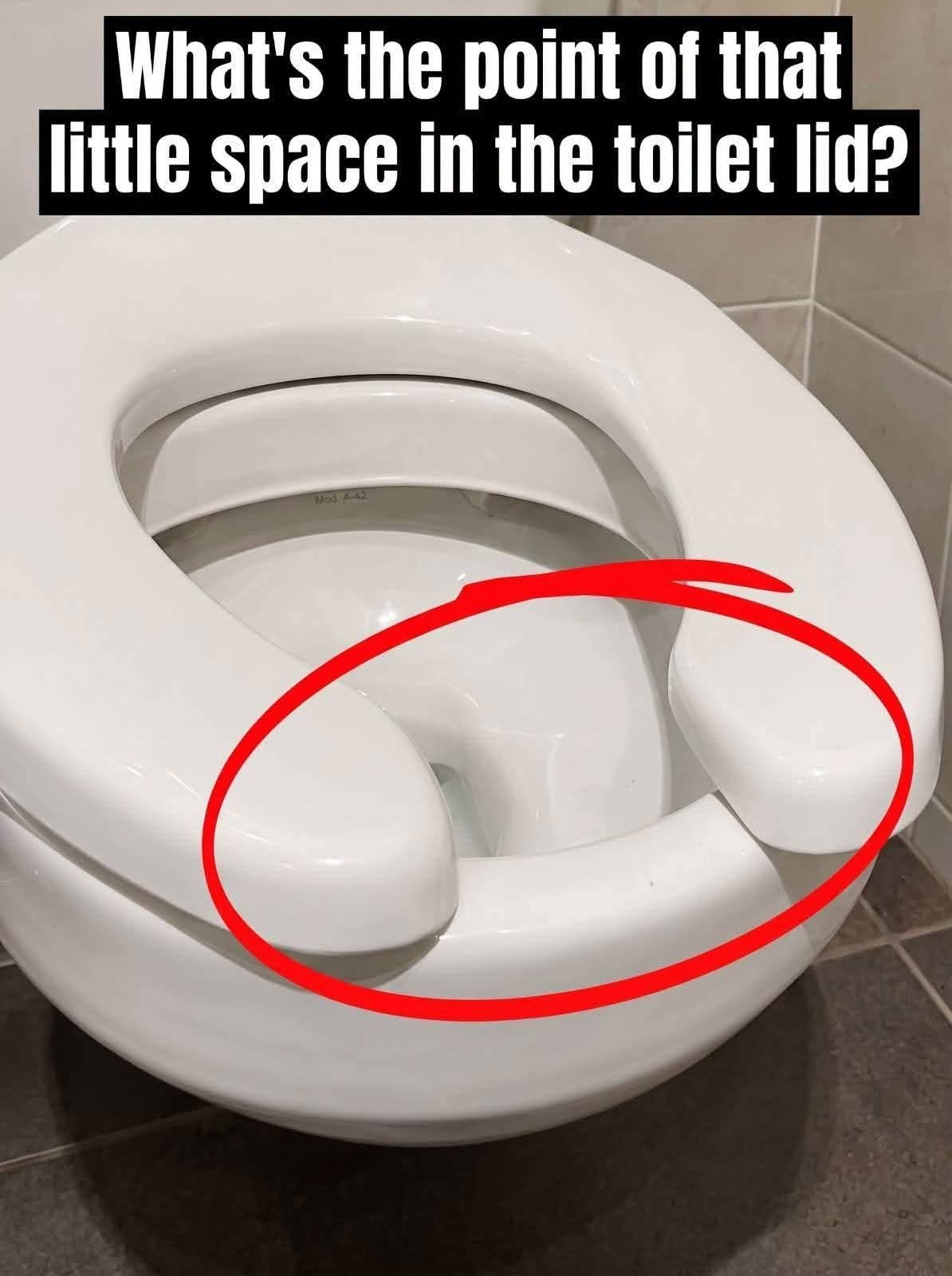
This is where things get a little more complicated.
You may have heard that public bathrooms are required by law to use open-front toilet seats.
That’s not a universal rule everywhere.
Building, plumbing, accessibility, and sanitation requirements vary by country, state, province, municipality, and type of facility.
Some plumbing codes and standards have historically included requirements or recommendations concerning open-front seats in certain public or institutional settings.
But you shouldn’t assume that every public restroom in every location is legally required to have one.
That’s why you’ll occasionally find closed-front seats in public bathrooms too.
The important distinction is between a design commonly used or required in particular settings and a universal law applying everywhere.
Why Don’t Most Homes Have U-Shaped Seats?
Now we get to the really interesting part.
If open-front seats have practical advantages, why don’t we see them in most homes?
Because residential bathrooms have different priorities.
At home, there’s generally a smaller number of users.
The toilet isn’t being used continuously by strangers throughout the day.
Homeowners also tend to choose bathroom fixtures based on:
- Comfort
- Appearance
- Personal preference
- Cost
- Ease of installation
- Matching bathroom décor
And many people simply prefer the traditional closed oval design.
So a household toilet seat doesn’t need to prioritize the same institutional concerns as a heavily used public restroom.
Why Are They So Common in Public Bathrooms?
Think about what a public restroom has to deal with.
A family bathroom might be used by a handful of people each day.
ADVERTISEMENT
A busy airport bathroom could be used by an enormous number of travelers.
A restaurant bathroom might see constant use during dinner service.
A school restroom may need to withstand years of heavy use.
That means public fixtures are designed with durability, maintenance, sanitation, and standardized replacement in mind.
The open-front toilet seat fits naturally into that environment.
ADVERTISEMENT
It’s a small design choice, but small design choices can become incredibly important when something is used thousands of times.
The U-Shape Isn’t Actually About Plumbing
Despite how closely the seat is associated with public bathrooms, the shape isn’t primarily a plumbing feature.
The toilet bowl underneath can generally be the same basic type you’d see with a conventional seat.
The difference is the seat design.
So if you see a U-shaped seat, don’t imagine that the toilet itself has some special plumbing system hidden underneath.
The opening is primarily about the seat and how people interact with it.
