

“She’s still my mother,” she told me. “Love is not always easy, Clara. Sometimes it is simply choosing not to leave.”
My grandmother died three years before my mother.
Her will had caused an enormous family dispute.
Most of her visible property had been divided among distant relatives and charitable organizations.
There were rumors that she had hidden money elsewhere, but nothing was ever found.
After months of searching and arguing, everyone eventually gave up.
Everyone except my mother, perhaps.
Sitting on the couch with the shawl around my shoulders, I began wondering whether it had belonged to my grandmother before it belonged to Mother.
I checked the edges and found a tiny stitched letter near one corner.
An “E.”
Eleanor.
I had never noticed it before.
I traced the letter with my finger.
For the first time, the shawl did not feel like an insult.
It felt like a question.
Still, I had no idea how important that question would become.
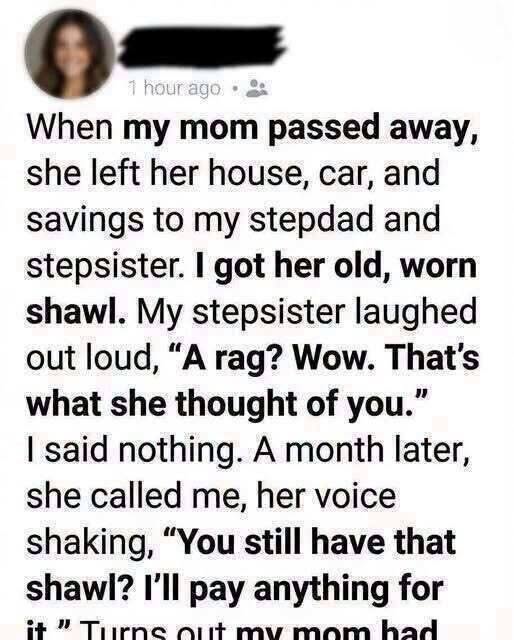
Nearly six weeks passed before Lila called me.
She had not spoken to me since the will reading.
When I answered, her breathing sounded rapid and uneven.
“Do you still have it?”
I frowned.
“Have what?”
“The shawl.”
Her voice was so urgent that I sat up straighter.
“Yes.”
“Where is it?”
“At my house.”
“Is it safe?”
I looked toward the bedroom, where I had placed it over the back of a chair.
“Why wouldn’t it be?”
There was a pause.
Then Lila spoke in a much calmer tone, though I could hear the strain beneath it.
“I’ve been thinking about what I said at the lawyer’s office. It was cruel. I was emotional.”
“You were laughing.”
“I know, and I regret it.”
Lila rarely apologized.
When she did, there was usually a reason.
“What do you want?”
“I want to buy the shawl.”
I almost laughed.
“What?”
“I’ll give you five thousand dollars.”
I thought I had misheard her.
“For Mother’s old shawl?”
“Yes.”
“Why?”
“It has sentimental value.”
“To you?”
“Of course.”
“You called it an old blanket.”
“I was upset.”
I remained silent.
Her breathing grew louder.
“Fine,” she said. “Ten thousand.”
My skin prickled.
“Lila, what is going on?”
“Nothing is going on. I just want something that belonged to Mother.”
“You inherited her entire house.”
“I want the shawl too.”
“No.”
The answer came instinctively.
She had mocked it.
She had mocked me.
Now she wanted to purchase it for more money than I earned in several months.
That meant she knew something.
“Twenty-five thousand,” she said.
I stood up.
“What did you find out?”
“Clara, don’t be ridiculous.”
“What did you find out?”
She became quiet.
Then she hung up.
Less than an hour later, someone knocked on my door.
It was not Lila.
It was the family lawyer.
Mr. Bennett stood on my porch holding a leather briefcase.
“I apologize for arriving without an appointment,” he said. “May I come inside?”
I let him in.
He sat at my kitchen table and looked unusually serious.
“Your sister contacted me yesterday.”
“I assumed she had.”
“She asked several questions about your grandmother’s estate.”
