

“More than once.”
Pike explained that Caldwell had instructed employees to record cattle weights lower than the actual amounts.
The difference was divided between Caldwell’s office and the buying operation.
He also admitted that several loan statements had been altered.
“Why didn’t you report it?” Martha asked.
Pike looked at the floor.
“I was afraid. My wife was ill. Caldwell knew where my children went to school. He told me if I talked, I would lose my job and never work in this county again.”
“Did you alter the records yourself?”
Pike closed his eyes.
“Sometimes. Not always. I was told what numbers to write.”
“Who gave the instructions?”
“Mr. Caldwell’s accountant. A man named Everett Sloan.”
Martha wrote the name down.
“Would you testify?”
Pike stared at her.
“I don’t know.”
Griffin leaned forward.
“My father lost years of his life because of what these men did.”
Pike’s face tightened.
“I know.”
“Then help us.”
The older man remained silent.
Finally, he opened a drawer and removed a small envelope.
Inside were copies of several original cattle shipping records.
“I kept these after I left.”
Martha took them carefully.
“Why?”
“Because I thought someday someone might ask the right questions.”
He also gave them the name of another employee who had witnessed the falsified entries.
A bookkeeper named Nora Bell.
By the time they left Cheyenne, they had more than numbers.
They had witnesses.
But Caldwell was not finished.
That evening, Griffin and Martha returned to the Broken Spur to discover that the barn door had been forced open.
Several sacks of feed had been torn apart.
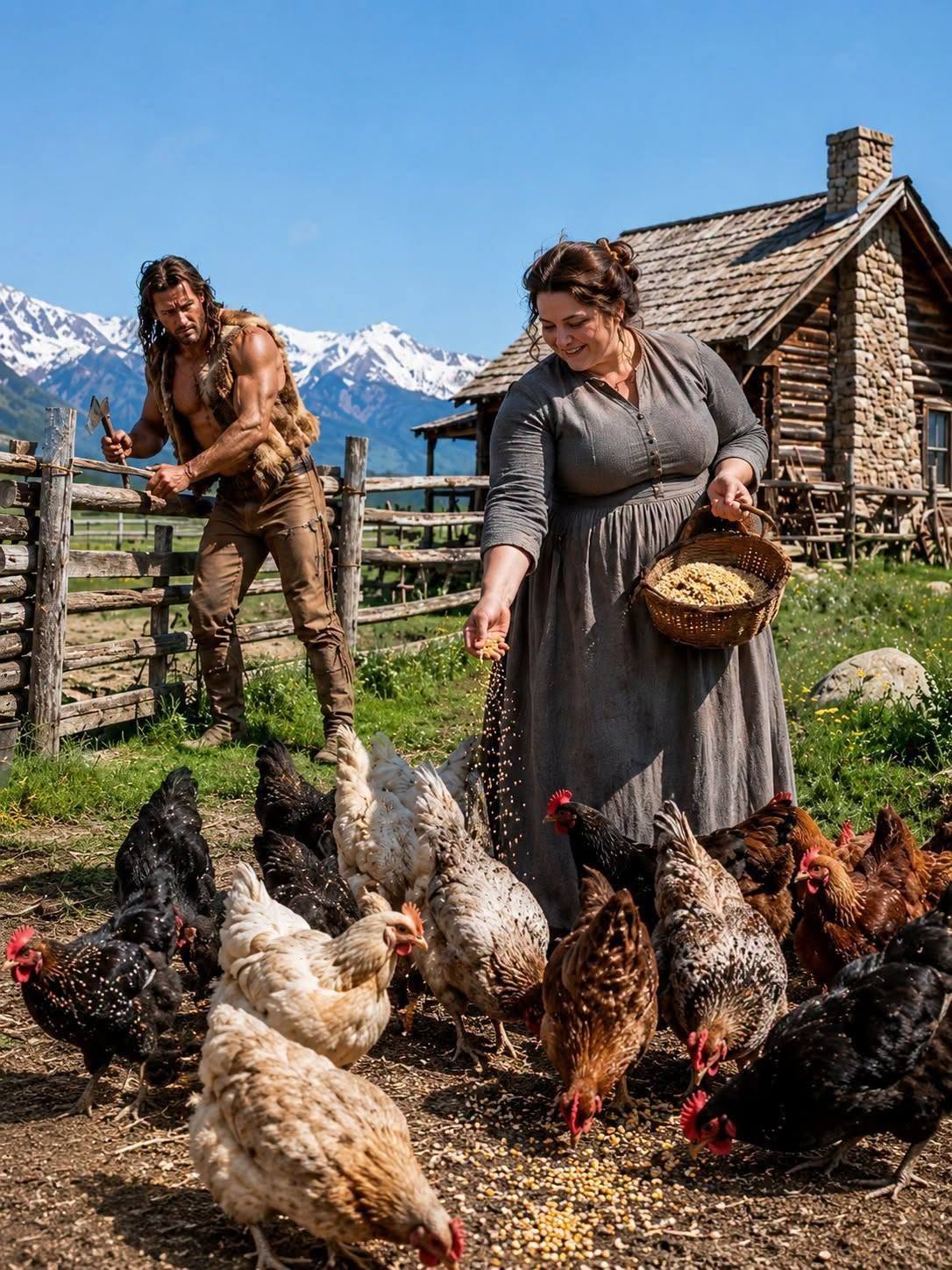
The chicken enclosure had been damaged.
And a fire had been started near the old haystack.
Griffin ran toward it.
He and Martha managed to stamp out the flames before they reached the barn.
A section of the haystack was lost.
The next morning, they found a warning nailed to the cabin door.
The message contained only six words.
Stop digging or lose everything.
Griffin read it twice.
Then he crumpled the paper.
“We should leave.”
Martha looked at him.
“Where would we go?”
“Somewhere he cannot reach us.”
“That place does not exist.”
“He could burn the whole ranch.”
“Then we make certain he cannot do it without consequences.”
Griffin looked at the damaged hay.
He was furious.
But beneath the anger was fear.
Not for himself.
For Martha.
She had arrived expecting a marriage and a home.
Instead, she had been dragged into a battle with a man who was willing to destroy property to protect his wealth.
Griffin walked toward her.
“I am sorry.”
She looked up.
“For what?”
“For bringing you into this.”
Martha studied his face.
“Griffin, I chose to come here.”
“You did not know what you were walking into.”
“Neither did you.”
He looked at the barn.
“We could lose everything.”
She placed her hand on his arm.
“Then we will make sure that when we fight, we fight for something worth keeping.”
He nodded.
The following afternoon, Whitcomb sent word that the county judge had granted a temporary injunction.
Caldwell could not seize the ranch or alter its boundaries until the dispute was resolved.
It was a victory.
But the injunction did not stop Caldwell from using his influence elsewhere.
Within days, the general store refused to extend Griffin credit.
The feed merchant canceled a promised delivery.
The blacksmith demanded payment in advance.
Two ranch hands who had occasionally helped Griffin declined further work.
Caldwell had turned the town against them.
Or so he believed.
Elias Boone arrived with a wagon of hay.
“I heard what happened,” he said.
Griffin looked at the load.
“You shouldn’t get involved.”
“Perhaps.”
Elias unloaded the first bale.
“But I remember your father helping me through the winter of seventy-eight. He never asked for payment.”
Another wagon arrived the next morning.
Then a third.
Clara Bell brought feed and medical supplies for the chickens.
A shopkeeper named Ruth Henderson sent flour and sugar.
One afternoon, a young rancher arrived with a repaired fence post and a message.
“Mr. Boone says you’re not the only one Caldwell has cheated.”
Martha looked at Griffin.
The words hung between them.
For the first time, they began to understand the scale of what they had uncovered.
The Broken Spur was not an isolated case.
It might be the beginning of something much larger.
By the first week of October, the Broken Spur had become the center of an unexpected movement.
Ranchers began arriving with old receipts, loan agreements, and cattle statements.
Some came quietly, afraid Caldwell would discover they had spoken.
Others came openly, carrying boxes of documents that had been hidden in barns and cupboards for years.
Martha gave each person a chair at the kitchen table.
She examined their papers, asked questions, and recorded every discrepancy.
The velvet ledger grew thicker with notes.
Some cases involved missing cattle payments.
Others involved excessive interest charges or unexplained fees.
A widow named Eleanor Briggs brought a mortgage statement that showed she had been charged for a loan she had already repaid.
A rancher named Thomas Reed had lost twenty acres after Caldwell claimed he had missed a payment that Reed could prove he had made.
Another family had surrendered their entire homestead after receiving a foreclosure notice based on an agreement they had never signed.
The stories were different.
The pattern was the same.
Caldwell had made his fortune by taking advantage of people who did not understand the documents placed before them.
Martha realized that the Broken Spur had not been the first target.
It was simply the first ranch where someone had refused to surrender.
Samuel Whitcomb began collecting sworn statements.
He also contacted the county prosecutor.
The prosecutor was reluctant at first.
Caldwell had donated money to local institutions and had considerable influence.
But the number of witnesses continued to grow.
Then Nora Bell arrived.
She was a quiet woman in her forties who had worked as Caldwell’s bookkeeper for six years.
She carried a small wooden box.
Inside were copies of accounting entries, private correspondence, and several pages of handwritten instructions.
Martha recognized the handwriting on the instructions.
Everett Sloan, Caldwell’s accountant.
The notes ordered employees to reduce cattle weights, add unauthorized interest, and move payments between accounts.
One page included Griffin’s name.
Beside it was a handwritten instruction.
Tucker property. Increase balance. Secure deed before winter.
Griffin stared at the words.
“How long has this been happening?”
Nora looked at him.
“Since before your father died.”
The room became silent.
“Your father questioned the figures several times,” she continued. “Mr. Caldwell told him the discrepancies were caused by transportation losses and market adjustments.”
Griffin swallowed.
“My father knew?”
“He suspected something. He was preparing to challenge the accounts.”
“Why didn’t he tell me?”
Nora looked down.
“He was ill by then. Mr. Caldwell visited him shortly before he died.”
Griffin felt the blood drain from his face.
“What did he say?”
“He threatened to take the ranch if your father continued making accusations.”
Martha placed a hand on Griffin’s shoulder.
He did not move.
“Did my father leave anything?” he asked.
Nora hesitated.
“Yes.”
She removed another document from the box.
It was a letter written in Griffin’s father’s hand.
The paper was old, and the ink had faded.
The letter was addressed to a lawyer in Cheyenne, but it had never been mailed.
Griffin recognized the handwriting immediately.
He read it slowly.
His father had described Caldwell’s suspicious accounting practices and expressed concern that the ranch was being deliberately pushed into debt.
Near the end, he had written:
If anything happens to me, I want my son to know that this land was never meant to be surrendered. I fear I have trusted the wrong man, and I fear he will use my death to finish what he started.
Griffin lowered the letter.
For years, he had believed his father had simply failed to manage the ranch.
Now he understood that the old man had spent his final months fighting a battle Griffin had never known existed.
He folded the letter carefully.
“I thought I had disappointed him.”
Martha’s eyes softened.
“You did not know what he was fighting.”
“I should have looked harder.”
“You were grieving. And Caldwell made certain you were too overwhelmed to understand the accounts.”
Griffin sat down.
For a long time, he said nothing.
That evening, he walked alone to the old cottonwood tree near the western pasture.
His father had built the first cattle pen beneath its branches.
He remembered being a boy, running between the fence posts while his father worked.
He remembered the old man’s voice.
A ranch is not the buildings, son. It is the people who refuse to let the land die.
Griffin stood beneath the tree until the sky darkened.
When he returned, Martha was waiting on the porch.
She did not ask what he had been thinking.
She simply handed him a cup of coffee.
He sat beside her.
“My father would have liked you.”
Martha smiled faintly.
“Your father would have asked why I was sitting in his chair.”
Griffin laughed.
Then his expression became serious.
“I think he would have been proud of you.”
She looked toward the dark pasture.
“I hope he would have been proud of what we are building.”
The next morning, Samuel Whitcomb arrived with urgent news.
Caldwell had requested a public hearing before the county court.
He intended to argue that Griffin had knowingly accepted the original loan terms and was now using fabricated accusations to avoid repayment.
He also planned to present the disputed deed transfer as proof that Griffin had already agreed to surrender the ranch.
The hearing was scheduled for October twentieth.
That gave them twelve days.
Whitcomb warned that Caldwell would bring his own witnesses.
He would attempt to discredit Pike and Nora.
He might also argue that Martha had no legal standing to challenge the debt.
Griffin looked at his wife.
“Can he do that?”
“Not if our marriage is legally registered and the property agreements are properly examined,” Whitcomb replied.
Martha opened her ledger.
“The original mortgage was signed by Griffin before our marriage. But the fraudulent transfer was attempted after I became his legal wife. I am not claiming ownership of the original debt. I am challenging the validity of the transfer and the accounting.”
Whitcomb nodded.
“That distinction matters.”
He examined the ledger.
“Your records are remarkably thorough.”
“Every entry has a source.”
“Every one?”
“Every one.”
Whitcomb closed the book.
“Then we have a case.”
The days leading to the hearing were exhausting.
Martha spent hours organizing the evidence.
Griffin visited the ranchers who had agreed to testify.
Pike and Nora prepared sworn statements.
Clara Bell offered to accompany Martha to court.
Elias Boone promised to stand with Griffin.
But Caldwell was preparing his own surprise.
On October seventeenth, a letter arrived from the county recorder.
The disputed deed had been submitted for official registration.
The injunction should have prevented it.
Yet the document had somehow entered the filing office.
Martha read the notice twice.
Then she saw the signature of the clerk who had accepted it.
It was a man named Walter Hensley.
Griffin recognized the name.
“Hensley works for Caldwell’s cousin.”
Martha folded the letter.
