

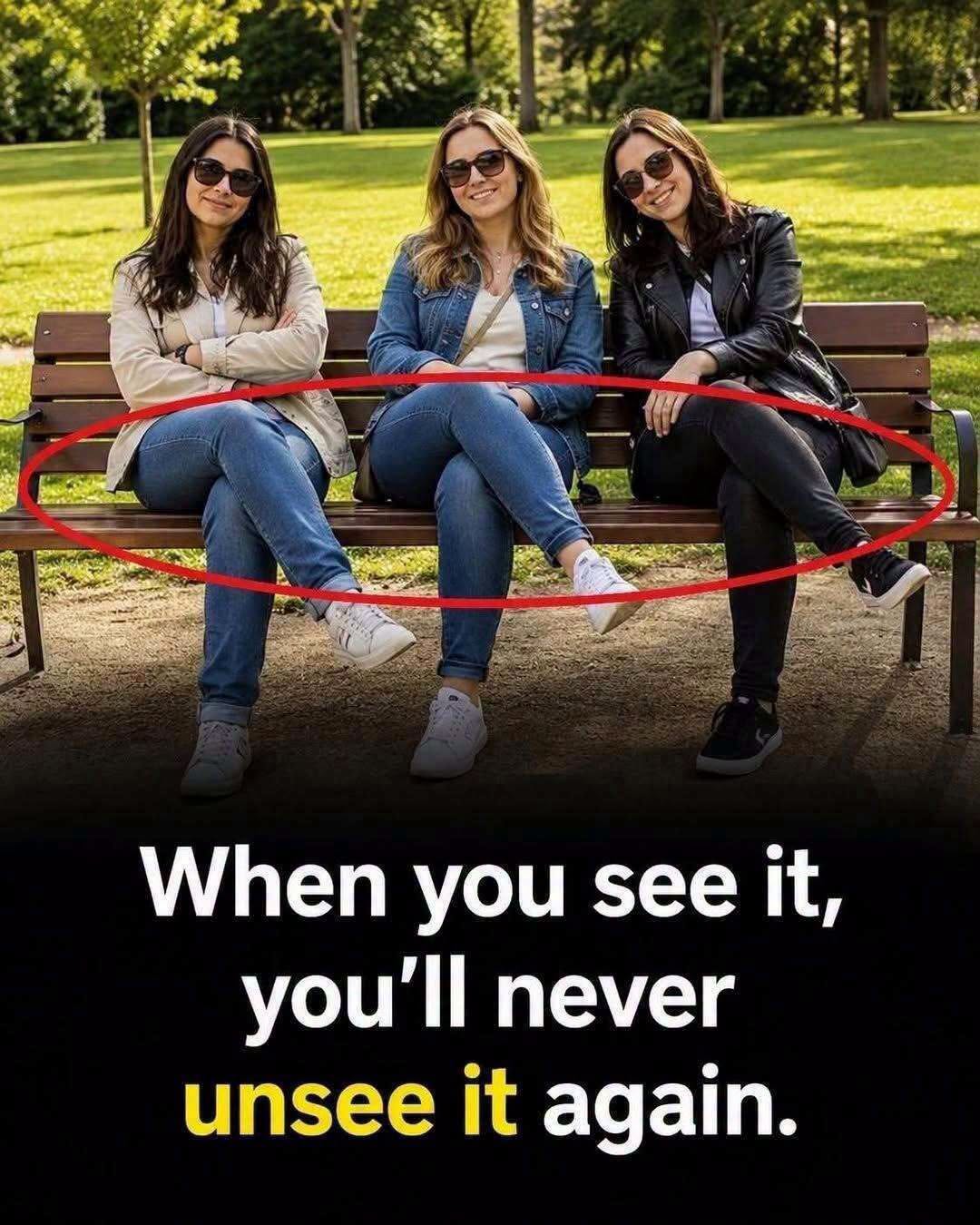
The Source’s Proposed Answer
The article directs readers away from counting legs or studying shoes and toward the bench. Its explanation is that the actual wooden seat is missing, leaving the women apparently unsupported.
That is the published interpretation. It is fair to report it as the source’s claim. It would not be fair to rewrite it as something this image clearly proves when the visible details do not comfortably support it.
Look along the front and sides of the sitting area. Brown horizontal boards appear beneath the figures. They look consistent with seat slats, although overlap and image quality can complicate reading individual parts. At minimum, they prevent a confident declaration that there is plainly no seat.
What We Can and Cannot Confirm
We can confirm that the source offers a missing-seat explanation. We cannot confirm that explanation from the supplied version of the picture. Those two statements can sit beside each other without forcing a different answer into the gap.
There is no need to invent an extra limb, a hidden support, or a story about how the women posed. None of those ideas becomes true simply because the first answer seems doubtful. A weak explanation does not automatically prove its opposite.
It is also possible for an image and its accompanying explanation to become mismatched when shared, but we do not have evidence that this happened here. Treat that as a general possibility, not a discovered history of this particular post.

A Better Way to Inspect the Park Bench Picture Puzzle
First, look at the full image rather than only the red oval. Identify the backrest, armrests, front edge, and visible supports. Then compare the area behind the knees with the exposed sections beside the women.
Second, enlarge the original display if your screen allows. Enlargement can make an existing edge easier to inspect, but it does not create reliable new detail. A blurry patch remains uncertain even when it fills the screen.
Third, describe what you see before deciding what it means. “I can see horizontal brown boards” is a more useful starting point than “they must be floating.” The description leaves room to test an interpretation instead of making the conclusion the first step.

