

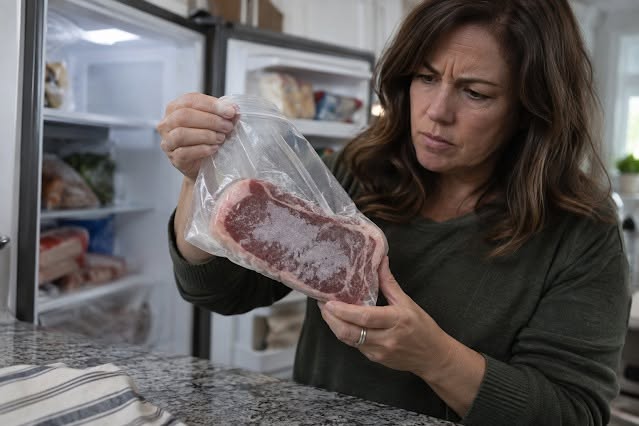
Discard the meat when:
- It was above 40°F for more than two hours.
- You do not know how long it was warm.
- It has a persistent sour or rotten odor after thawing.
- Its surface is unusually slimy or sticky.
- The packaging leaked extensively.
- The package was torn and contamination may have occurred.
- It was spoiled before being frozen.
- A power outage made its temperature history uncertain.
- Its quality is so poor that cooking it would not be worthwhile.
Freezer burn alone is not necessarily a reason to discard meat. Suspicious storage conditions are more important.
Frequently Asked Questions
Can freezer-burned meat make you sick?
Freezer burn itself is mainly a quality problem and does not normally cause food poisoning. However, meat may still be unsafe because of improper thawing, temperature abuse, contamination, or spoilage.
Can freezer-burned meat be given to pets?
Do not give a pet meat you believe may be spoiled. Freezer-burned but safely stored meat is not automatically toxic, but it may be nutritionally inappropriate depending on how it is prepared.
Avoid bones, heavy seasonings, onions, garlic, and fatty scraps. Ask a veterinarian when uncertain.
Is gray frozen meat spoiled?
Not necessarily. Freezing, limited oxygen, and freezer burn can all change meat’s color. Evaluate its storage history, packaging, smell, and texture after safe thawing.
Can cooking restore freezer-burned meat?
Cooking cannot replace lost moisture completely, but slow cooking, braising, sauces, and soups can make mildly freezer-burned meat more enjoyable.
Does vacuum sealing completely prevent freezer burn?
Vacuum sealing greatly reduces air exposure and can extend quality, but damaged seals, trapped moisture, or very long storage can still lead to deterioration.
The Bottom Line
Dry, gray, pale, or leathery patches on frozen meat often indicate freezer burn. If the meat remained continuously frozen at 0°F or below, freezer burn is generally a quality issue—not proof that the food is unsafe.
You can trim small affected areas and use the meat in a moist recipe. Nevertheless, discard it if it experienced unsafe temperatures, has a persistent foul odor, develops an unusual slimy texture, or has an uncertain storage history.
The most effective prevention is simple: freeze fresh meat promptly, remove excess air, use freezer-safe packaging, label every package, and maintain a freezer temperature of 0°F.
