

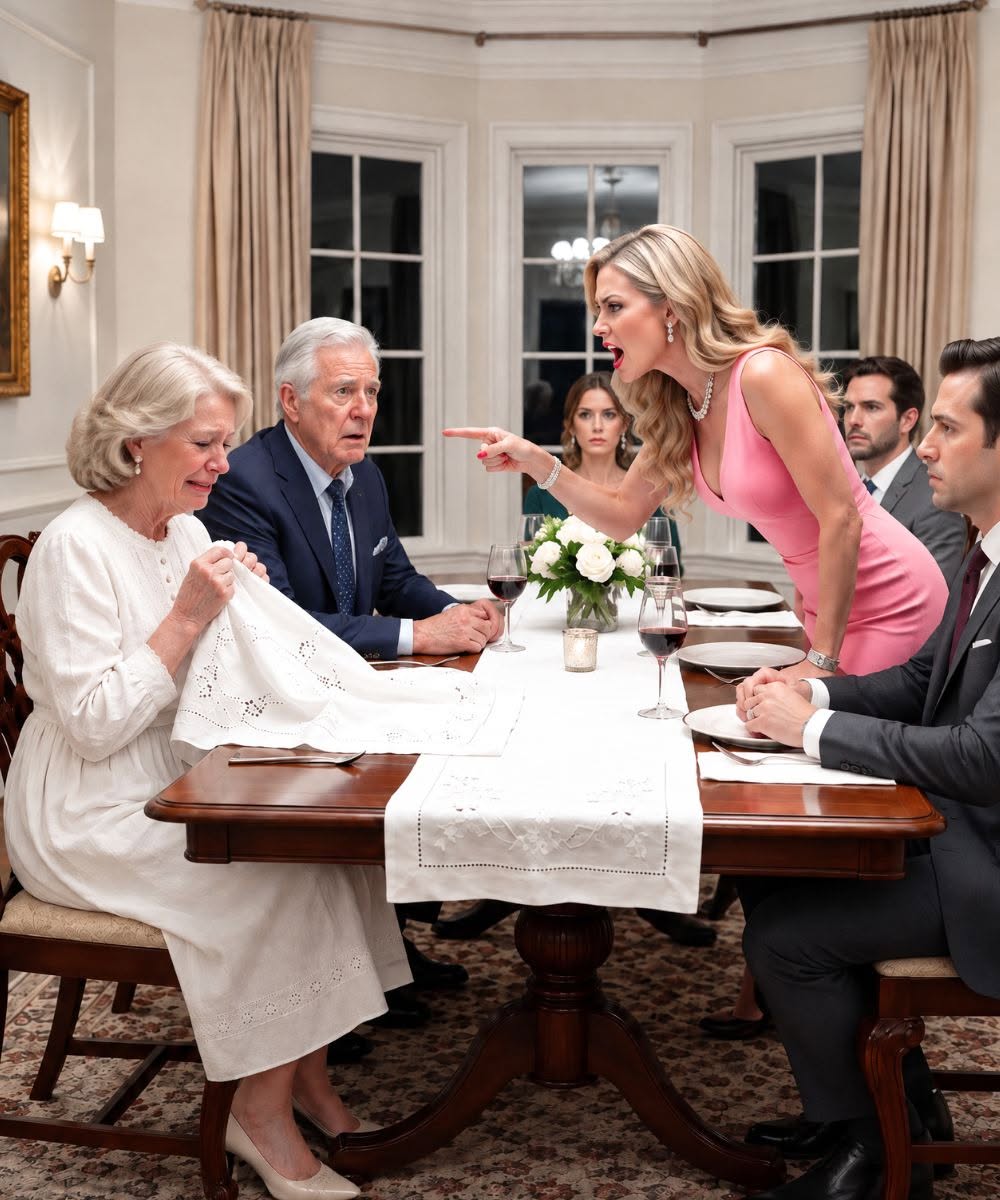
I looked around at the marble floors, elegant furnishings, and enormous windows.
Then I answered quietly.
“Who helped make it possible.”
His expression changed.
But I didn’t stay to explain.
I helped Eleanor into our car and drove away.
For several miles, neither of us spoke.
Finally, she looked down at the folded tablecloth in her lap.
“Maybe I shouldn’t have brought it.”
I glanced at her.
“Eleanor, you spent three weeks making that gift with love. You did nothing wrong.”
Her voice trembled.
“Daniel didn’t even say anything.”
I felt a deep sadness.
Because she was right.
Our son had watched his mother being humiliated and decided that remaining silent was easier than defending her.
But Vanessa didn’t know something important.
The magnificent house she’d proudly called hers had been purchased with substantial financial help from me.
And that help had never been intended as a gift.
Two years earlier, Daniel had approached me with what he called a promising family investment opportunity.
He and Vanessa wanted to purchase a $1.4 million property.
But they didn’t have enough money for the purchase and associated expenses.
“Dad, this house is perfect,” Daniel told me. “It’s in an excellent neighborhood. Vanessa loves it.”
I reviewed his financial information.
His income was respectable, but the purchase would place considerable pressure on his finances.
I warned him.
“Daniel, a beautiful house isn’t worth much if you can’t comfortably afford it.”
He promised he’d manage.
Eventually, I agreed to provide $500,000.
But I made one thing clear.
The money would be a loan.
Not a gift.
My attorney prepared a formal agreement, and the debt was secured by a properly recorded second mortgage.
Daniel signed the documents.
Vanessa witnessed the arrangement.
They thanked me repeatedly.
At the time, I believed I’d given our son an opportunity to build a stable future.
Unfortunately, the payments were supposed to begin three months before the housewarming dinner.
And Daniel hadn’t made a single one.
I’d let the missed payments pass because Eleanor believed he was simply going through a difficult period.
“He’ll catch up,” she told me.
I wanted to believe her.
But after the way he’d allowed his mother to be treated, I began questioning whether our generosity had taught him the wrong lesson.
The next morning, I called my attorney, Richard Hayes.
He reviewed the loan documents.
“Robert, your son is in default.”
“I know.”
“We’ve already allowed additional time.”
“I know that too.”
Richard paused.
“Would you like to proceed with a formal notice?”
“Yes,” I answered. “Follow the agreement and give him the opportunity to resolve the outstanding payments.”
We sent Daniel written notice explaining the missed obligations and the contractual opportunity to bring the loan current.
His response arrived within hours.
Dad, are you seriously asking your own son to repay you now?
I replied:
I’m asking you to honor the agreement you signed.
A few minutes later, Vanessa called.
She sounded furious.
“You can’t threaten our home!”
“I haven’t threatened anything, Vanessa. Daniel received a notice about overdue loan payments.”
“You know he can’t afford that right now!”
“Then we need an honest conversation about his finances.”
“This house was supposed to be part of his inheritance!”
I paused.
“No, Vanessa. The $500,000 was a documented loan.”
She raised her voice.
“That’s unbelievably selfish!”
I ended the call.
Three days later, Vanessa’s aunt Patricia visited our home.
She’d been among the guests who walked out of the housewarming dinner.
“Robert, I think there’s something you should know.”
She placed several printed messages on our dining table.
They were conversations in which Vanessa had discussed the money Daniel borrowed from me.
One message read:
