

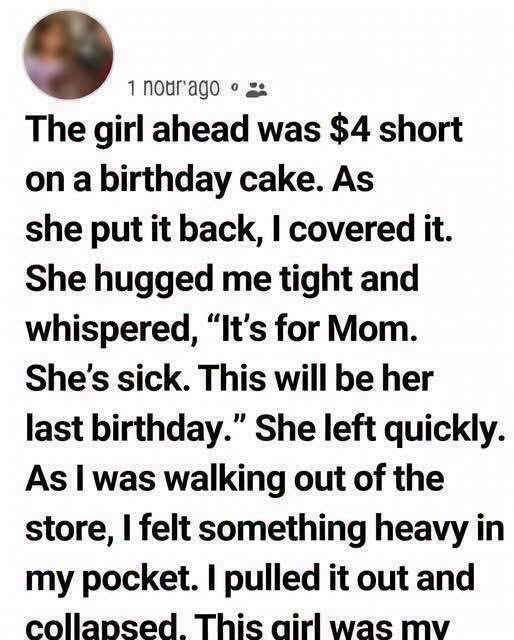
“It’s the cake lady!” she shouted. “Grandpa! It’s the cake lady!”
Walt stood up slowly, brushing dirt off his knees, and squinted at me. Then a huge smile spread across his face.
“So you’re the famous one,” he said, walking over and shaking my hand with a grip like a friendly bear. “Lily hasn’t stopped talking about you. You’ve been described to me as ‘nice, with a brown coat and wet hair.'”
“That’s accurate,” I said, laughing.
“I’m Walt Harper. And this one you’ve met.”
“Did my mom like the cake?” I asked Lily, then caught myself. “I mean, did your mom like the cake?”
Lily giggled at my mistake. “She cried,” she said, very matter-of-fact. “But the good kind of crying. Grandpa says there are two kinds.”
Walt put a hand on her head. “Lily, how about you go water the sunflowers?
They look thirsty.”
She ran off with the can. Walt and I sat on a wooden bench at the edge of the garden, and for a minute he didn’t say anything. He just watched his granddaughter giving each sunflower a careful drink, talking to them like they were old friends.
“I owe you four dollars and thirty-six cents,” he finally said.
“You don’t owe me anything.”
“I know. But I wanted to say it anyway.” He sighed. “I offered to buy that cake, you know. Three times. She wouldn’t let me. She said it had to be from her money, because a present isn’t a real present if somebody else pays for it. She’s been saving since March. Every coin she found in the couch. Every dollar from the tooth fairy.
She even sold lemonade on the sidewalk in August and gave half of it to the animal shelter, because, and I quote, ‘the dogs need birthdays too.'”
I laughed and wiped my eyes at the same time. “She sounds amazing.”
“She is. She’s the best thing that ever happened to this family.” He was quiet for a second. “Can I tell you about her mom?”
“Only if you want to.”
He nodded. “My daughter’s name is Rachel. She’s a nurse. Has been for fifteen years. Hospice and palliative care, mostly. The hardest kind of nursing there is, if you ask me. Taking care of folks at the very end.” He shook his head with pride. “She was always the one holding everybody’s hand.”
Something in the back of my mind flickered. I didn’t know why yet.
“About three years ago,” Walt went on, “her kidneys started failing.
Some condition she’d had since she was young finally caught up with her. She was on dialysis for a long time. Three times a week, four hours at a time. She kept working as long as she could, but eventually she couldn’t. Lily was only five when it started.”
“I’m so sorry.”
“Don’t be sorry yet. This part’s the good part.” He smiled. “One year ago this week, Rachel got a kidney transplant. A donor family said yes on the worst day of their lives, and because of them, my daughter got a second chance.”
I felt the pieces clicking into place.
“One year,” I said slowly. “One candle.”
Walt looked at me, surprised. “Lily told you about the candle?”
I pulled the note out of my pocket and showed him.
He held it for a long time, and his big hands were shaking a little.
“That’s her new birthday,” he said quietly. “That’s what Lily calls it. Rachel’s real birthday is in June, but Lily decided the transplant day was her mom’s ‘new birthday,’ the day she got to start over. So this year, Rachel is turning one.” He laughed through his nose. “Lily insisted on exactly one candle. I tried to tell her we could do a few more for decoration. You’d have thought I suggested canceling Christmas.”
“And she’s not feeling well?” I asked gently.
“Rough couple of weeks,” Walt said. “An infection. Nothing she can’t beat, the doctors say. Transplant patients take medicine that keeps their body from rejecting the new kidney, but it also makes it easier to catch things. She’s home now, resting, getting stronger.
But it scared Lily. That’s why the cake mattered so much. She wanted her mom to have a happy day.”
We sat for a while and watched Lily tell a sunflower a long story about a dog named Pancake.
“Would you like to meet Rachel?” Walt asked. “She’s been asking about you. Wants to thank you herself. Sunday afternoon, we’re doing a little party at the house. Just family. Well. Family and whoever Lily invites, which this week seems to be you, the mailman, and a squirrel.”
“I’d love to,” I said. And I meant it more than I’d meant anything in a long time.
Chapter 7: The Snowstorm I Never Talk About
That night, I couldn’t stop thinking about something Walt had said. Hospice and palliative care. She was always the one holding everybody’s hand.
I hadn’t told Walt this, but six years ago, my dad died in hospice.
His name was Frank Bennett, and he was the funniest man I’ve ever known. He was a retired mail carrier who whistled old songs badly and told the worst penguin jokes you’ve ever heard. “Why don’t penguins fly, Nora? Because they’re not tall enough to be pilots.” Every single time, he’d laugh so hard at his own joke that you couldn’t help laughing too, even though it was terrible.
He got sick quickly. Too quickly. One minute he was complaining about my driving, and a few months later he was in a hospice center two hours north of here, closer to where my aunt lived.
I visited every weekend. But on the night he passed, there was a snowstorm. A real one. The highway closed.
I sat in my car on the side of the road for three hours, snow piling up on my windshield, calling the hospice over and over.
A nurse answered. I never got her last name. She had a calm, warm voice, and she said, “Nora, I’m right here with him. I’m holding his hand. Would you like me to put the phone by his ear so he can hear you?”
So I talked to my dad from a frozen car on the side of a highway. I told him I loved him. I told him I was sorry I wasn’t there. And then, because I didn’t know what else to say, I told him one of his own terrible penguin jokes.
The nurse told me later that he smiled.

He passed about an hour later, peacefully, with that nurse still holding his hand.
